
“What are the best exercises for seniors at home?” is the question nearly everyone types first — and it hides a second question underneath: best for what? The best exercise for a wobbly turn in the kitchen is balance practice. The best for a stiff back is gentle core work. The best for a day when standing feels like too much is a chair workout. There is no single winner; there is a right tool for each job.
This guide is organised by job. For each goal — balance, strength, back care, flexibility, daily loosening, walking, mobility, and an all-round routine — it names the gentle Tai Chi practice that fits, gives you two or three real movements from it so you can feel what it is like, and links to the full routine. Every one of them is done at home, standing or seated, with nothing more than a sturdy chair and flat shoes.
Read the section that sounds like your life. Start there. The other sections will still be here when you want them.
Best for balance: supported standing practice
Choose this if: you feel less steady turning, stepping or standing on one leg than you used to, and you want to practise the skill itself.
Balance responds to rehearsal: weight shifts, stepping in every direction, and standing on one leg with support nearby. A good starter set is our Balance Exercises for Seniors routine — 16 supported movements including the Supported Single-Leg Stand, Sit to Stand and Heel-to-Toe Walk, every one done beside a chair.
When that feels familiar, the deeper library is Senior Balance Exercises: timed holds such as Golden Rooster and the T-Stance, travelling Tai Chi forms, and hip circles, for people who want their balance practice to grow with them.
And if unsteady feelings are new or worsening, read Why Do I Feel Off Balance? first — some causes need a doctor, not a routine.
Best for strength without standing: the chair workout
Choose this if: your legs and arms need strengthening but standing exercise is not right for you at the moment — sore knees, low energy, or a balance you do not yet trust.
The Tai Chi Chair Workout works the whole body from a seat: Leg Extensions and Knee Lifts for the thighs, Heel Raises for the calves, an Inner Thigh Squeeze with a cushion, plus Arm Presses and Push and Pull for the shoulders. Sixteen movements, each in 3 sets of 10, with the chair doing all the balancing.
For a calmer, more flowing seated practice, Chair Tai Chi remains the gentlest seated starting point on the site.
Best for a stiff, aching back: gentle core movement
Choose this if: sitting and standing both get uncomfortable, and you want to keep your trunk moving in every direction it owns.
Our Core Exercises for Back Pain article sets out 16 slow standing movements — Pelvic Tilts, a Cat-Cow Flow, gentle Spinal Twists, a Hip Hinge, Hold the Ball — that train the muscles around the middle at the level daily life asks of them. Read its safety notes carefully: it is gentle exercise, not a treatment, and some backs should be assessed before any routine begins.
Best for tight hips and general flexibility
Choose this if: chairs feel hard to get out of, the car takes a strategy, and your joints feel like they have lost a few degrees in every direction.
The routine in How to Stretch Hips is a full flexibility set built around the hip opener Play the Lute, with every stretch held for 20 seconds: hamstrings (Needle at Sea Bottom), quadriceps (Golden Rooster), calves (Heel Push), shoulders and spine between them. Standing, supported, and finished in about fifteen minutes.
Best for everyday stiffness: the daily stretch
Choose this if: you want one short routine, done daily, that visits everything — the morning answer.
Stretching Exercises for Seniors works down the body in order: Centering Breath, neck stretches and rotations, Shoulder Rolls, a Chest Opener, Spinal Twist, then hips, hamstrings, calves and Knee to Chest, closing with three slow breaths. One set of each, about twelve minutes, no mat and no floor work. Done first thing, it doubles as one of the best morning exercises at home — gentle enough for stiff early joints, and finished before the kettle has properly boiled.
Best for walking practice when the weather says no
Choose this if: you love your walks but the pavement is icy, soaked or scorching — or you simply prefer the privacy of home.
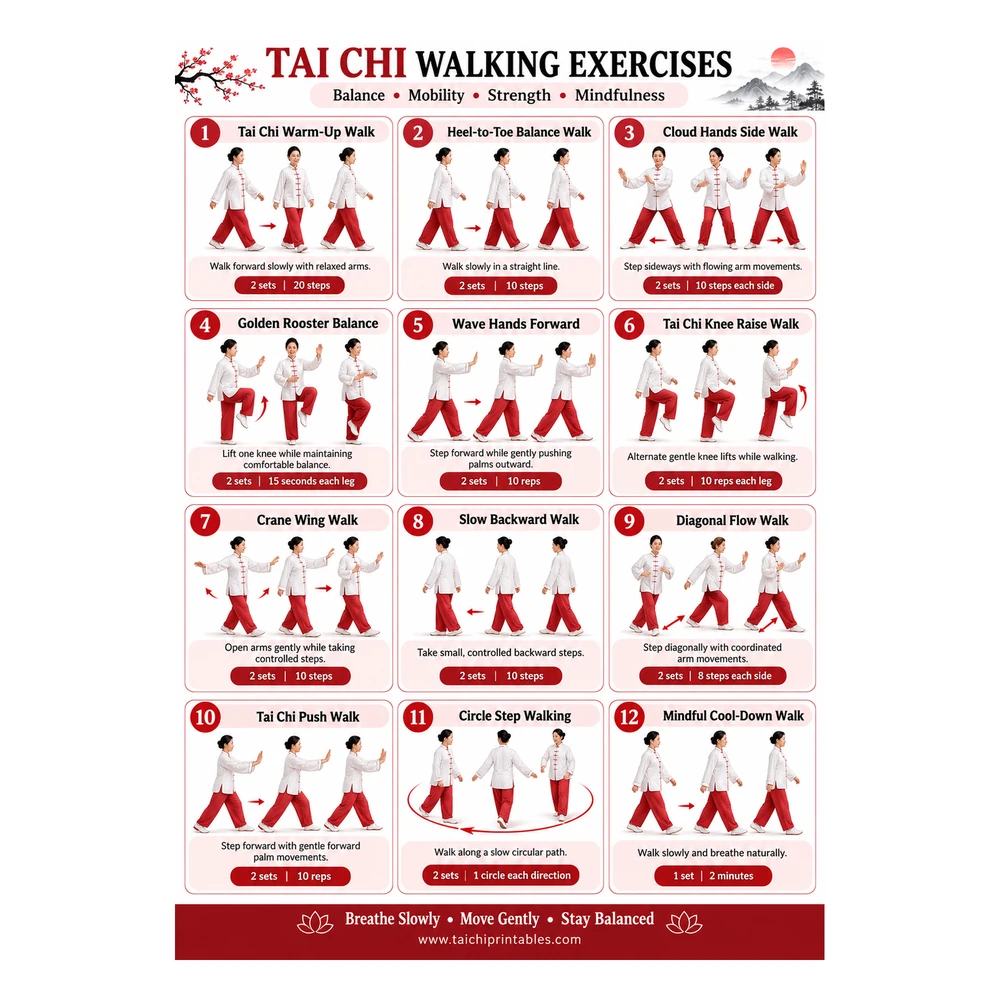
Tai Chi Indoor Walking adapts all 12 Tai Chi walking movements to a hallway: balance walks along a wall, a Slow Backward Walk on a checked-clear route, Circle Step Walking in a small patch of floor. For the movements’ full technique and benefits guide, see Tai Chi Walking Exercises.
Best for whole-body mobility
Choose this if: everything feels a degree stiffer than it should — neck, shoulders, wrists, spine, hips, knees and ankles alike.
The routine in Exercise and Mobility works joint by joint through all 16 movements of our mobility chart, from Neck Gentle Turns and Wrist Rotations down to Ankle Rotations and a Seated to Stand finish. It is the general-service option: nothing extreme, everything visited. If what you are really after is the best exercises for full body coverage in a single gentle routine, this is the closest match in the guide.
Best all-round starter routine
Choose this if: you are new to Tai Chi entirely and want one complete, classic routine to learn first.
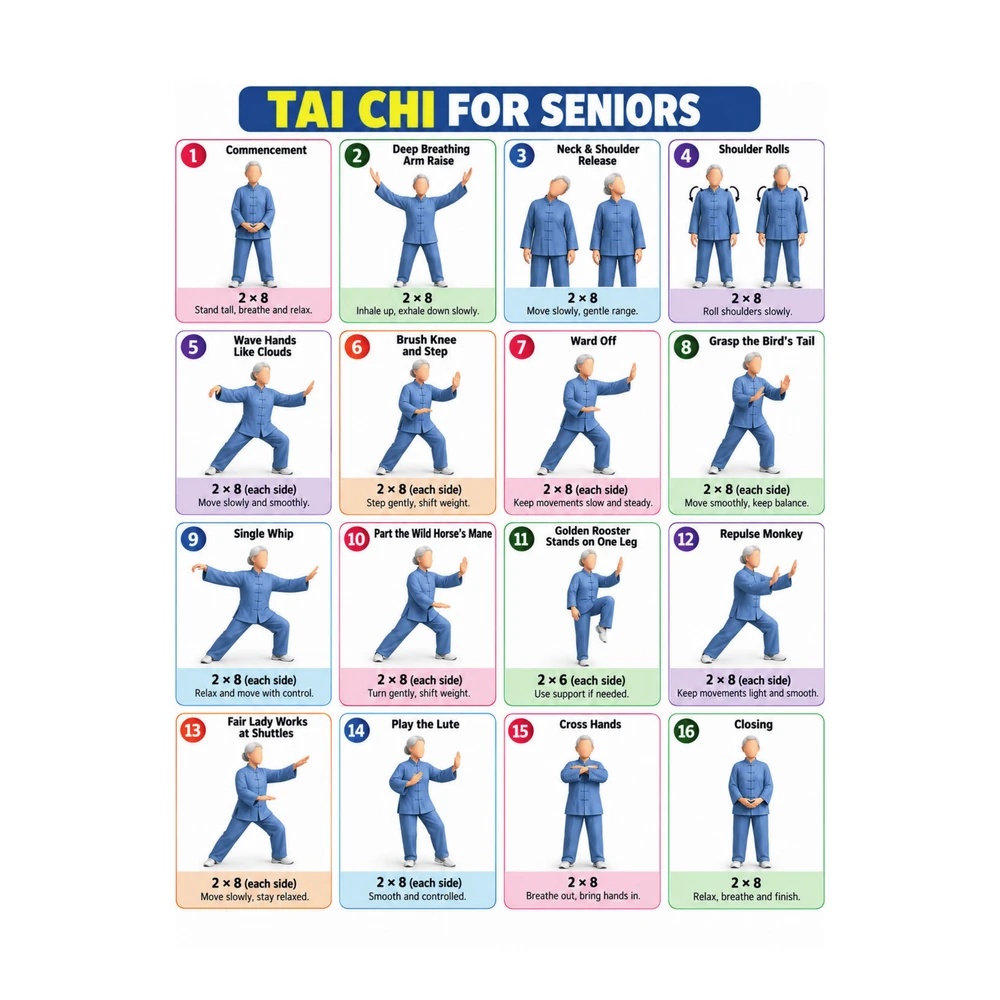
Tai Chi for Seniors teaches the full 16-movement standing form — Commencement, Wave Hands Like Clouds, Brush Knee and Step, Golden Rooster, Repulse Monkey, Closing — the traditional sequence, at a senior-friendly pace. It is the routine the other, specialised practices branch off from.
A sample week that uses them all
| Day | Practice |
|---|---|
| Monday | Daily stretch (12 minutes) + balance starter routine |
| Tuesday | Chair workout, or the all-round Tai Chi for Seniors routine |
| Wednesday | Daily stretch + indoor walking session |
| Thursday | Gentle core movement (back care day) |
| Friday | Daily stretch + balance practice |
| Saturday | Flexibility routine (hip opener day), or a walk outdoors |
| Sunday | Rest, or the daily stretch only |
Treat the table as a sketch, not a contract. Two or three of these sessions a week, kept up for a month, will teach you more about what your body likes than any plan written in advance.
Before you start: safety first
- Every routine here is practised beside support — a sturdy chair or countertop — whenever balance is involved. Support is part of the exercises, not a concession.
- Clear the floor, wear flat non-slip shoes, and keep sessions gentle: mild effort is the goal; pain is a stop signal in every section of this guide.
- Stop any session if you feel dizzy, and sit down. Start again another day.
- Check with your doctor before starting if you have a heart, joint or balance condition, a history of falls, or recent surgery — and follow any personal movement restrictions you have been given over anything written here.
- This article is general educational information, not medical advice, and no routine here treats or prevents any condition.
The printable charts behind these routines
Every routine in this guide exists as a one-page printable PDF chart in our shop — each chart shows its full movement set with illustrations, instructions and repetitions, made to be followed without a screen. The articles above are the guides; the charts are the wall-friendly versions of the same routines.
Frequently asked questions
1. What is the single best exercise for seniors at home?
There is not one — there is a best match for each goal, which is what this guide is organised around. If you truly want one starting point that touches a little of everything, the all-round Tai Chi for Seniors routine is the usual recommendation, with the daily stretch as its companion.
2. How many days a week should a senior exercise at home?
Most people do well with something gentle most days and the more focused sessions — strength, balance, flexibility — two or three times a week each. Short and regular beats long and rare: ten daily minutes will do more for you than a heroic monthly hour.
3. Do I need any equipment for these exercises?
A sturdy chair without wheels, flat non-slip shoes and a clear patch of floor. One chair-workout movement uses a soft cushion or ball to squeeze. Nothing else, for any routine in this guide.
4. I have bad knees. Which sections should I avoid?
Avoid deep bending and any movement that loads a painful knee — and lean on the seated options: the chair workout trains the legs without standing, and Chair Tai Chi is gentler still. Have a painful, worsening or unstable knee assessed in person rather than exercising around it indefinitely.
5. Can I combine routines on the same day?
Yes — the daily stretch pairs with anything, and many people add ten balance minutes to a walking day. Just keep the total gentle, and do not stack two strength-style sessions (chair workout plus a full core session) on the same day when you are starting out.
6. Where should a complete beginner start?
With the daily stretch for a week — it is the gentlest full tour of your own body — then add the all-round Tai Chi for Seniors routine. When both feel familiar, pick your next section by goal: balance, back, hips or walking. That order has carried many beginners comfortably.
Final thoughts
“Best” turns out to be a kind question once you let it be specific: best for your balance, your back, your hips, your rainy days. The routines in this guide were built to be chosen between, not ranked.
Pick the one that matches your life this month. Practise it gently, beside a chair, a few times a week. That is the whole secret, and it works because ordinary people can actually keep it up.
Safety note: This article is general educational information, not medical advice. Stop any exercise that causes pain, rest if you feel dizzy, and check with your doctor before starting a new routine if you have a health condition, a history of falls, or recent surgery.