
If your back complains when you sit too long, stand too long, or get up from a low chair, you are in large company. Many people look for gentle core exercises for back pain not because they want a workout, but because they want to keep moving comfortably through an ordinary day — and stiffness rarely improves by staying still.
This article sets out 16 slow Tai Chi movements that work the middle of the body: the abdominal and back muscles, the hips and the spine’s natural range of turning, bending and lengthening. They are standing movements, done at an easy pace, with a chair nearby for support whenever you want it.
For the full picture of this gentle approach, our tai chi for back pain guide explains the same slow movements in more detail.
Two honest points before anything else. First, these movements are gentle exercise, not a treatment. Nothing here can diagnose why your back hurts, and nothing here promises to relieve pain. Second, backs differ. If you have a diagnosed back condition, a recent injury, or pain that travels down a leg, check with your doctor or physiotherapist before trying any new routine — and stop any movement that makes your symptoms worse.
Why the core matters for your back
Your core is not a single muscle. It is the group of muscles around your middle — abdominals in front, muscles along the spine behind, and the deeper muscles that brace the two together. When you reach into a cupboard, turn to answer the door, or lift a shopping bag, these are the muscles doing quiet work in the background.
Many gentle exercises for lower back pain work on exactly this group of muscles. Tai Chi trains that group in a particular way: slowly, while standing, with your weight shifting and your trunk turning in small, controlled amounts. There is no straining against weights and no holding your breath and bearing down. The movements below — pelvic tilts, gentle twists, side bends, a hip hinge — ask the core to work at the level daily life actually asks of it.
6 reasons people choose gentle core practice like this
1. It starts from standing still
The routine opens and closes with simply standing well — feet grounded, spine long, breathing slow. For many people with sore backs, learning to stand comfortably is practice in itself.
2. The movements are small on purpose
A pelvic tilt is a few centimetres of movement. A spinal twist here is a gentle turn, not a wrench. Small ranges are where control lives, and control is what you are training.
3. It works the front and back together
Abdominal bracing without back movement, or back movement without abdominal support, is only half the picture. These exercises pair the two, the way your body pairs them when you move through a day.
4. Turning, bending and reaching are all covered
Daily life does not move in one direction. The routine includes gentle rotation, side bending, a careful hip hinge and reaching patterns, each in modest amounts.
5. There is no floor work and no equipment
Everything is standing. You need a clear patch of floor, flat shoes, and a chair or countertop within reach for the balance moments. Nothing else.
6. It fits alongside the rest of your routine
Ten to fifteen minutes, two or three times a week, sits comfortably next to walking and seated exercise. It is a practice you can keep, and a practice you keep is the only kind that counts.
Before you start: safety first
- Check with your doctor or physiotherapist first if you have a diagnosed spinal condition, osteoporosis, a recent back injury or surgery, or pain that radiates into a leg or foot. Some movements — twists and backbends in particular — are not suitable for every back.
- Keep every movement small and inside a range that feels comfortable. “Gentle” is the instruction, not a warm-up for something bigger.
- Never force a stretch or push through pain. Mild muscular effort is expected; sharp, shooting or increasing pain is a stop signal.
- Stop straight away if you feel dizzy, and sit down.
- Practise beside a chair or countertop for the standing balance movements (Knee Lift with Balance especially).
- Breathe normally throughout. If you notice you are holding your breath and bracing hard, make the movement smaller.
- This article is general educational information about gentle exercise. It is not medical advice and not a substitute for assessment of your own back.
The 16 gentle Tai Chi movements
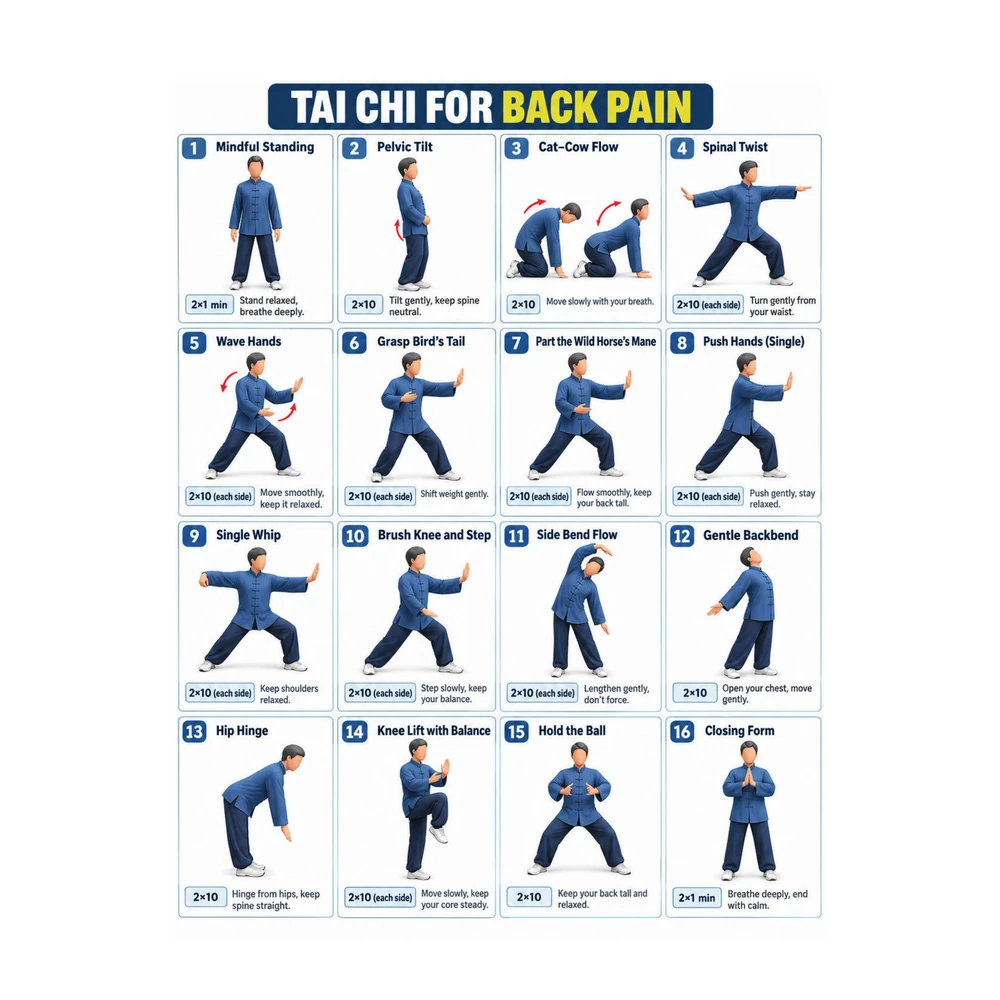
The order below follows the printable chart this routine is based on: it begins and ends with standing and breathing, moves through tilts, flows and twists in the middle, and keeps every range modest. Repetitions are the chart’s own — treat them as a guide. Fewer, done comfortably, is always the right choice.
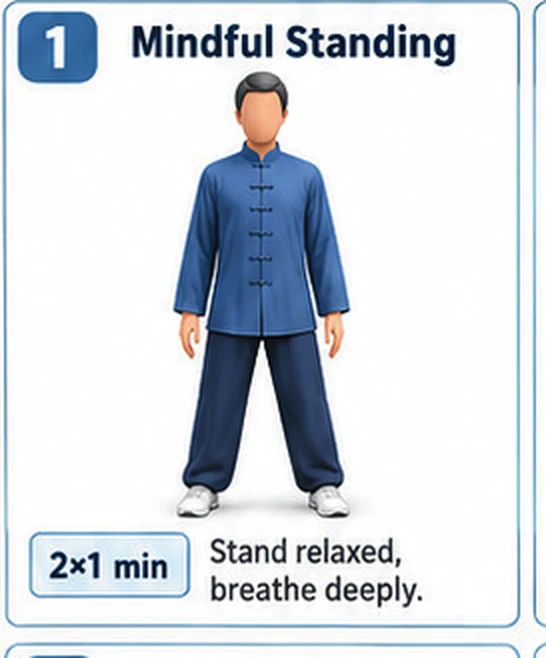
1. Mindful Standing
Purpose: A standing reset that teaches the posture every other movement returns to.
How to perform:
- Stand with feet hip-width apart, knees soft, arms resting by your sides.
- Let your weight settle evenly through both feet.
- Lengthen gently through the top of your head, as if standing a fraction taller.
- Breathe slowly and simply stand, noticing where you hold tension — jaw, shoulders, lower back — and let it go where you can.
Recommended practice: 2 sets of 1 minute.
Beginner tip: If standing still makes your back ache, that is information, not failure. Note how long feels comfortable today and start there.
2. Pelvic Tilt
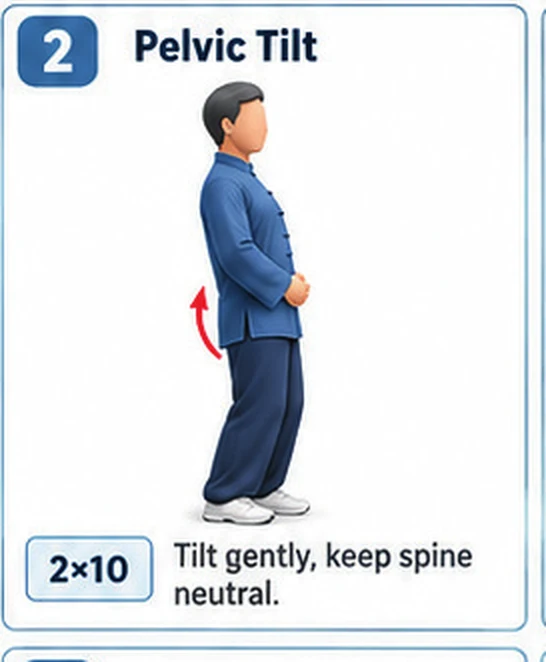
Purpose: A small rocking of the pelvis that moves the lower spine gently between its two natural curves — the simplest core exercise there is.
How to perform:
- Stand tall with feet hip-width apart, knees soft.
- Place your hands on your hips so you can feel the movement.
- Tuck your tailbone slightly under, flattening your lower back a little, as your stomach draws gently in.
- Release back to neutral, letting the natural curve return. Keep the movement slow and small.
Recommended practice: 2 sets of 10.
Beginner tip: Imagine a bowl of water at your pelvis, tipping a little forward and back without spilling. If the image helps you keep it small, use it.
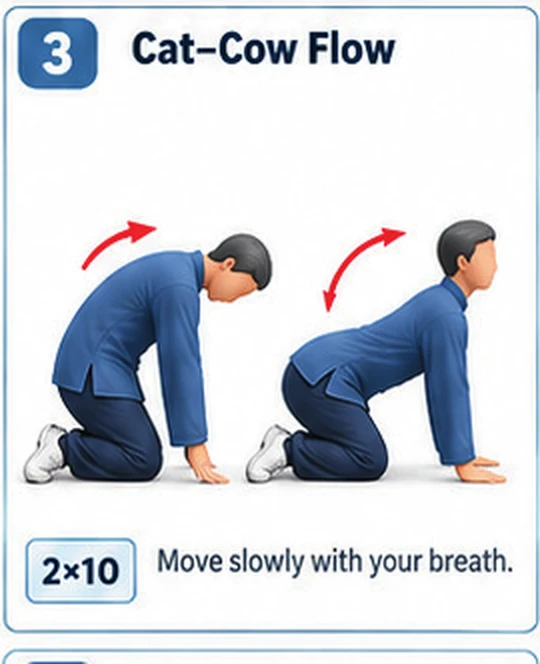
3. Cat-Cow Flow
Purpose: A slow wave through the spine, rounding and arching in turn — done standing here, with your hands resting on your thighs.
How to perform:
- Stand with feet hip-width apart, knees bent a little, hands resting on the fronts of your thighs.
- Round your back gently, tucking your chin and tailbone, like a cat stretching.
- Then reverse: lift your chest, let your back arch softly and your gaze come up a little.
- Move slowly between the two, letting your breath set the pace.
Recommended practice: 2 sets of 10 flows.
Beginner tip: Keep both ends of the wave small. The middle of your back should feel like it is being oiled, not tested.
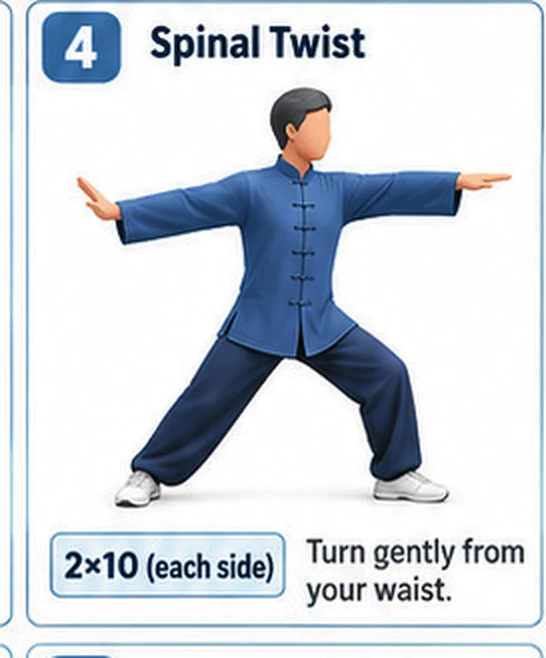
4. Spinal Twist
Purpose: A gentle rotation of the trunk, the direction daily life asks for most often — and the one stiff backs lose first.
How to perform:
- Stand tall, feet hip-width apart, arms folded loosely in front of your chest.
- Turn your chest and head slowly to one side, keeping your hips facing forward.
- Pause at the point where the turn is easy, not forced.
- Return to the middle, then turn to the other side.
Recommended practice: 2 sets of 10, each side.
Beginner tip: Let your eyes lead and your shoulders follow. If a twist has ever been on your “avoid” list from a clinician, skip this one entirely.
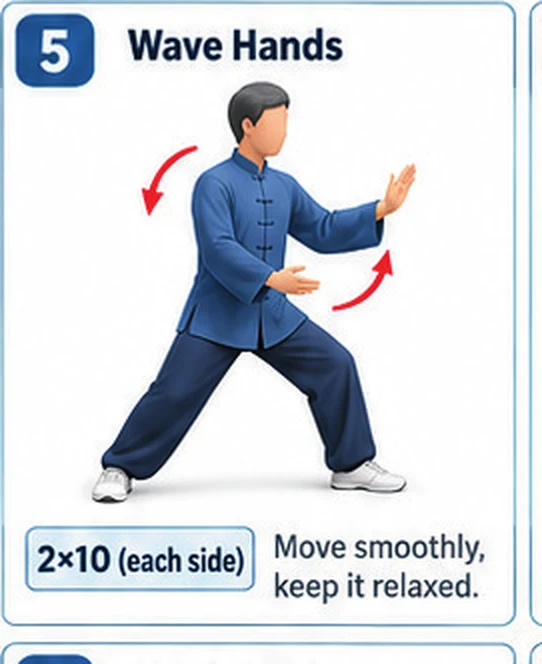
5. Wave Hands
Purpose: A flowing side-to-side arm movement with a weight shift, which turns the trunk a little with every pass.
How to perform:
- Stand with feet a little wider than hip-width, knees soft.
- Raise both hands to chest height on one side, palms angled down, as your weight shifts that way.
- Sweep them across and down, then up on the other side as your weight follows.
- Move continuously and slowly, like smoothing a wide table.
Recommended practice: 2 sets of 10, each side.
Beginner tip: The turn comes from the waist, gently. If you keep your hips quiet and let the chest travel, you have the shape of it.
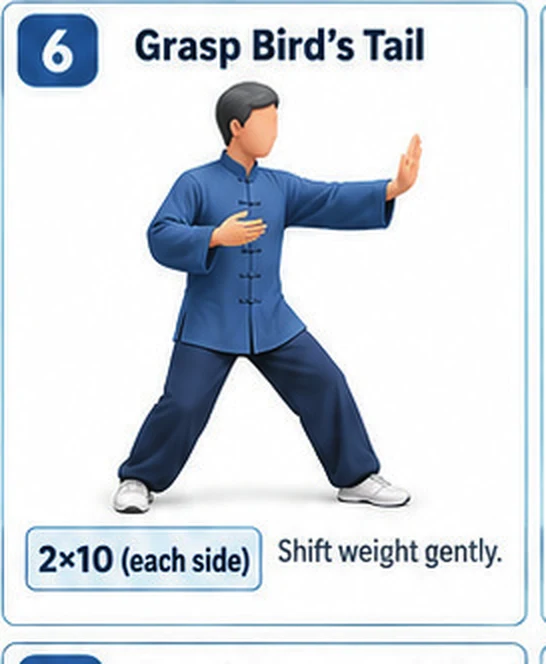
6. Grasp the Bird’s Tail
Purpose: A classic sequence of weight shifts and arm shapes that rolls the trunk through small turns while the legs manage the balance.
How to perform:
- Step one foot forward into a short, comfortable stance.
- Rock your weight forward as your arms sweep up and press gently forward, palms away.
- Settle back, drawing your hands down and back toward your hips.
- Flow between forward and back a few times, then change the leading foot.
Recommended practice: 2 sets of 10, each side.
Beginner tip: Keep the stance short. A long stance turns this into a leg workout and makes the trunk work harder than intended.
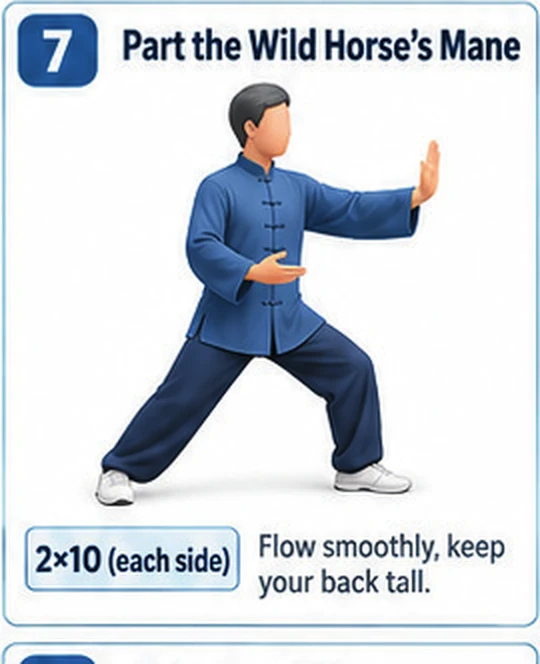
7. Part the Wild Horse’s Mane
Purpose: A stepping movement with a gentle trunk turn — one arm rises as the other lowers, and the body rotates a little with each step.
How to perform:
- Stand tall and step one foot forward at a slight angle.
- Let the opposite arm float forward and up to chest height as the other hand lowers by your hip.
- Step back to the start, then repeat on the other side.
- Move slowly, letting the turn stay small and natural.
Recommended practice: 2 sets of 10, each side.
Beginner tip: Practise the first few repetitions beside a countertop. Stepping plus turning plus arms is three things at once — support lets you learn them in peace.
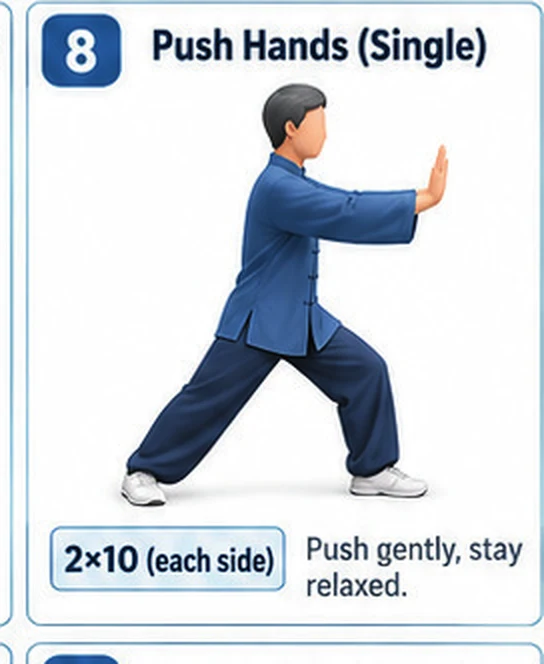
8. Push Hands (Single)
Purpose: A one-handed gentle press forward with a weight shift, which asks the trunk to brace softly against the push.
How to perform:
- Stand with one foot a short step forward, weight mostly on the back leg.
- Bring one palm up in front of your chest.
- Shift your weight forward as the palm presses softly ahead, as if pushing a door almost closed.
- Settle back, lower the hand, and repeat before changing sides.
Recommended practice: 2 sets of 10, each side.
Beginner tip: The press is a gesture, not a shove. If your shoulders climb toward your ears, the movement has become effort — soften it.
9. Single Whip
Purpose: A wide, turning movement that opens the chest and rotates the trunk gently while the legs make a small side step.
How to perform:
- Stand tall with feet together and arms in front of your chest, hands soft.
- Turn slowly to one side, opening one arm out at shoulder height, the hand forming a loose hook.
- Let the other palm press gently forward near your chest as you take a small side step.
- Draw back to the centre, then practise the other side.
Recommended practice: 2 sets of 10, each side.
Beginner tip: This is the most choreographed movement in the set. Two or three slow, untidy repetitions teach more than rushing all ten.

10. Brush Knee and Step
Purpose: A stepping pattern where one hand sweeps past the knee as the other presses forward — rotation, bracing and balance in one smooth package.
How to perform:
- Stand tall and step one foot forward at a comfortable length.
- Sweep the hand on the stepping side softly down past your knee, as if brushing something aside.
- At the same time, press the other palm gently forward at chest height.
- Step back, reset, and repeat on the other side.
Recommended practice: 2 sets of 10, each side.
Beginner tip: The brush passes your knee; it does not reach for the floor. Stay upright — your back will thank you for not folding.

11. Side Bend Flow
Purpose: A slow lean to each side that works the muscles along the waist and ribs — the side of the core that pure forward-and-back exercises miss.
How to perform:
- Stand with feet hip-width apart and one arm resting by your side.
- Slide that hand a short way down your thigh as you bend gently to that side, the other arm floating up if comfortable.
- Come back up through the middle using the muscles of your waist.
- Repeat to the other side, keeping the bend small and sideways — no tipping forward.
Recommended practice: 2 sets of 10, each side.
Beginner tip: Imagine standing between two panes of glass, front and back. Your bend should stay in the plane between them.

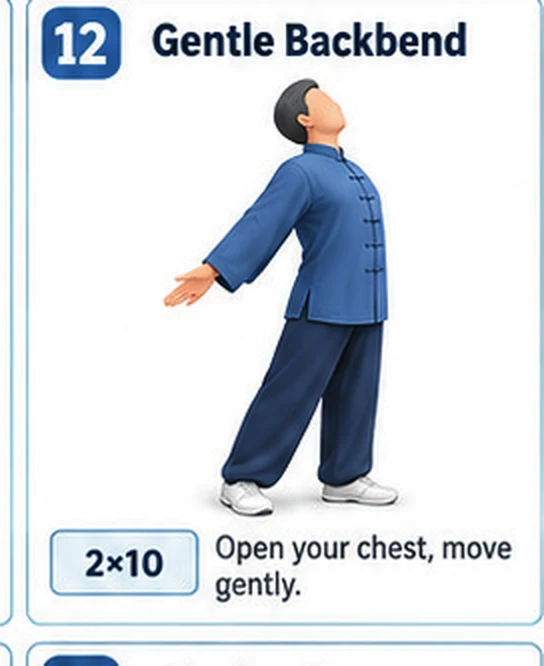
12. Gentle Backbend
Purpose: A mild, supported extension of the spine — the opposite direction to sitting — kept deliberately small.
How to perform:
- Stand tall with your hands resting on your lower back or hips, fingers pointing down.
- Lift your chest and lean back just a little, supporting your weight with your hands.
- Keep your knees soft and your head in line — look forward, not up at the ceiling.
- Return to upright slowly.
Recommended practice: 2 sets of 10.
Beginner tip: This is the movement to skip, or make smallest of all, if extension bothers your back — and to leave out entirely if a clinician has advised you against backbends. Small and comfortable, or not at all.
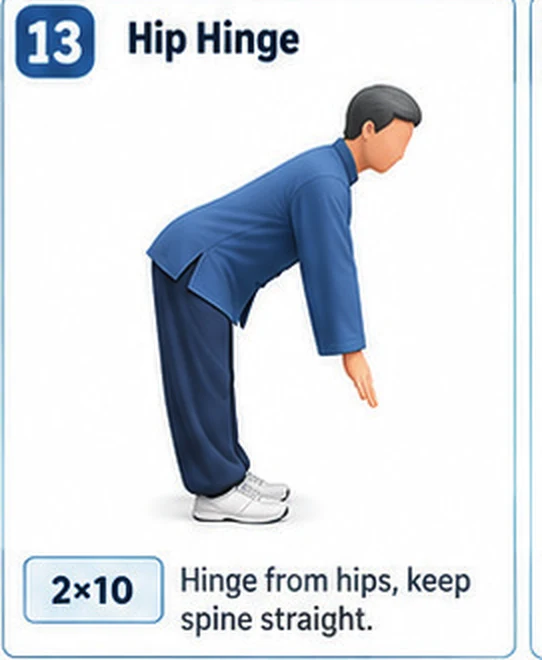
13. Hip Hinge
Purpose: The most useful bending pattern of all: folding at the hips with a straight back, the way safe lifting and reaching are meant to happen.
How to perform:
- Stand tall, feet hip-width apart, hands on your hips.
- Soften your knees and tip forward from the hips, keeping your back long and flat.
- Go only a short way — a bow, not a dive — feeling your hips do the folding.
- Press through your feet and use your legs and hips to stand tall again.
Recommended practice: 2 sets of 10.
Beginner tip: Practise facing a wall, close to it. The wall stops you rounding forward and teaches your hips to fold instead.
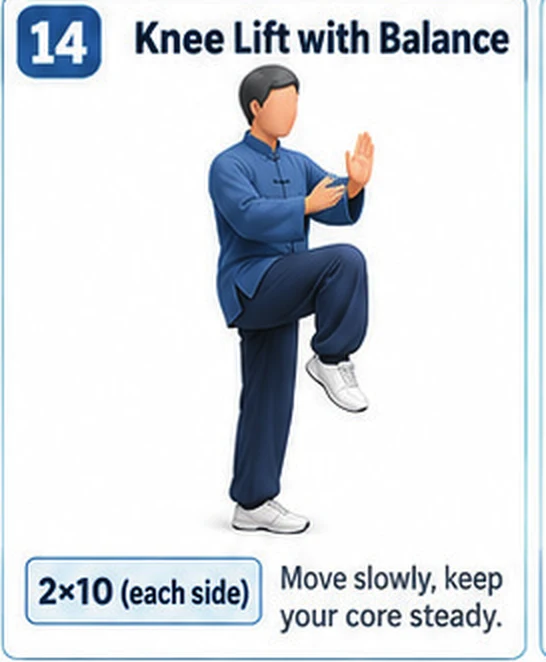
14. Knee Lift with Balance
Purpose: Lifting one knee while standing tall asks the standing leg and the deep core muscles to steady the whole frame together.
How to perform:
- Stand beside your chair or countertop and hold it.
- Shift your weight onto one leg and lift the other knee a few inches.
- Hold briefly, standing tall — no leaning away from the lifted side.
- Lower with control and repeat on the other side.
Recommended practice: 2 sets of 10, each side.
Beginner tip: Height is not the goal. A low lift with a tall, quiet trunk is exactly the exercise.
15. Hold the Ball
Purpose: A rounded-arm posture that draws the shoulder blades gently apart and gives the upper back a mild, open stretch.
How to perform:
- Stand tall with feet hip-width apart, knees soft.
- Raise both arms in front of you as if holding a large, light beach ball, palms facing you.
- Let your shoulders sink and your upper back widen a little as you breathe.
- Hold the shape for a few breaths, then lower your arms slowly.
Recommended practice: 2 sets of 10 breaths.
Beginner tip: Keep the “ball” light — if your shoulders creep up, lower your arms a notch and try again.

16. Closing Form
Purpose: A quiet finish that returns you to still standing, letting breathing and heart rate settle before you walk away.
How to perform:
- Stand tall, feet together or hip-width apart.
- Raise your hands slowly in front of you as you breathe in.
- Lower them gently as you breathe out, palms pressing down softly.
- Rest your hands by your sides and stand for the last few breaths.
Recommended practice: 2 sets of 1 minute.
Beginner tip: Do not walk off the moment you finish. A few still seconds close the session properly.

A simple 12-minute practice
| Time | What to do |
|---|---|
| Minutes 0–2 | Mindful Standing, then Pelvic Tilts |
| Minutes 2–5 | Cat-Cow Flow, Spinal Twist, and Side Bend Flow |
| Minutes 5–9 | Wave Hands, Push Hands (Single), and Hip Hinge |
| Minutes 9–12 | Hold the Ball, then Closing Form |
Start with two or three sessions a week and shorten any session that leaves your back more uncomfortable than it began. A shorter, comfortable session is always the correct one. Some people also enjoy a few gentle lower back stretches on other days; the same rules apply there — keep them small and slow, and stop if pain increases.
Get the printable chart
This routine comes from our Tai Chi Exercises for Back Pain Printable PDF Chart: a single page with all 16 movements illustrated, with their instructions and repetitions, so you can follow the routine without a screen. The chart itself is a movement reference for home practice — it is not a treatment programme, and if your back pain is persistent, worsening, or accompanied by leg symptoms, the right next step is a healthcare professional, not a chart.
Frequently asked questions
1. Can exercise help a sore back?
There is no single set of the best exercises for lower back pain that suits every back. Staying gently active is widely recommended for many common back complaints, and movement is generally better than complete rest. But backs and their causes differ, and this article cannot tell you what your back needs. For advice about your situation, speak to your doctor or physiotherapist.
2. Which of these exercises should I avoid?
Any that increase your pain — and, for some backs, twists and backbends need a clinician’s clearance first. If you have been given a list of movements to avoid, that list outranks this article every time.
3. How often should I practise?
Two or three short sessions a week is a reasonable starting rhythm. Increase slowly if it suits you, and never push through a flare-up to keep a schedule.
4. I cannot stand for long. Can I still use this routine?
This set is a standing routine. If standing is difficult at the moment, a seated practice is the better fit — seated chair exercises and chair Tai Chi work the trunk gently from the safety of a chair.
5. Should the movements hurt a little to work?
No. Mild muscular effort in the legs or around the waist is normal; pain is not the price of progress. Sharper, shooting or lasting pain during or after a movement means stop, and if it recurs, get assessed in person.
6. When should I see a doctor about back pain?
Promptly, if pain follows a fall or injury, comes with leg weakness or numbness, affects bladder or bowel control, or comes with fever or unexplained weight loss. Those are assessment-first situations, not exercise-first ones.
Final thoughts
A back that moves a little, often, in every direction it owns — that is the modest goal of this routine. Sixteen slow movements, kept small, practised with a chair in reach and a clear stop rule: if it hurts more, it stops.
Begin with the standing, the pelvic tilts and the gentle flows. Add the turns and bends as they feel manageable. And keep your clinician in the loop if your back has a history — gentle exercise and proper assessment are partners, not rivals.
Safety note: This article is general educational information, not medical advice, and none of these movements is a treatment for back pain or any other condition. Stop any exercise that causes or increases pain. Check with your doctor or physiotherapist before starting, especially if you have a diagnosed spinal condition, osteoporosis, recent injury or surgery, or pain that travels into a leg.