
Ask a room of over-sixties which joint complains first, and hips win the vote more often than not. Tight hips make themselves known in small ways: the first steps out of a chair feel stiff, getting in and out of the car takes a strategy, and bending to the garden asks more than it used to. Learning how to stretch hips gently — and regularly — is one of the simplest answers.
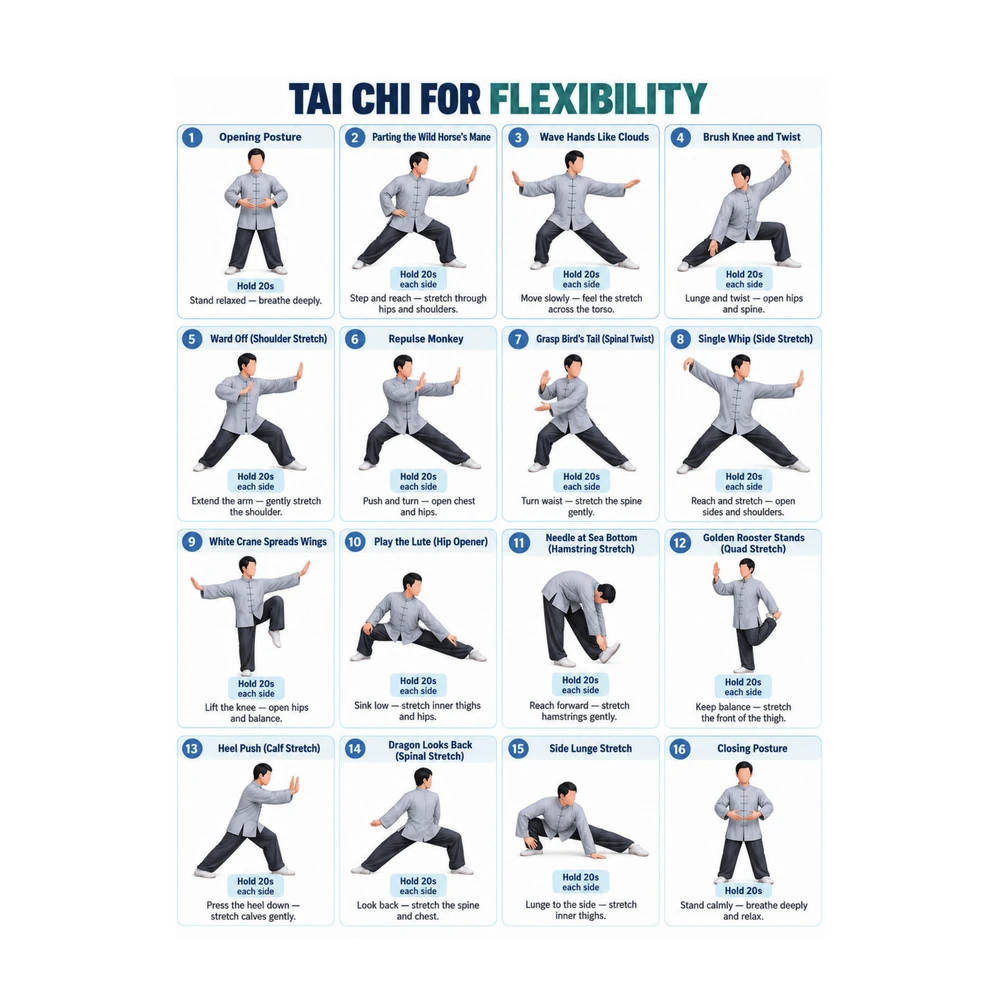
This article gives you a full 16-movement Tai Chi flexibility routine in which the hip stretches sit alongside work for the shoulders, spine, hamstrings, calves and quadriceps. That order matters: hips rarely tighten alone, and a routine that only ever pulls at the hip itself misses the neighbours that share the load. Every stretch in this set is held for 20 seconds — long enough to settle into, short enough to keep the whole session near 15 minutes.
Nothing here is extreme. There are no deep lunges to the floor, no leg-swinging, no forcing. Each movement reaches a comfortable stretch point, stays there while you breathe, and comes out as slowly as it went in.
Why hips stiffen, and what gentle stretching does about it
Hips spend much of modern life folded at roughly ninety degrees: chairs, cars, sofas, dining tables. Muscles adapt to the positions they live in, and a joint that spends its days folded can gradually become reluctant to do the opposite — to open, straighten and rotate. Long sitting also shortens the muscles at the front of the hip, while the muscles at the back and side get less work than they were built for.
Gentle stretching answers that pattern directly. It takes the joint, regularly, to the comfortable end of the ranges it has been avoiding: opening (Play the Lute, this set’s named hip opener), straightening the leg behind you (Golden Rooster’s quadriceps stretch), stepping wide (Side Lunge Stretch), and folding forward with soft knees (Needle at Sea Bottom for the hamstrings). Held for 20 seconds at a time, without bouncing, these are stretches your body can accept rather than defend against.
A note on expectations: stretching keeps the range you practise. It is maintenance, done little and often — not a one-time repair. And joint pain is different from muscle tightness: if your hip pain is sharp, one-sided, worsening, or came on after a fall, that is a job for a doctor or physiotherapist, not a stretching chart.
6 benefits of this flexibility routine
1. The hips get their own dedicated work
Play the Lute opens the hip directly, and the Side Lunge Stretch lengthens the inner thigh and hip. Around them, the hamstring and calf stretches remove the neighbouring tightness that often masquerades as a hip problem.
2. Every stretch has the same simple rule
Twenty seconds, each side where the movement has sides. One rule for the whole chart — nothing to memorise, nothing to count beyond a slow breath or two.
3. Shoulders and spine are included, not forgotten
Ward Off stretches the shoulder, Grasp the Bird’s Tail and Dragon Looks Back turn the spine gently. Stiff hips and a stiff trunk usually arrive together; this routine treats them as the team they are.
4. The stretches are standing and supported
Every movement is done on your feet, with a chair beside you for balance. No getting down to a mat and — the part people quietly dread — no getting back up again.
5. Tai Chi pacing keeps stretching calm
The movements between stretches are flowing Tai Chi forms — Wave Hands, Repulse Monkey, Brush Knee — so the session feels like a slow dance with pauses, not a test of endurance.
6. It pairs well with strength and balance days
Flexibility work is the natural third leg of a weekly routine: strength one day, balance the next, stretching whenever you like — including after walks, when muscles are warm.
Before you start: safety first
- A stretch should feel like a gentle pull, never pain. Ease off the moment a stretch becomes sharp, pinching or electric — especially in the hip joint itself.
- Never bounce or force a stretch deeper. Arrive slowly, breathe, and let the 20 seconds do the work.
- Practise beside a sturdy chair for the one-leg stretches (Play the Lute, Golden Rooster) and hold it without apology.
- If you have had a hip replacement, follow your surgeon’s movement restrictions exactly — some hip stretches are restricted after surgery, and those instructions outrank this article.
- Warm muscles stretch more comfortably. A few minutes of easy walking or the opening movements of this set come before the deeper stretches for a reason.
- Stop if you feel dizzy, and sit down. Check with your doctor first if you have joint disease, osteoporosis, or a recent injury.
- This article is general educational information, not medical advice.
The 16 flexibility movements
The order is the chart’s: it opens the posture, warms the shoulders and spine, reaches the hips, hamstrings and calves in the second half, and closes quietly. Every stretch is held for 20 seconds, on each side where the movement is one-sided.
1. Opening Posture
Purpose: A standing settle that lengthens the spine and sets the calm pace the stretches need.
How to perform:
- Stand tall, feet hip-width apart, arms by your sides.
- Breathe in as your hands float slowly up in front of you to chest height.
- Breathe out as they sink back down, shoulders dropping with them.
- Repeat the float a few times, then hold a tall, quiet stand.
Recommended practice: Hold the final posture for 20 seconds.
Beginner tip: Think height, not effort. Stand as if a thread from the top of your head were gently taking your weight.

2. Parting the Wild Horse’s Mane
Purpose: A flowing step-and-turn that warms the hips and shoulders before the held stretches begin.
How to perform:
- Step one foot forward at a slight angle, beside your support if you wish.
- Float the opposite arm forward and up as the other hand lowers by your hip, turning gently.
- Hold the finished shape briefly, feeling the front hip of the back leg lengthen a little.
- Step back, reset, and repeat on the other side.
Recommended practice: Hold 20 seconds, each side.
Beginner tip: The stretch here is mild and in the back leg’s front hip. A longer (still comfortable) step makes it clearer.

3. Wave Hands Like Clouds
Purpose: A continuous side-to-side flow that keeps the waist turning and the shoulders moving between stretches.
How to perform:
- Stand with feet shoulder-width apart, knees soft.
- Sweep both hands across your body at waist height as your weight shifts that way.
- Let the hands change over as your trunk turns gently.
- Travel back the other way, slow and even.
Recommended practice: Hold the flow’s end position 20 seconds, each side.
Beginner tip: This is the breather between stretches. If your breathing has sped up, slow the hands until it settles.

4. Brush Knee and Twist
Purpose: A step with a sweeping arm that rotates the trunk and gives the front of the stepping hip a mild stretch as you settle.
How to perform:
- Step one foot forward at a comfortable length.
- Sweep the hand on the stepping side softly past your knee while the other palm presses forward.
- Settle into the shape, trunk turning slightly over the front leg.
- Hold, breathe, then step back and change sides.
Recommended practice: Hold 20 seconds, each side.
Beginner tip: Stay upright — the sweep passes your knee, it does not dive toward the floor.

5. Ward Off (Shoulder Stretch)
Purpose: The set’s dedicated shoulder stretch: one arm raised in a rounded guard position that lengthens the shoulder and side of the chest.
How to perform:
- Stand tall and step one foot slightly forward.
- Raise the forearm on the stepping side in front of your chest, rounded, as if holding off a soft push.
- Let your other hand rest near your hip.
- Hold, feeling the stretch through the raised shoulder, then change sides.
Recommended practice: Hold 20 seconds, each side.
Beginner tip: Keep the raised shoulder down, away from your ear — the stretch should live in the shoulder, not the neck.

6. Repulse Monkey
Purpose: Backward steps with alternating arm presses — light mobility for the front of the hips with every retreat step.
How to perform:
- Check the floor behind you is clear first.
- Step one foot slowly backwards, toe first.
- Press the opposite palm forward as the other hand draws back to your hip.
- Continue alternating steps and arms, slow enough to stay graceful.
Recommended practice: Hold the final step’s shape 20 seconds, each side.
Beginner tip: Practise beside a countertop. Each backward step extends the front of the hip you’re leaving — that is the stretch working.

7. Grasp the Bird’s Tail (Spinal Twist)
Purpose: The routine’s main spinal twist, layered into a weight-shifting Tai Chi form: rotation for the trunk, taken slowly.
How to perform:
- Take a short forward stance with one foot.
- Rock gently forward as your arms press ahead, then settle back, drawing the hands toward your hips and turning slightly.
- Find the comfortable end of the turn and hold it there.
- Repeat the rock a few times, then change the leading foot.
Recommended practice: Hold 20 seconds, each side.
Beginner tip: Twists should feel like wringing a towel gently. If you have been told to avoid spinal rotation, skip this movement entirely.

8. Single Whip (Side Stretch)
Purpose: A wide opening posture that stretches the side of the trunk — ribs, waist and the outer hip of the stepped leg.
How to perform:
- Stand tall, arms gathered softly in front of your chest.
- Turn to one side, opening that arm wide at shoulder height while the other palm presses near your chest.
- Take a small side step with the turning-side foot.
- Hold the open shape, breathing into the stretched side, then change sides.
Recommended practice: Hold 20 seconds, each side.
Beginner tip: Open only as wide as your balance allows beside support. The side stretch survives a smaller step perfectly well.

9. White Crane Spreads Wings
Purpose: An upright one-leg posture with arms opened high and low — stretches the front of the body while the standing hip stabilises.
How to perform:
- Stand behind your chair, holding on until you know the shape.
- Shift onto one leg, the other toe resting lightly by your ankle.
- Float one arm up beside your head and press the other gently down.
- Hold tall, then lower everything and change sides.
Recommended practice: Hold 20 seconds, each side.
Beginner tip: Keep the resting toe on the floor as long as you like. This is a stretch posture first and a balance pose second.

10. Play the Lute (Hip Opener)
Purpose: The set’s named hip opener: a semi-stepping posture that takes one hip into gentle external rotation — opening the joint the way getting out of a car demands.
How to perform:
- Stand beside your chair and step one foot forward, then let that foot’s toes turn slightly outward.
- Settle a little weight into the turned-out leg, feeling the hip open softly.
- Raise your hands in front of you as if holding a lute against your chest — one higher, one lower.
- Hold, keeping the opening comfortable, then step back and change sides.
Recommended practice: Hold 20 seconds, each side.
Beginner tip: The turn-out is small — a few degrees past straight. A comfortable opening held calmly beats a dramatic one held with gritted teeth, every time.

11. Needle at Sea Bottom (Hamstring Stretch)
Purpose: A soft forward fold over one leg that stretches the hamstrings — the back-of-thigh tightness that so often travels with stiff hips.
How to perform:
- Stand tall beside your support and step one foot a short way forward, heel down, toes lifted.
- Hinge gently from the hips over the front leg, keeping your back long and knees soft.
- Reach one hand down toward the front shin, only as far as the hamstring asks you to stop.
- Hold, then rise slowly and change legs.
Recommended practice: Hold 20 seconds, each side.
Beginner tip: Shorten the step to reduce the stretch. The fold should feel like a polite bow, not a dive.

12. Golden Rooster Stands (Quadriceps Stretch)
Purpose: The front-of-thigh stretch, done in the Golden Rooster’s one-leg posture: lengthening the quadriceps and the front of the hip together.
How to perform:
- Stand behind your chair and hold on — this one is done holding, by design.
- Shift onto one leg and bend the other knee, drawing the heel up behind you toward your seat.
- If your hand reaches your ankle comfortably, hold it; if not, simply keep the knee bent and pointing down.
- Stand tall, feel the stretch along the front of the bent leg’s thigh, then change sides.
Recommended practice: Hold 20 seconds, each side.
Beginner tip: Never force the heel to your seat. Knee bent, thigh vertical, gentle pull in the front of the thigh — that is the whole requirement.

13. Heel Push (Calf Stretch)
Purpose: A wall-style calf stretch folded into the routine: one leg back, heel pressed down, lengthening the calf and the back of the ankle.
How to perform:
- Face a wall or your chair back and rest both hands on it.
- Step one foot back, keeping that leg straight and the heel reaching for the floor.
- Bend the front knee slightly until you feel the stretch in the back calf.
- Hold with the heel down, then change legs.
Recommended practice: Hold 20 seconds, each side.
Beginner tip: A shorter step back gives a kinder stretch. Your heel staying down matters more than the depth of the lean.

14. Dragon Looks Back (Spinal Stretch)
Purpose: A standing look-back over the shoulder that rotates the whole spine and opens the chest diagonally.
How to perform:
- Stand tall, feet hip-width apart, hands resting lightly on your hips.
- Turn your head and chest slowly to look behind you on one side.
- Let the turn travel gently down your spine without forcing the end of it.
- Hold, return to centre, and look back over the other shoulder.
Recommended practice: Hold 20 seconds, each side.
Beginner tip: Lead with your eyes and let the body follow only as far as it volunteers. Turning the head alone is an acceptable version.

15. Side Lunge Stretch
Purpose: A wide stance shifted to one side: stretches the inner thigh and hip of the straight leg — the groin’s opening range that sideways movement depends on.
How to perform:
- Stand with feet wide, beside your support, toes pointing forward or turned slightly out.
- Shift your weight over one foot, bending that knee a little while the other leg stays straight.
- Feel the stretch along the inner thigh of the straight leg.
- Hold, come back to centre, and shift to the other side.
Recommended practice: Hold 20 seconds, each side.
Beginner tip: Narrow the stance and sit the shift higher until it feels easy. Depth is the last dial to turn, weeks from now.

16. Closing Posture
Purpose: A final tall stand with slow breathing that lets the stretched muscles settle and closes the session in the same calm it opened with.
How to perform:
- Stand with feet together or hip-width apart, arms resting by your sides.
- Breathe in as your hands float up in front of you one last time.
- Breathe out as they lower, palms pressing the air down softly.
- Stand quietly for the last few breaths before walking away.
Recommended practice: Hold 20 seconds.
Beginner tip: Notice the difference between your first stand and this one. That before-and-after is the quiet evidence the session did its work.

How to stretch hips in a simple 15-minute practice
| Time | What to do |
|---|---|
| Minutes 0–3 | Opening Posture, Parting the Wild Horse’s Mane, Wave Hands Like Clouds |
| Minutes 3–7 | Brush Knee and Twist, Ward Off, Grasp the Bird’s Tail |
| Minutes 7–12 | Play the Lute (hip opener), Needle at Sea Bottom, Golden Rooster, Heel Push |
| Minutes 12–15 | Dragon Looks Back, Side Lunge Stretch, Closing Posture |
Two or three sessions a week keep the gains from these hip stretches; after a walk, when your muscles are already warm, is the kindest time of day for the leg stretches. Never stretch a cold, painful joint hard — the 20 seconds only work when the tissue is willing.
Get the printable chart
These 16 movements come from our Tai Chi Exercises for Flexibility Printable PDF Chart — a single page showing each flexibility movement with its illustration, instructions and the 20-second hold, including Play the Lute, the hip opener at the heart of this routine, so you can stretch at home without a screen in the room.
Frequently asked questions
1. How long should I hold a hip stretch?
In this routine, every stretch is held for 20 seconds, on each side where the movement is one-sided. That is long enough for the muscle to settle into the stretch without turning the session into an endurance test. Longer holds are unnecessary for gentle maintenance work.
2. Why does a hip routine include shoulder and spine stretches?
Because stiffness travels in company. Shoulders, spine and hips share the work of turning, reaching and stepping, and a routine that only ever pulls at the hip leaves its partners out. The full chart covers the whole chain, with the hip opener and side lunge at its centre.
3. My hips feel tighter on one side. Should I stretch that side more?
Stretch both sides as the chart sets out — an uneven-feeling pair of hips is common, and quietly doubling up on one side rarely helps. If one hip is markedly painful, restricted or worsening while the other is fine, have it assessed in person instead.
4. Can I do these stretches after a hip replacement?
Only within the movement restrictions your surgical team gave you, and only once they have cleared you for exercise. Some of these movements — deep opening and rotation especially — are commonly restricted after hip surgery. Your surgeon’s list outranks any chart.
5. What is the difference between stretching tightness and joint pain?
Muscle tightness feels like a broad, gentle pull that eases as you hold the stretch. Joint pain is sharper, deeper, sometimes pinching or catching in the groin or joint itself — and it does not ease with holding. Stop at joint pain and have persistent hip pain assessed.
6. When is the best time to stretch?
When your muscles are warm: after a walk, after the opening movements of this routine, or later in the day rather than first thing in the morning, when most people are at their stiffest. Cold, hurried stretching is how gentle routines stop being gentle.
Final thoughts
Hip stretches are unglamorous, patient work: open the joint a little, hold for twenty seconds, breathe, repeat on the other side, and do the same again on Thursday. But the returns are the everyday ones — chairs that feel lower-effort, car doors that stop being a puzzle, first steps that loosen in seconds instead of minutes.
Keep the stretches gentle, keep the holds honest, and let consistency do the heavy lifting.
Safety note: This article is general educational information, not medical advice. A stretch should feel like a gentle pull, never pain — stop at anything sharp or pinching, and follow any post-surgical restrictions you have been given exactly. Check with your doctor or physiotherapist if you have joint disease or persistent hip pain.