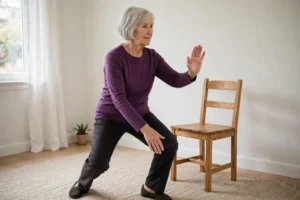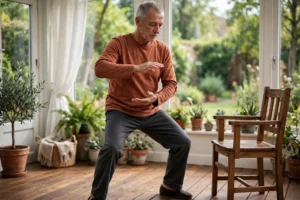


Chair tai chi is the easiest way to start tai chi — or keep practising it — when standing for long periods is difficult, tiring, or simply not appealing today. You sit on a sturdy chair, follow slow, flowing tai chi moves with your arms, torso and breath, and finish feeling looser, calmer and more awake. No equipment, no floor work, and no experience needed.
In this guide you will learn exactly what sitting tai chi is, who it suits, how to set up safely, and a complete 10-minute chair tai chi routine with eight gentle movements you can practise at home. At the end you will also find a simple weekly plan and answers to the questions beginners ask most.
Chair Tai Chi at a Glance
- What it is: Traditional tai chi movements adapted to be performed seated on a chair
- Best for: Beginners, seniors, and anyone with limited mobility or balance concerns
- Session length: 10 minutes is enough to start; build up gradually
- Equipment: One sturdy chair without wheels, comfortable clothing, flat shoes or bare feet
- Focus: Gentle mobility, breathing, posture, coordination and relaxation
What Is Chair Tai Chi?
Chair tai chi (often searched as sitting tai chi) adapts the slow, continuous movements of tai chi so they can be done while seated. Instead of shifting your weight between your legs, the movement comes from your arms, shoulders, waist and breath — the same flowing quality, without the demand on your legs and balance.
Tai chi itself is a centuries-old Chinese practice that combines gentle physical movement, mental focus and controlled breathing. Health organisations such as the National Center for Complementary and Integrative Health (NCCIH) describe tai chi as a mind-body practice that is generally safe and may support balance and overall well-being, particularly in older adults. You can read more in the NCCIH guide to tai chi.
Chair tai chi keeps the heart of the practice — slow, coordinated, mindful movement — while removing the biggest barrier for many people: having to stand.
Who Is Chair Tai Chi For?
- Complete beginners who want a gentle introduction before trying standing tai chi
- Seniors looking for low-impact tai chi exercises for seniors they can do at home
- Anyone who gets tired, dizzy or unsteady standing for more than a few minutes
- People with stiff shoulders, a stiff back or limited mobility who need seated movement
- Office workers who want a short, calming movement break at a desk
If you can sit comfortably and move your arms, you can start chair tai chi today.
Benefits of a Seated Tai Chi Practice
Chair tai chi is gentle, but it is not passive. A regular seated practice can help you:
- Move stiff joints gently — shoulders, elbows, wrists, spine and neck all move through comfortable ranges
- Breathe more deeply — movements are timed with slow breathing, which most people find calming
- Improve posture awareness — seated practice makes it easier to notice slouching and sit tall
- Build coordination — the two arms often do different things at once, in slow, controlled patterns
- Create a daily movement habit — because it is comfortable and repeatable, it is far easier to stick to than an ambitious standing routine
Chair tai chi is a general wellness practice. It is not a treatment or cure for any medical condition, and the benefits above are about everyday movement, comfort and relaxation — see the safety note before the routine.
Before You Begin: Chair, Posture and Safety
Choose the right chair
- A sturdy chair without wheels, ideally without armrests so your arms can move freely
- Both feet should rest flat on the floor; if they do not reach, place a firm cushion or book under them
- Sit towards the front half of the chair so your back is free and not leaning on the chair back
Find your seated posture
- Sit tall, as if a thread is gently lifting the crown of your head
- Relax your shoulders down and let your chin stay level
- Rest your hands on your thighs, palms down, and take three slow breaths before you start
Safety first
Move slowly and stay within a comfortable range — tai chi should never hurt. Stop if you feel pain, dizziness or unusual shortness of breath. If you have a medical condition, a recent injury or surgery, or significant balance problems, check with your doctor or a qualified health professional before starting a new exercise routine, and consider learning from a qualified tai chi instructor first.
The 10-Minute Chair Tai Chi Routine: 8 Gentle Movements
This tai chi chair workout follows the natural arc of a traditional class: settle and breathe, warm movements, flowing sequences, then a quiet close. Repeat each movement slowly for the time shown, breathing naturally — a useful rhythm is to breathe in for one half of the movement and out for the other half.
1. Seated Posture and Breathing (1 minute)
Sit tall with your hands resting palms-down on your thighs. Breathe in slowly through your nose and feel your belly soften and expand; breathe out and let your shoulders drop. Repeat for 6–8 breaths. This centres your attention and sets your posture for everything that follows.

2. The Commencement — Raising the Arms (1 minute)
Breathe in and slowly float both arms up in front of you to shoulder height, palms facing down, as if your hands are resting on water. Breathe out and lower them back to your thighs just as slowly. Repeat 4–6 times. Keep your elbows soft — there should be no strain in your shoulders.

3. Seated Cloud Hands (2 minutes)
One of the most loved tai chi moves. Turn your waist gently to the left as your left hand floats up to face height, palm towards you, and your right hand settles at waist height, palm down — as if one hand is waving slowly past your face. Then turn to the right and let the hands exchange roles. Flow from side to side like clouds drifting, 6–8 turns in total.

4. Opening and Closing the Chest (1 minute)
Breathe in and open your arms wide to the sides, palms up, feeling your chest open. Breathe out and bring your hands back towards each other in front of your chest, palms down, without letting them touch. Repeat 4–6 times. This is excellent for releasing a tight chest and shoulders after sitting at a desk.

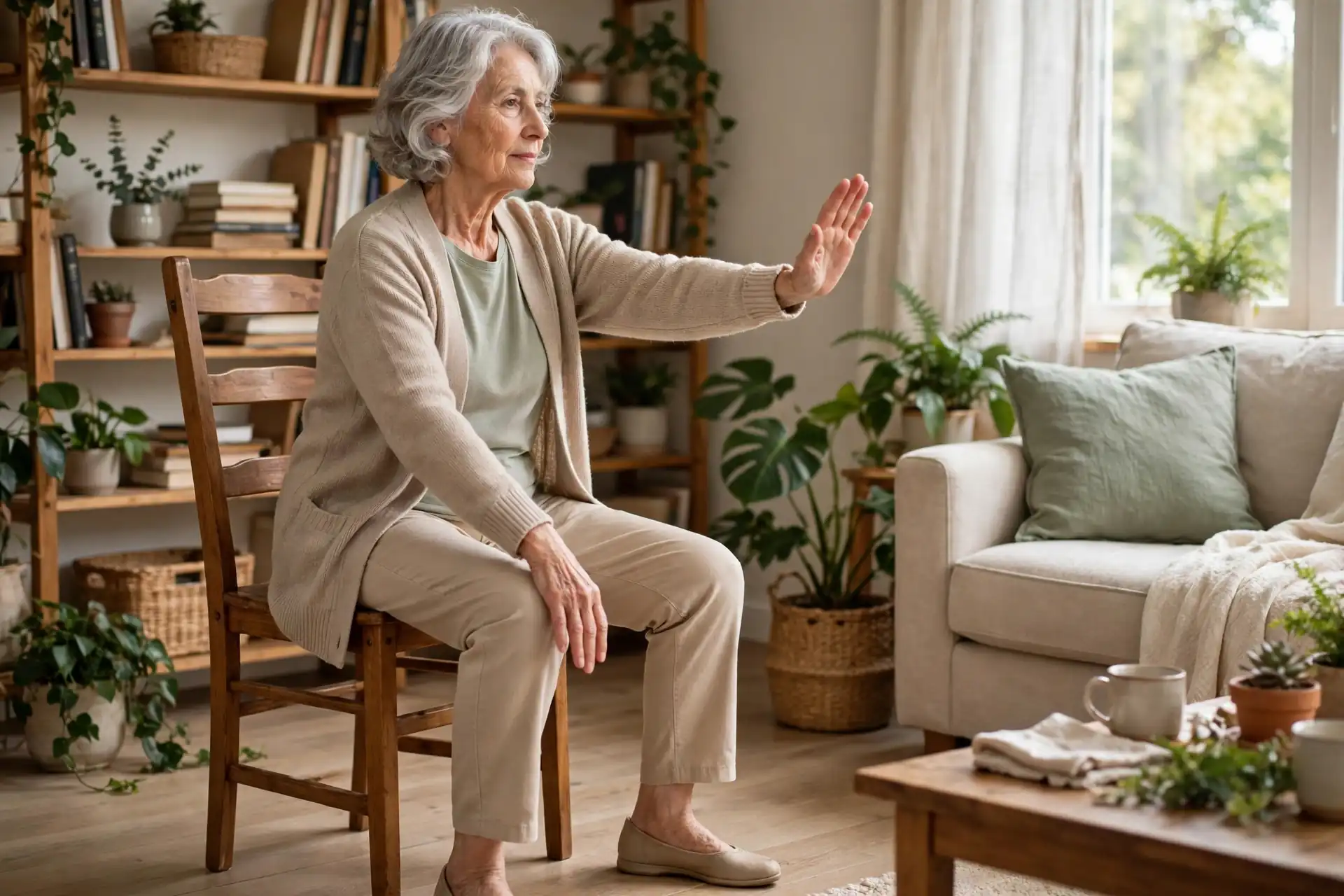
5. Brush Knee, Seated (1 minute)
Raise your right hand beside your ear, palm forward, while your left hand rests near your left knee. Slowly push the right hand forward as if smoothing the air, while the left hand sweeps gently across your body. Bring both hands back and repeat on the other side. Alternate for 4 turns each side, turning your waist slightly as you push.
6. Waist Turns — Turning to Look Behind (1 minute)
Place your hands on your thighs. Breathe in to sit tall, then breathe out and turn your upper body gently to the right, letting your gaze follow. Breathe in back to centre, then turn to the left. Repeat 3–4 times each side. Only turn as far as is comfortable — this is a gentle twist, not a stretch to force.

7. Seated Leg Lifts — Golden Rooster, Adapted (1 minute)
Hold the sides of your chair for support. Keeping your back tall, breathe out and lift your right foot a few centimetres off the floor, straightening the leg only as far as is comfortable; breathe in and lower it slowly. Repeat 3–4 times, then change legs. If lifting is not comfortable today, simply slide the heel forward along the floor instead — the movement still counts.

8. Closing Form — Gathering and Centring (2 minutes — includes quiet sitting)
Float both arms out and up in a wide, gentle arc as you breathe in, then breathe out and draw your palms slowly down the front of your body, imagining you are smoothing everything back to stillness. Repeat 3 times. Then rest your hands on your thighs, close your eyes if you wish, and sit quietly breathing for the final minute. This is where the calm of the practice settles in — do not skip it.

Four more movements from the same chart
The routine above is the heart of this article, but it is not everything on the chart it comes from. Our printable Chair Tai Chi Exercises for Seniors chart contains sixteen seated exercises in total, and the four movements below are also on it. They sit outside the timed 10-minute routine — think of them as extra movements to explore once the routine feels familiar. They are described here in brief only: the full step-by-step instructions for each one are printed on the chart itself, so if you would like to follow them in detail, download the chart and use the printed guidance.
9. Neck Rotation
A gentle seated movement for the neck. Sitting tall with your shoulders relaxed, you turn your head slowly to look towards one side, then bring it back through centre and turn towards the other side. It is one of the smaller, simpler movements on the chart, and a comfortable way to release stiffness in the neck.

10. Wrist Circles
A small seated movement for the hands and wrists. With your hands held up in front of you, you make slow, easy circles with your wrists, keeping the movement smooth and relaxed. It loosens the very joints that the flowing arm movements of chair tai chi — such as Cloud Hands — rely on.
11. Seated Marching
A seated leg movement that brings a marching rhythm into the practice. Sitting tall, and holding the sides of your chair for support if you wish, you lift one foot at a time in a slow, steady pattern, as if marching on the spot without standing up.

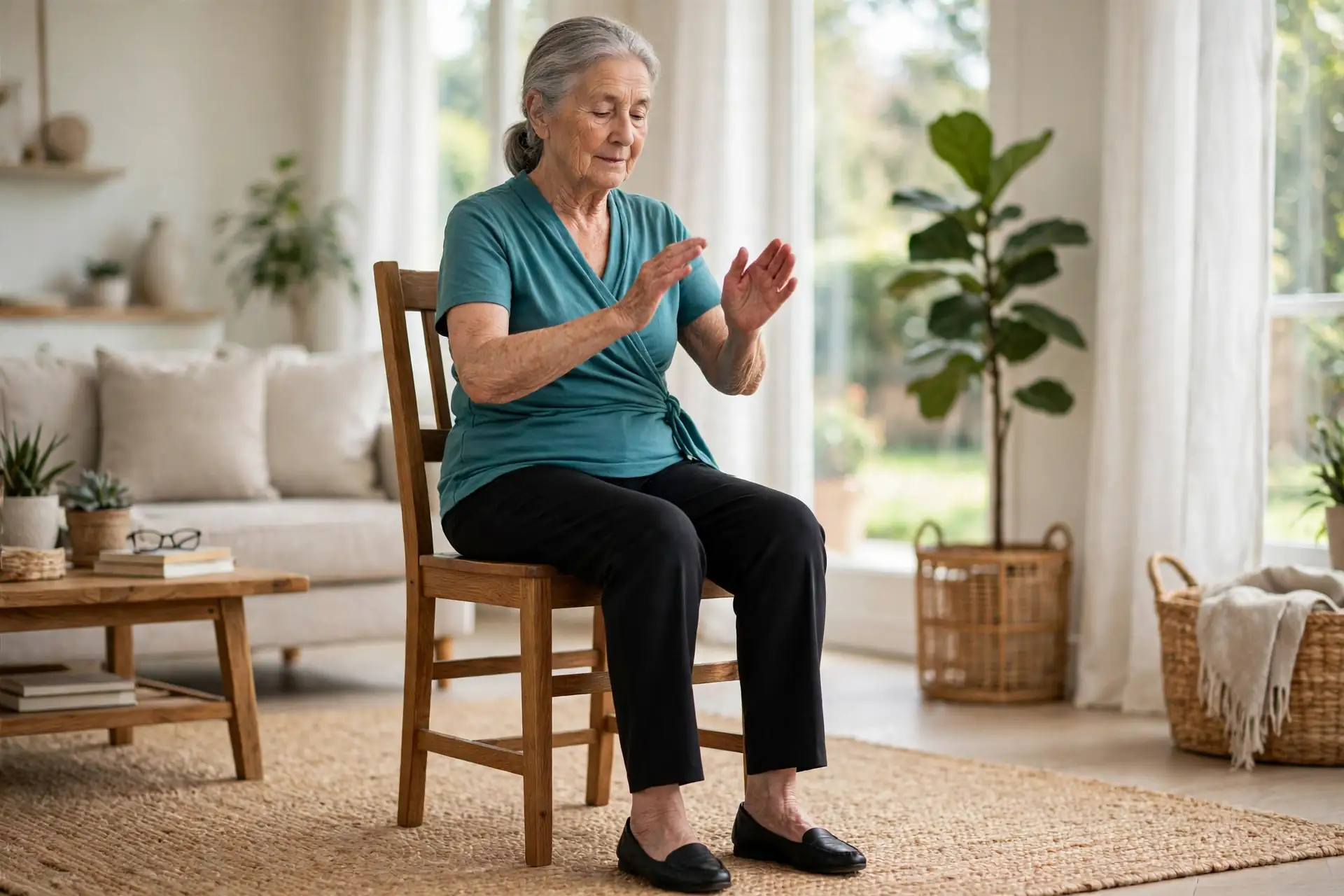
12. Palm Press
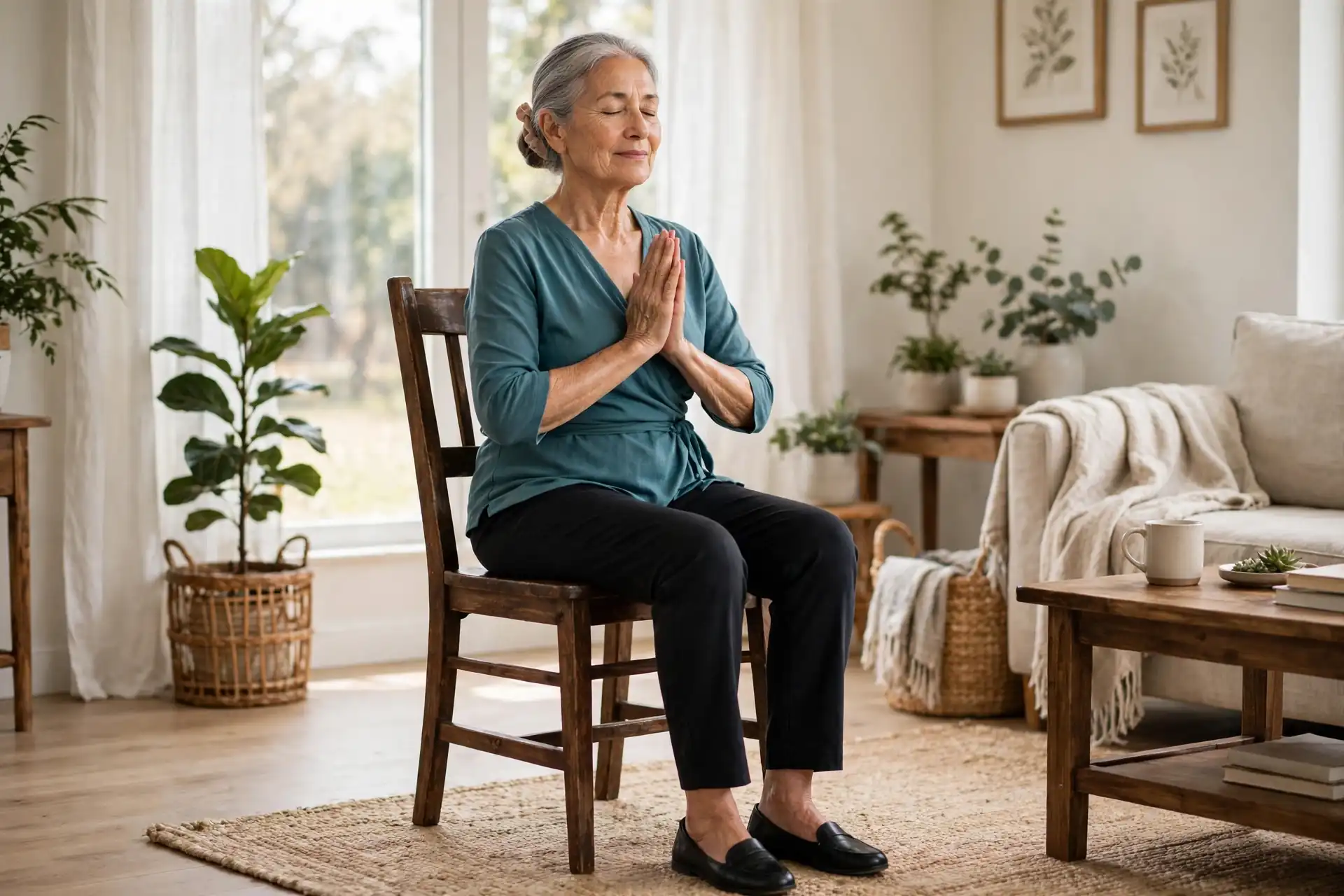
A quiet, still seated movement. The palms are brought together in front of your chest and pressed gently against each other while you sit tall and breathe slowly. With almost no movement involved, it is a calm, focused moment that sits naturally alongside the breathing exercises at the start or end of a session.
Your 10-Minute Routine at a Glance
| Time | Movement | Focus |
|---|---|---|
| 0:00–1:00 | Seated posture and breathing | Settle, sit tall, slow the breath |
| 1:00–2:00 | The Commencement — raising the arms | Shoulders, breath timing |
| 2:00–4:00 | Seated cloud hands | Waist, coordination, flow |
| 4:00–5:00 | Opening and closing the chest | Chest and shoulder release |
| 5:00–6:00 | Brush knee, seated | Arms, gentle waist turn |
| 6:00–7:00 | Waist turns | Spine mobility |
| 7:00–8:00 | Seated leg lifts | Legs, supported strength |
| 8:00–10:00 | Closing form and quiet sitting | Calm, centring, relaxation |
Prefer following your routine on paper, without a screen? Many people print their routine and keep it beside their chair. Our free Seniors printable and Balance & Flexibility printable follow the same gentle, follow-along approach, in A4 and US Letter sizes.
How Often Should You Practise?
- Week 1–2: 10 minutes, 3 times per week — learn the movements without rushing
- Week 3–4: 10–15 minutes, 4–5 times per week — repeat favourite movements for longer
- Ongoing: A short daily practice is ideal; consistency matters far more than duration
On days when you feel stronger and want more, pair this seated routine with standing practice. Our 28-Day Walking Tai Chi Challenge builds the same gentle habits into a progressive four-week walking programme.
Chair Tai Chi vs Standing Tai Chi
| Chair Tai Chi | Standing Tai Chi | |
|---|---|---|
| Balance demand | Very low — fully supported | Moderate — weight shifting is part of the practice |
| Leg involvement | Light (optional lifts) | High — legs drive most movements |
| Best for | Beginners, seniors, limited mobility, desk breaks | Those comfortable standing and stepping |
| Where | Anywhere with a chair | Needs floor space to step |
| Typical starting session | 10 minutes | 15–20 minutes |
Neither is “better” — they are two doors into the same practice. Many people start seated, and later mix both.
5 Common Beginner Mistakes to Avoid
- Moving too fast. If your breathing speeds up, slow down. Slower is the exercise.
- Holding your breath. Let the breath flow continuously; never force it to match a count that feels uncomfortable.
- Raising the shoulders. Check often: shoulders down, elbows soft, jaw relaxed.
- Sitting back in the chair. Sit towards the front so your torso can turn freely.
- Skipping the quiet finish. The closing minute is where your body registers the practice. Keep it.
New to tai chi altogether? Start with our Tai Chi for Beginners printable for the basic principles, then use this seated routine as your daily practice.
Frequently Asked Questions
Is chair tai chi effective?
Chair tai chi works the same upper-body, breathing and coordination elements as standing tai chi, with much lower balance and leg demands. Practised regularly, it is an effective way to stay gently active, mobile and relaxed — especially for people who would otherwise not exercise at all. It is a wellness practice, not a medical treatment.
Is sitting tai chi the same as chair tai chi?
Yes — “sitting tai chi”, “seated tai chi” and “chair tai chi” all describe the same thing: tai chi movements performed while seated on a chair.
How long should a chair tai chi session be?
Ten minutes is an ideal starting point. As the movements become familiar, extend to 15–20 minutes by repeating the flowing movements (cloud hands, opening the chest) for longer rather than adding complexity.
Can seniors do chair tai chi every day?
Because it is low-impact and self-paced, gentle chair tai chi suits daily practice for most healthy seniors. Listen to your body, rest when you need to, and check with your doctor first if you have medical conditions, recent surgery or significant balance problems.
Do I need a tai chi chair workout PDF or any equipment?
No special equipment — just a sturdy chair. A printed routine (often searched as a tai chi chair workout pdf) simply makes it easier to follow along without a screen. All of our printables at Tai Chi Printables are currently free to download in A4 and US Letter formats.
What should I wear?
Comfortable clothing that lets your arms and waist move freely, and flat shoes or bare feet so your feet rest stable on the floor.
Start Your Seated Practice Today
Chair tai chi removes every excuse: no standing, no equipment, no experience — just a chair, ten minutes, and slow, kind movement. Work through the eight movements of the routine above two or three times this week and notice how your shoulders, breath and mood respond.
Ready to make it a habit? Browse our free tai chi printables — including guides for beginners, seniors, and balance & flexibility — download the one that suits you, print it, and keep it beside your chair. Move gently, feel stronger, live better.
Disclaimer: This article is for general education and wellness information only and is not medical advice. Consult a qualified health professional before starting a new exercise programme if you have any health condition, injury or concern.