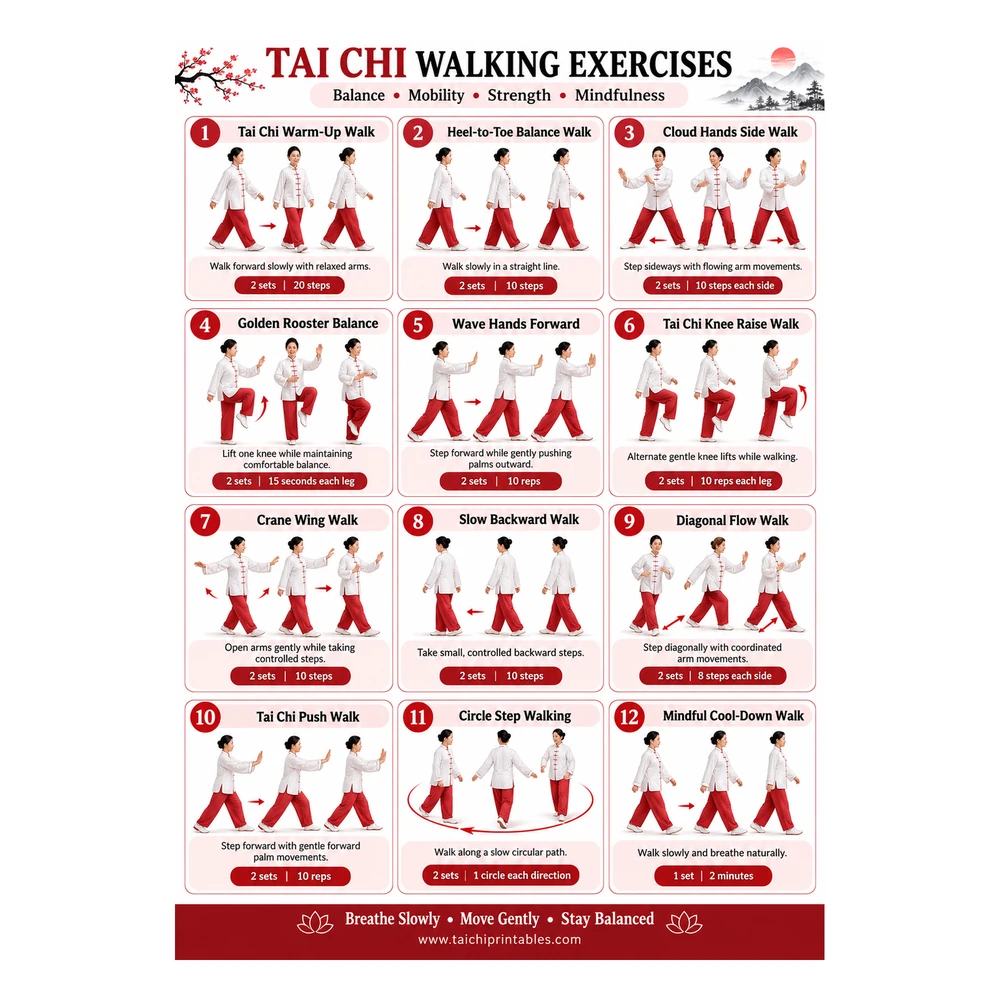

There is a particular kind of confidence that comes from trusting your own feet. Senior balance exercises are how you rebuild that trust: not with anything dramatic, but by practising — slowly, beside a chair — the exact skills standing asks of you. Holding still on one leg. Turning without hurrying. Stepping in a straight, narrow line.
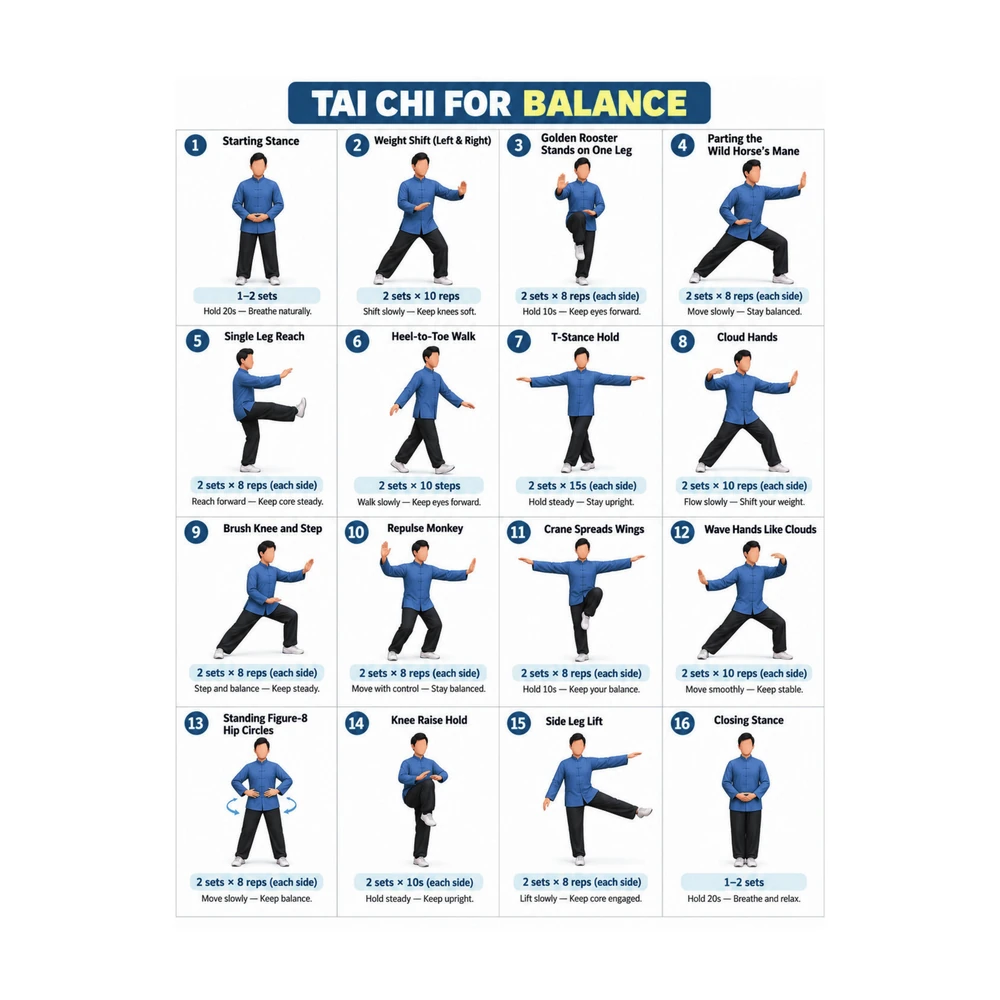
This article is a complete library of 16 Tai Chi balance movements. Where a simple starter routine uses short holds and basic weight shifts, this set goes deeper: timed single-leg holds, heel-to-toe walking, classic Tai Chi forms that load one leg while the arms move, and hip circles that take your balance in every direction. It is the set you grow into, one honest second at a time.
If you are completely new to balance practice, begin with our gentler Balance Exercises for Seniors routine first — the movements there are simpler and heavily supported — and come back to this set when you want more. And if you have been wondering why steadiness changes with age, Why Do I Feel Off Balance? explains the causes plainly, including the ones that need a doctor rather than an exercise.
What these 16 movements train
Balance is not one skill but several, and this set covers each of them:
- Stillness under load — the Starting Stance, T-Stance Hold, Golden Rooster and Knee Raise Hold ask you to stand on one or both legs and simply stay, for a counted time, while nothing rescues you but your own adjustments.
- Moving balance — Heel-to-Toe Walk, Brush Knee and Step, Repulse Monkey and Parting the Wild Horse’s Mane practise balance while your feet are travelling, which is when daily life needs it most.
- Arm–leg independence — Cloud Hands, Wave Hands Like Clouds and Crane Spreads Wings move the arms through wide patterns while the legs manage a shifting base. Carrying, reaching and turning all ask for this.
- Range and recovery — Single Leg Reach, Side Leg Lift and the Figure-8 Hip Circles take your weight toward the edges of your base and bring it back — the rehearsal for catching yourself.
Every movement is done slowly, beside a sturdy chair or countertop. Timed holds start at 10 to 20 seconds; if your honest hold today is four seconds, then four seconds is your correct version, and it will grow.
6 benefits of a deeper balance practice
1. Holds make progress visible
When a stance goes from five shaky seconds to a calm ten, you can feel the training working. Timed holds give you that feedback in a way general exercise does not.
2. One-leg strength and steadiness train together
Golden Rooster, Single Leg Reach and the Knee Raise Hold all stand you on one leg while the other does something. That combination — a working leg and a steady leg — is the hidden structure of every step you take.
3. Turning gets practised, not avoided
Many people quietly stop turning quickly because turning feels risky. Cloud Hands and Wave Hands Like Clouds rehearse rotation at walking-pace slowness, beside support, until it feels ordinary again.
4. Your hips learn their full circle
The Standing Figure-8 Hip Circles move the pelvis in the pattern standing balance actually uses — forward, side, back, side — rather than only side to side.
5. Classic forms give practice a shape
These are real Tai Chi movements with names and a sequence, which makes the routine feel like learning something rather than doing exercises about a problem. People keep up practices they enjoy identifying with.
6. The set scales with you
Every hold here can be shortened, every step shortened, every movement done with two hands on the chair. The same 16 movements serve a first month and a second year — you adjust the dials, not the routine.
Before you start: safety first
- Practise beside a sturdy chair or countertop, within arm’s reach for the entire session — especially for every single-leg movement.
- Clear the floor: no loose rugs, cords, bags or pet toys inside your practice area.
- Wear flat, non-slip shoes. Never practise these movements in socks alone.
- Timed holds are ceilings, not targets. Come out of any hold the moment your form wobbles into grabbing and straining.
- Stop any movement that causes pain, and stop the session if you feel dizzy. Sit down and rest.
- If you have a history of falls, significant dizziness, or a condition affecting your balance, check with your doctor before starting — and practise with another person in the house at first.
- This article is general educational information, not medical advice, and balance practice cannot guarantee protection against falls.
Senior balance exercises: the 16 Tai Chi movements
Follow them in the chart’s order: stillness first, then shifts and holds, the travelling forms in the middle, and stillness again to close. Repetitions and hold times are the chart’s own.
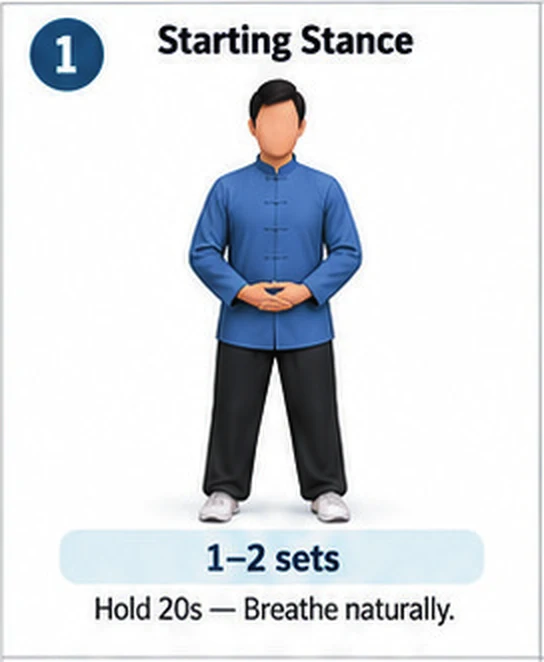
1. Starting Stance
Purpose: The Tai Chi standing posture — feet grounded, spine long, weight even — from which every hold in this set begins.
How to perform:
- Stand with feet hip-width apart, toes forward, a chair within reach.
- Soften your knees slightly and let your arms hang or rest lightly in front of you.
- Distribute your weight evenly through both feet and lengthen gently upward.
- Hold, breathing slowly, letting small adjustments happen without fighting them.
Recommended practice: 1–2 sets, holding 20 seconds.
Beginner tip: Swaying slightly is your balance system working, not failing. Aim for quiet, not frozen.
2. Weight Shift (Left & Right)
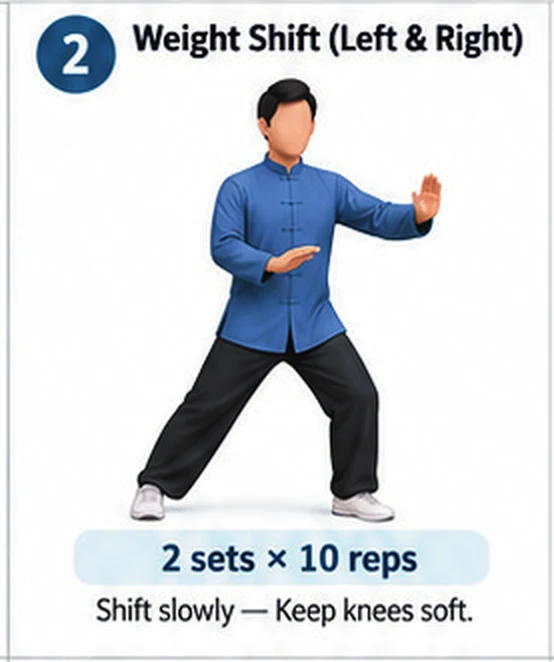
Purpose: Full, deliberate transfers of weight from foot to foot — the movement underneath every step and every other exercise in this set.
How to perform:
- Stand tall, feet hip-width apart, holding support if you wish.
- Shift slowly onto your left foot until the right foot is light enough to lift.
- Pause, then travel back through the centre to your right foot.
- Keep hips level and the pace even, like a slow tide.
Recommended practice: 2 sets of 10 shifts.
Beginner tip: Put a hand on a hip on the loaded side if it helps you confirm the weight has truly arrived.
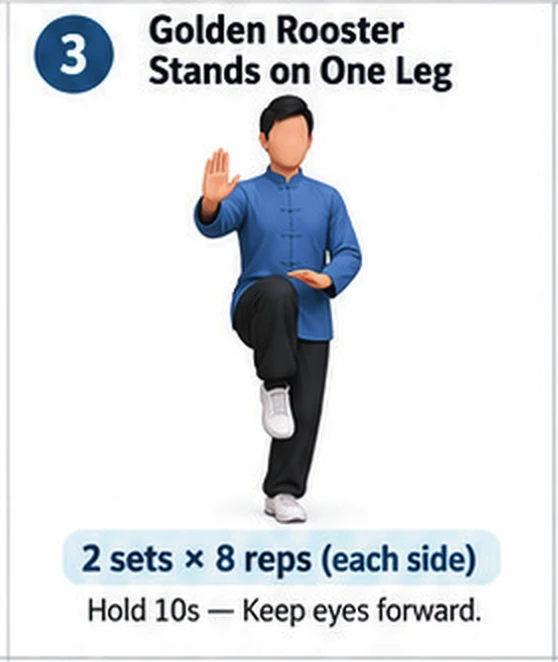
3. Golden Rooster Stands on One Leg
Purpose: The classic Tai Chi one-leg posture: one knee lifted, one palm raised, and a timed hold that trains the whole standing side.
How to perform:
- Stand behind your chair, holding the back with both hands at first.
- Shift fully onto one leg and lift the other knee a few inches.
- If steady, let the hand on the lifted side float up to chest height, palm down.
- Hold, then lower everything and change sides.
Recommended practice: 2 sets of 8, each side, holding 10 seconds.
Beginner tip: Ten seconds is the chart’s hold, not an entry requirement. Begin with both hands on the chair and whatever hold you honestly have.
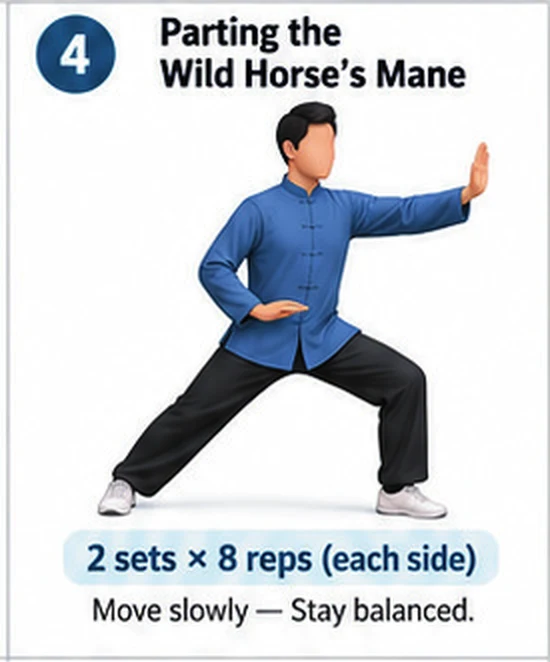
4. Parting the Wild Horse’s Mane
Purpose: A travelling step with a gentle trunk turn — balance challenged on the move, with the arms describing a slow parting motion.
How to perform:
- Stand tall beside your support and step one foot forward at a slight angle.
- Let the arm opposite the stepping foot float forward and up as the other hand settles by your hip.
- Settle your weight into the step, staying tall.
- Step back, reset, and repeat on the other side.
Recommended practice: 2 sets of 8, each side.
Beginner tip: Practise along a countertop so a hand can land on it mid-step. Confidence first, choreography second.
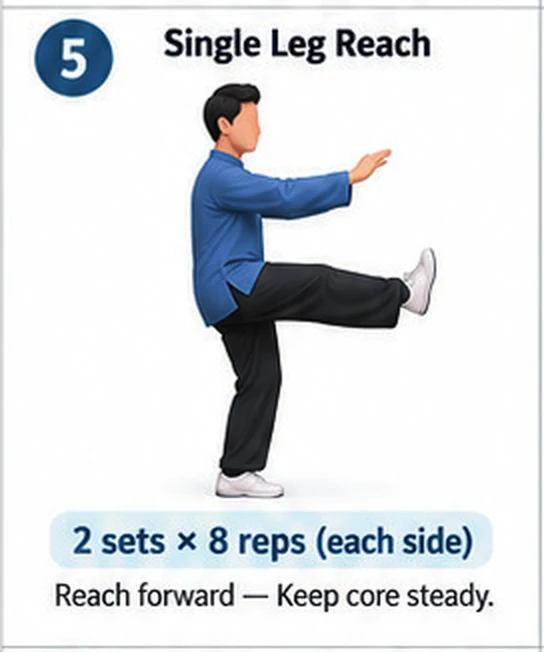
5. Single Leg Reach
Purpose: Standing on one leg while the other reaches out in front — balance tested in the direction of a step you have not yet taken.
How to perform:
- Stand behind your chair and hold on with both hands.
- Shift your weight onto one leg and reach the other foot forward, toe touching the floor.
- Hold the reach briefly, trunk tall, without leaning back.
- Bring the foot home and repeat before changing sides.
Recommended practice: 2 sets of 8, each side.
Beginner tip: The reaching toe can stay in contact with the floor the whole time. The reach is about control, not hovering.
6. Heel-to-Toe Walk
Purpose: Narrow-line walking, the purest moving-balance drill there is, done along a support you can touch throughout.
How to perform:
- Stand beside a countertop or wall, facing along it.
- Place one foot directly in front of the other, heel close to toes.
- Continue stepping in the same heel-to-toe pattern for the length of your space.
- Turn slowly at the end and walk back.
Recommended practice: 2 sets of 10 steps.
Beginner tip: Look ahead, not down at your feet. Your feet are better at this than your eyes give them credit for.

7. T-Stance Hold
Purpose: Standing with one foot directly in front of the other — the heel-to-toe position, held still — narrows your base to a line and makes your ankles work honestly.
How to perform:
- Stand beside your support and place one foot in front of the other, heel close to the toes behind it.
- Let go with one hand if you can; keep the other resting lightly on the support.
- Hold the position, weight shared between both feet, standing tall.
- Step out, rest, and repeat with the other foot in front.
Recommended practice: 2 sets, holding 15 seconds, each side.
Beginner tip: A small gap between heel and toe is a perfectly respectable T-stance. Narrow the gap over weeks, not within a session.

8. Cloud Hands
Purpose: A flowing, turning movement where the hands describe slow circles while weight travels side to side — coordination of arms, trunk and feet in one loop.
How to perform:
- Stand with feet a little wider than hip-width, knees soft.
- Shift your weight one way as both hands sweep across at waist height, one above the other.
- Turn gently from the waist as the hands change over, like passing a wide tray.
- Shift back the other way and repeat, continuous and slow.
Recommended practice: 2 sets of 10, each side.
Beginner tip: Learn the weight shift first with hands resting on your hips. Add the arms in the second week, not the second minute.

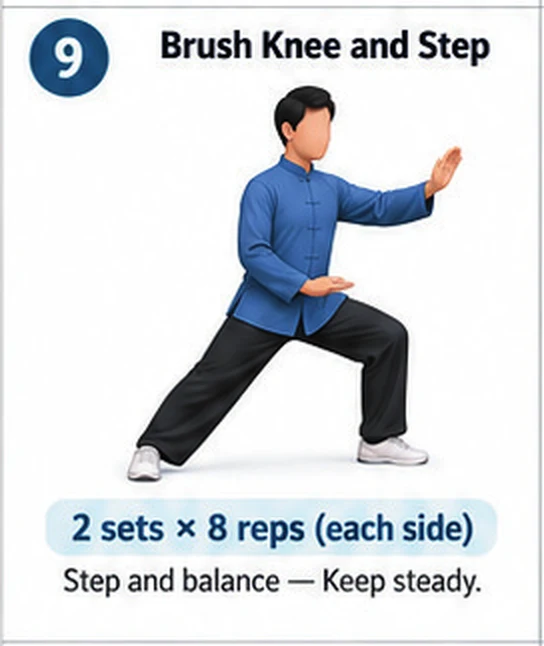
9. Brush Knee and Step
Purpose: A step forward combined with a sweeping arm and a pressing palm — stepping balance with a task attached, as real walking often has.
How to perform:
- Stand tall beside your support and step one foot forward at a comfortable length.
- Sweep the hand on the stepping side softly past your knee.
- Press the other palm gently forward at chest height as your weight settles into the step.
- Step back, reset, and repeat on the other side.
Recommended practice: 2 sets of 8, each side.
Beginner tip: Keep the step short enough that the return journey needs no lunge. If you can step back calmly, the length was right.
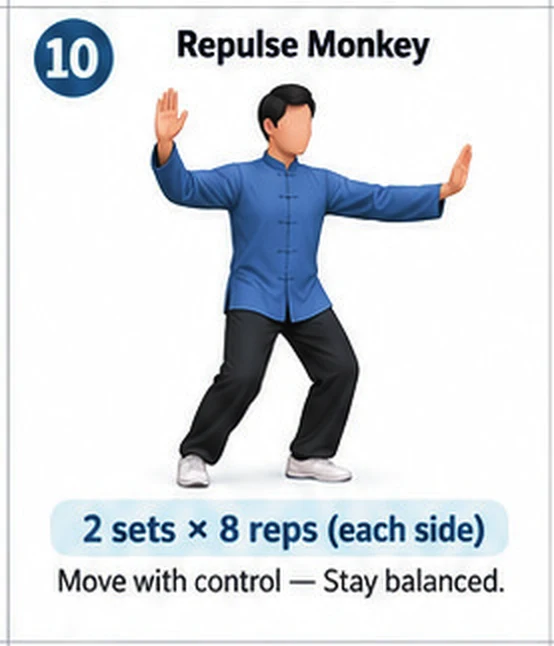
10. Repulse Monkey
Purpose: Stepping backwards — the direction nobody practises — with an arm pressing forward as you retreat. Co-ordination and rearward balance in one movement.
How to perform:
- First, check the floor behind you is clear for several steps.
- Stand tall and step one foot slowly backwards, toe landing first.
- As you step, press the opposite palm gently forward and let the other hand draw back.
- Continue stepping back in the same pattern, then walk forward normally to reset.
Recommended practice: 2 sets of 8, each side.
Beginner tip: Practise this facing a countertop you can slide a hand along. Backwards steps deserve a guide rail while you learn them.
11. Crane Spreads Wings
Purpose: A one-leg posture with the arms opened wide — one up, one down — held for time. Beautiful to look at, honest work to hold.
How to perform:
- Stand behind your chair, holding on.
- Shift onto one leg and bend the other knee, toe resting lightly near the standing ankle or just off the floor.
- Open your arms: one floats up beside your head, the other presses gently down by your hip.
- Hold, breathing slowly, then unwind and change sides.
Recommended practice: 2 sets of 8, each side, holding 10 seconds.
Beginner tip: Keep the lifted toe on the floor as a kickstand for as many weeks as you need. The pose counts — the hover is decoration.

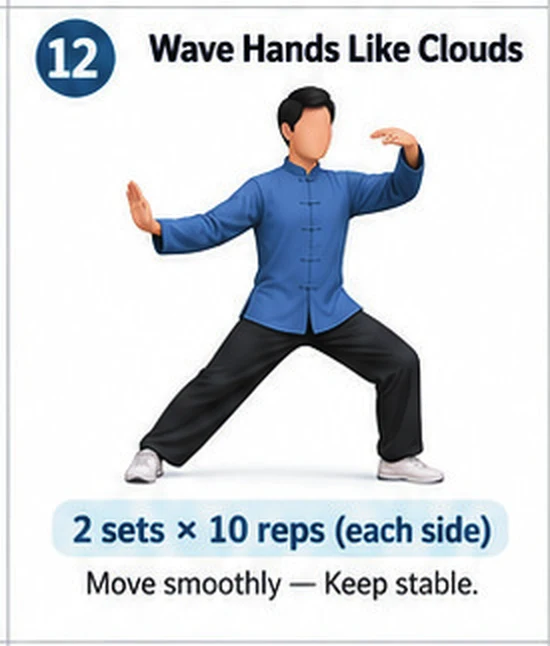
12. Wave Hands Like Clouds
Purpose: A longer, drifting version of the cloud-hands flow that travels sideways, turning the trunk and shifting weight in a continuous wave.
How to perform:
- Stand with feet shoulder-width apart, hands soft in front of your waist.
- Turn gently to one side, hands waving across as if through light cloud.
- Take a small side step as the wave travels, then continue the hands as your weight follows.
- Drift a few steps one way, then wave your way back.
Recommended practice: 2 sets of 10, each side.
Beginner tip: Small steps, slow hands. This movement should feel like wading through warm water — unhurried in every part.
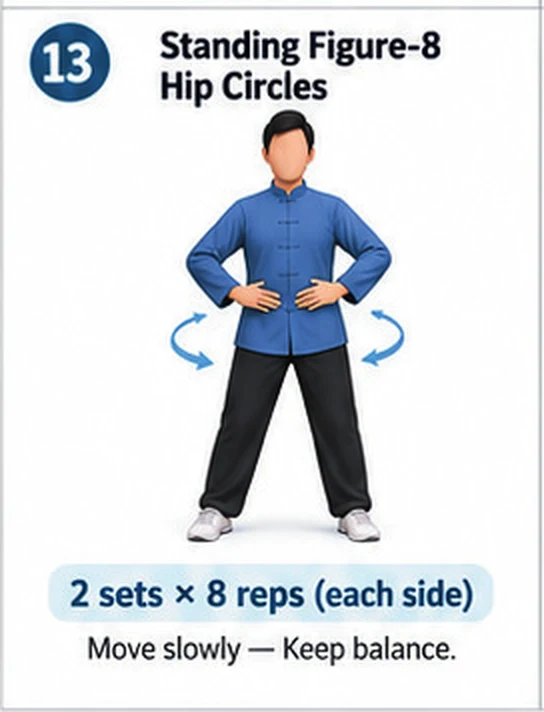
13. Standing Figure-8 Hip Circles
Purpose: Tracing a figure-8 with the hips moves your weight through every direction of your base — forward, corners, sides, back — in one continuous lesson.
How to perform:
- Stand tall, feet hip-width apart, hands on your hips or holding support lightly.
- Shift your weight in a slow circle over one foot: forward, side, back, middle.
- Continue into the mirror circle over the other foot, making a figure-8.
- Keep the loops small and the knees soft throughout.
Recommended practice: 2 sets of 8, each direction.
Beginner tip: Draw the 8 small enough that you never feel yourself tipping toward an edge. Control lives in the middle of the pattern.
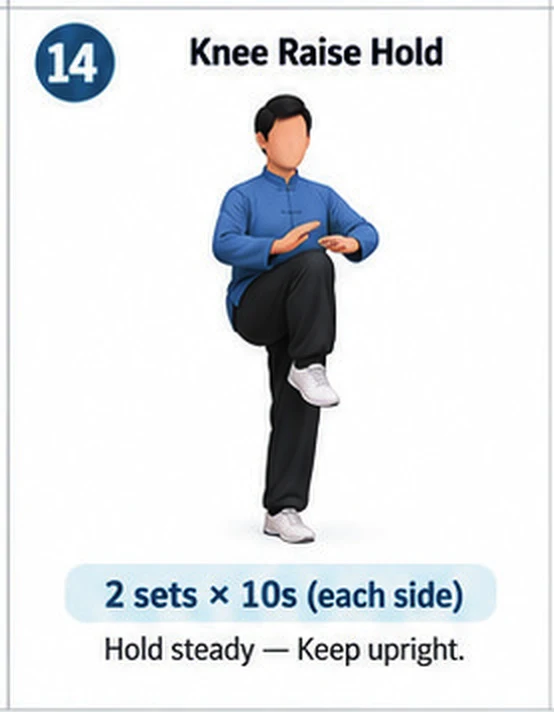
14. Knee Raise Hold
Purpose: A plain, honest hold: one knee up, trunk tall, standing leg working. No choreography to hide behind — just balance, held.
How to perform:
- Stand behind your chair and hold the back with both hands.
- Shift your weight fully onto one leg and lift the other knee to a comfortable height.
- Hold, keeping your trunk upright and your gaze forward.
- Lower slowly and repeat on the other side.
Recommended practice: 2 sets, holding 10 seconds, each side.
Beginner tip: Count your out-breaths instead of seconds. Two slow breaths is a fine hold to begin with.
15. Side Leg Lift
Purpose: Lifting the leg sideways strengthens the outer hip of the moving leg and the whole standing side — the muscles of corridors, kerbs and getting out of cars.
How to perform:
- Stand behind your chair, holding on with both hands, feet together.
- Shift your weight onto one leg and lift the other out to the side, toe pointing forward.
- Lift only as high as you can without leaning away.
- Lower slowly and repeat before changing sides.
Recommended practice: 2 sets of 8, each side.
Beginner tip: If your trunk leans, the lift is too high. A low lift with a tall trunk is the correct exercise.

16. Closing Stance
Purpose: The set ends as it began — standing still and tall — so your nervous system records calm standing as the final word of the session.
How to perform:
- Stand with feet hip-width apart, arms resting quietly.
- Soften your knees, lengthen your spine, and breathe slowly.
- Notice your weight through your feet and let the small sways settle.
- Hold until your breathing is back to resting pace before walking away.
Recommended practice: 1–2 sets, holding 20 seconds.
Beginner tip: If the room feels like it is still moving when you finish, sit for a minute. Ending steady matters more than ending quickly.

A simple 15-minute practice
| Time | What to do |
|---|---|
| Minutes 0–3 | Starting Stance, then Weight Shifts |
| Minutes 3–7 | Golden Rooster, T-Stance Hold, and Knee Raise Hold, alternating sides |
| Minutes 7–11 | Heel-to-Toe Walk, Brush Knee and Step, and Cloud Hands |
| Minutes 11–15 | Figure-8 Hip Circles, Side Leg Lifts, then the Closing Stance |
Practise these senior balance exercises two or three times a week. Track one hold — most people pick Golden Rooster — and note your honest seconds; watching that number creep up over a month is quietly satisfying.
Get the printable chart
All 16 movements come from our Tai Chi Exercises for Balance Printable PDF Chart — one page with each movement illustrated, its instructions, repetitions and hold times, so you can keep it beside your practice chair and work through the set without a screen. As with all balance practice: the chart gives you a structured way to practise; it cannot promise to prevent falls.
Frequently asked questions
1. How is this different from a beginner balance routine?
Depth. A starter routine covers the basics — weight shifts, sit-to-stand, short supported stands. This set adds timed holds up to 20 seconds, travelling Tai Chi forms, backward stepping and hip circles: the same skills, asked at a higher level. Start with the basics if any of those sound ambitious today.
2. My holds are much shorter than the chart’s times. Am I doing it wrong?
No — the chart times are where the practice leads, not where it starts. A four-second hold done with control is correct training. Add a second when four becomes steady; that is literally how the progression is supposed to work.
3. Can I skip the travelling movements and just do the holds?
You can, and on tired days that is a sensible session. Over a week, though, aim to include the stepping forms too — balance while moving is the skill daily life asks for most — which is why the best exercises for balance train stepping and turning, not just standing still.
4. What should I do if a movement makes me grab the chair hard?
That movement is telling you its current limit. Make it smaller — shorter hold, toe kept down, both hands on the chair — and practise at that level. Grabbing is information, not failure.
5. How often should I practise this set?
Two or three sessions a week is a good rhythm, with walking or gentle movement on the other days. Balance responds to regular practice far more than to long occasional sessions.
6. Do I need any equipment?
Nothing beyond a sturdy chair or countertop for support, flat non-slip shoes and a clear patch of floor. The whole set is designed to be practised at home with what you already have.
Final thoughts
Sixteen movements, most of them centuries old, arranged to teach one modern skill: trusting yourself on your own two feet. The holds will lengthen. The steps will steady. None of it happens in a week, and all of it happens by practising a little, often, beside a chair.
Pick the movements that feel within reach today, keep your support close, and let the timed holds grow in their own time.
Safety note: This article is general educational information, not medical advice. Balance practice cannot guarantee protection against falls. Stop any exercise that causes pain, and stop if you feel dizzy. Check with your doctor before starting if you have a history of falls, dizziness, or a condition affecting your balance.