
The first few minutes of the day tell you a lot. Neck stiff from the pillow. Shoulders up near your ears. A back that takes three attempts to straighten properly. Stretching exercises for seniors exist for exactly that hour — a slow, standing routine that works from the neck down to the calves and puts the whole body back in working order.
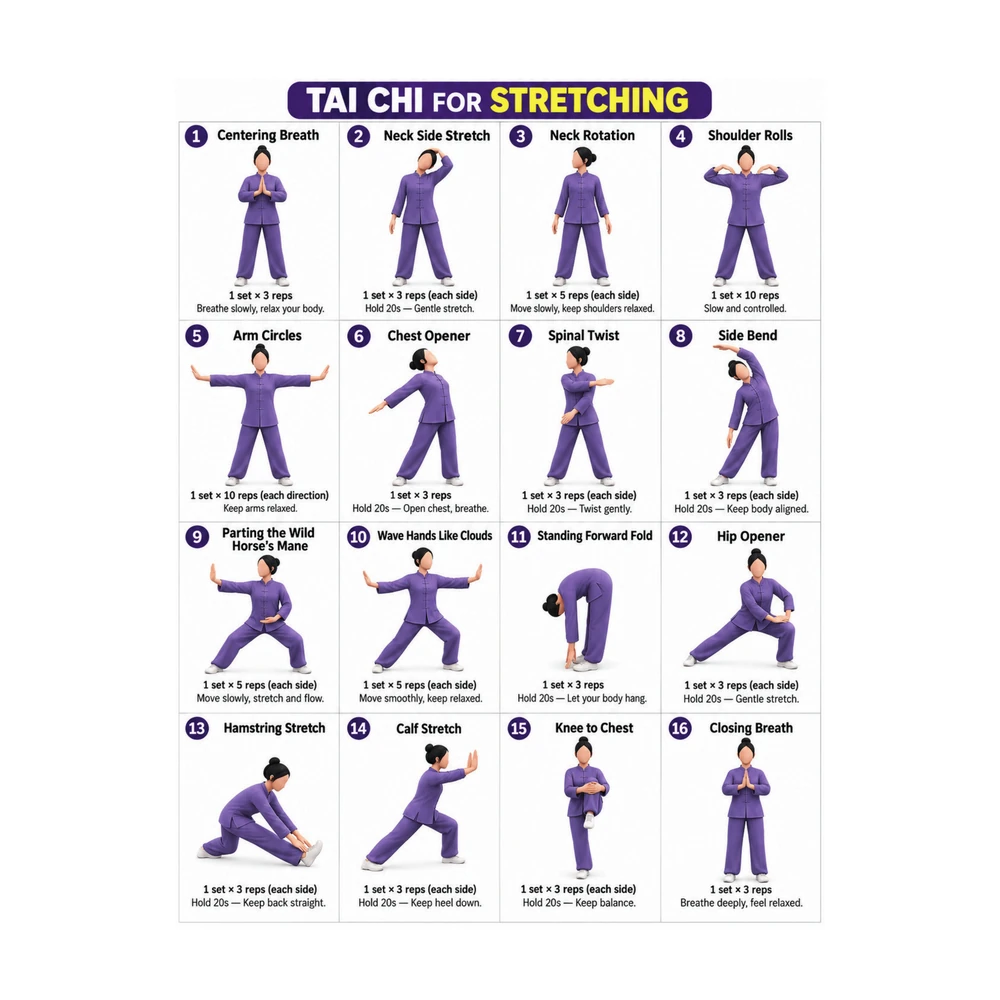
This stretching routine has 16 gentle Tai Chi stretches. It follows the body in order: neck, shoulders, arms and chest first; spine and waist in the middle; hips, hamstrings, calves and knees to close. Each movement is done once through (what the chart calls 1 set), with the held stretches kept for 20 seconds each. The full session takes about twelve minutes and leaves no part of you unvisited.
It is a standing routine from start to finish — no mat, no floor, no special clothes. A chair beside you for the one-leg and bending moments, and you are ready.
A whole-body stretch, in the order your body wakes up
Many stretching routines jump around: a leg here, a shoulder there. This one is deliberate about sequence. It begins with breathing and the neck, because those are where morning stiffness speaks loudest, then descends joint by joint, so nothing gets stretched cold that should have been warmed first.
The Tai Chi movements in the middle — Parting the Wild Horse’s Mane and Wave Hands Like Clouds — are there as moving stretches: they keep blood flowing and the spine turning gently between the held positions, so the held stretches that follow (forward fold, hip opener, hamstring and calf) arrive at muscles that are ready for them.
Held stretches in this routine follow one rule: 20 seconds, breathing normally, at a point of gentle pull. If you remember nothing else about stretching technique, remember that one. Depth is not the point — stillness at a comfortable length is.
6 benefits of a daily stretching routine
1. It answers morning stiffness directly
Neck, shoulders, spine, hips, knees — the routine visits them in the order they usually complain, with gentle movement before any real stretch is asked of them.
2. One pass covers the whole body
Sixteen movements, one set each. There is no wondering whether you forgot the calves; the chart’s order is the checklist, and finishing it takes about twelve minutes.
3. Standing stretches are easier to keep up
No floor work removes the biggest practical objection many people have to stretching routines. If you can stand beside a chair, you can do this entire session.
4. Breathing bookends the session
The routine opens with a Centering Breath and closes with a Closing Breath. Starting and ending slowly is not decoration — it is what turns twelve minutes of stretching into a settled daily ritual.
5. It loosens you for the rest of the day’s movement
A stretched body walks, gardens and climbs stairs more comfortably. Many people do this routine as the warm-up to everything else the day holds.
6. It needs almost nothing
Flat shoes, a clear patch of floor, a chair within reach. Stretching is the lowest-equipment exercise there is, and this set keeps it that way.
Before you start: safety first
- Stretch to a gentle pull, never to pain. If a position hurts sharply, pinches, or sends anything tingling down an arm or leg, come out of it.
- Never bounce into a stretch. Arrive slowly, hold still, breathe, and leave slowly.
- Hold your chair for the knee-to-chest and balance-adjacent movements, and for the forward fold if you are prone to light-headedness. Rise from bending slowly, in stages.
- Neck movements stay small and slow. If neck rotation makes you dizzy, keep the turns tiny or skip them and mention it to your doctor.
- Warm up first if you have just got out of bed: a minute of walking around the room, or the routine’s own breathing and shoulder movements done gently, before the held stretches.
- If you have osteoporosis, recent fractures, joint replacements or spinal conditions, check which stretches suit you with your clinician first.
- This article is general educational information, not medical advice.
Stretching exercises for seniors: the 16 stretches
Work down the body in the chart’s order. Repetitions below are the chart’s own — mostly a single set, with holds of 20 seconds where the movement is a stretch.
1. Centering Breath
Purpose: A breathing opener that settles your posture and gives stiff joints a moment of warmth before anything stretches.
How to perform:
- Stand tall, feet hip-width apart, hands resting in front of you.
- Breathe in slowly as your hands float up to chest height.
- Breathe out as they press gently back down.
- Let your shoulders drop lower with each out-breath.
Recommended practice: 1 set of 3 breaths.
Beginner tip: If you have just woken up, do this twice through. Cold joints appreciate a longer hello.

2. Neck Side Stretch
Purpose: Tilting the ear toward the shoulder lengthens the side of the neck — the classic site of pillow stiffness.
How to perform:
- Stand tall with your shoulders down and arms relaxed.
- Tilt your head slowly to one side, ear toward shoulder, without turning your face.
- Let the opposite shoulder sink a little further as the stretch settles.
- Hold, then return to centre and tilt the other way.
Recommended practice: 1 set of 3, each side, holding 20 seconds.
Beginner tip: The tilt is small — a few degrees is a real stretch for a stiff neck. Never pull your head down with a hand.

3. Neck Rotation
Purpose: Slow turns of the head keep the looking-over-your-shoulder range that driving, crossing roads and conversation all depend on.
How to perform:
- Stand tall and soften your shoulders.
- Turn your head slowly to look over one shoulder, as far as is comfortable.
- Pause there, then return through the centre.
- Turn to the other side with the same slowness.
Recommended practice: 1 set of 5, each side.
Beginner tip: Keep your chin level, as if your head were sliding on a shelf. If turning brings dizziness, make it smaller or skip it.

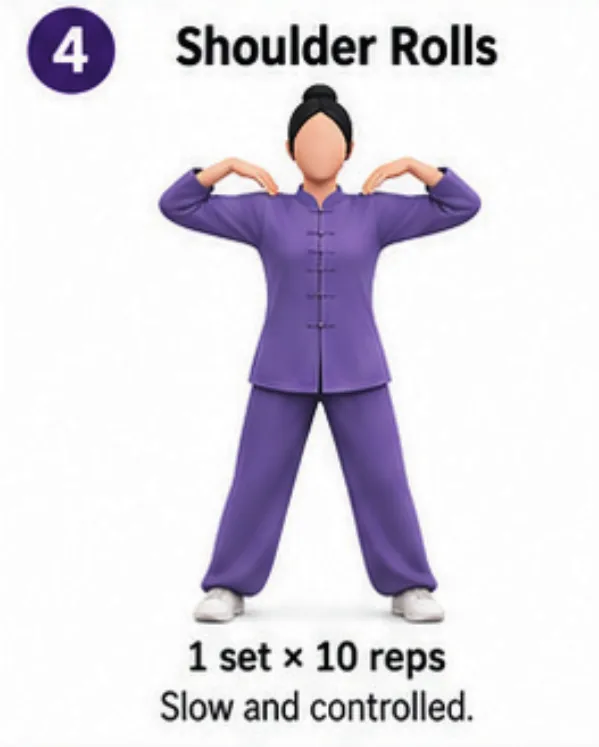
4. Shoulder Rolls
Purpose: Rolling the shoulders wakes up the whole shoulder girdle and melts the shrugged-up posture of sleep and sitting.
How to perform:
- Stand tall with arms hanging loose.
- Lift both shoulders toward your ears.
- Roll them back and let them drop in a slow circle.
- Continue, then reverse the direction for the second half.
Recommended practice: 1 set of 10 rolls.
Beginner tip: Exaggerate the drop, not the lift. Shoulders live too high already; the roll teaches them the way down.
5. Arm Circles
Purpose: Circles take the shoulders through their full circle of range, warming the joint in every direction it owns.
How to perform:
- Hold both arms out to your sides at a comfortable height.
- Draw small circles, growing gradually larger.
- Circle in one direction, then reverse and circle back.
- Lower your arms and shake them gently loose at the end.
Recommended practice: 1 set of 10, each direction.
Beginner tip: Start tiny — circles the size of a coin — and only grow them while they stay comfortable and controlled.

6. Chest Opener
Purpose: Opens the front of the chest and shoulders, undoing the rounded-forward shape of desks, driving and reading.
How to perform:
- Stand tall and bring your hands together loosely behind your back, or hold the back of your chair.
- Gently straighten your arms as you lift your chest.
- Let your shoulder blades draw a little closer together.
- Hold, breathing into the open chest, then release.
Recommended practice: 1 set of 3, holding 20 seconds.
Beginner tip: If hands-behind-back is out of reach, hold a towel between your hands instead — same stretch, longer arms.

7. Spinal Twist
Purpose: A gentle standing rotation for the whole trunk — the turning range that reaching into cupboards and checking blind spots depends on.
How to perform:
- Stand tall, feet hip-width apart, arms folded loosely in front of your chest.
- Turn your chest and head slowly to one side, hips staying forward.
- Settle at the comfortable end of the turn and hold.
- Return to centre, then twist to the other side.
Recommended practice: 1 set of 3, each side, holding 20 seconds.
Beginner tip: Let your eyes lead. If twists are on a clinician’s avoid-list for you, leave this one out entirely.

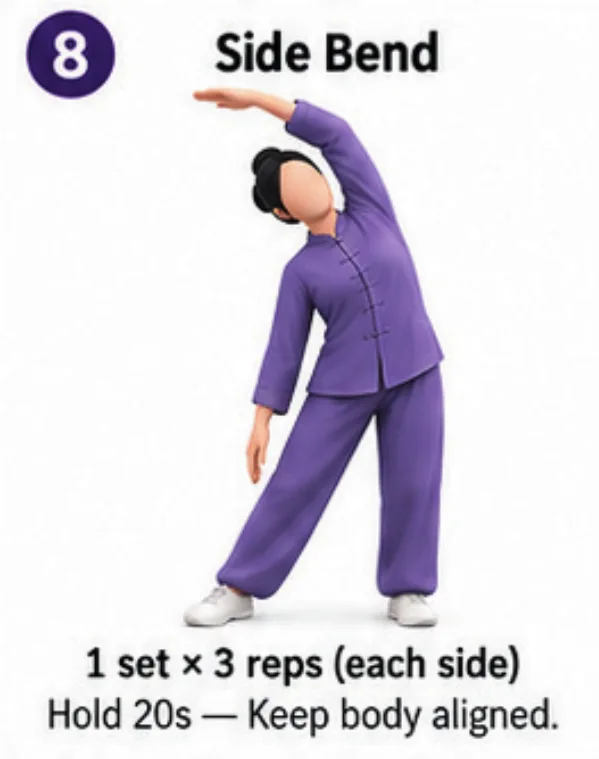
8. Side Bend
Purpose: Lengthens the waist and the side of the ribs, the direction of bending that pure forward-fold routines forget.
How to perform:
- Stand tall with one hand resting on your thigh.
- Slide that hand a short way down your leg as you bend gently sideways.
- Let the opposite arm float up if it feels natural.
- Hold, then use the waist muscles to stand tall again, and change sides.
Recommended practice: 1 set of 3, each side, holding 20 seconds.
Beginner tip: Bend sideways only — imagine sliding between two panes of glass so you cannot tip forward or back.
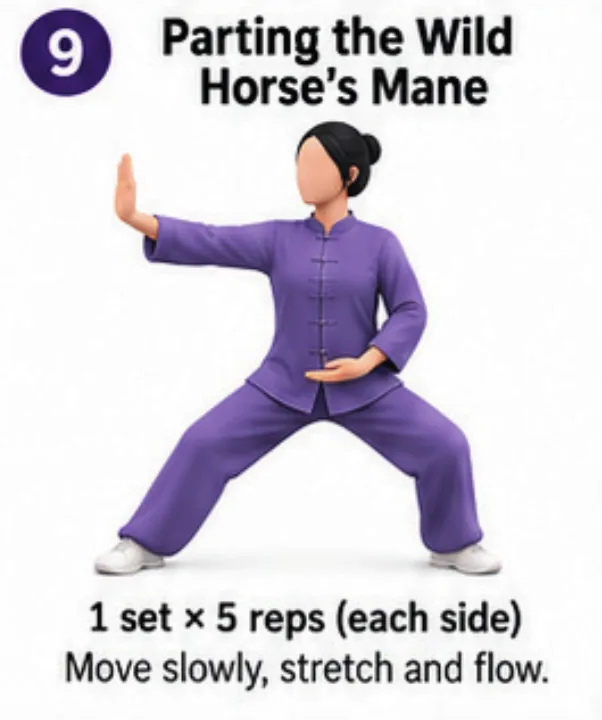
9. Parting the Wild Horse’s Mane
Purpose: A moving stretch: stepping and turning lengthens the front of the hip and side of the trunk in a slow, flowing way between held positions.
How to perform:
- Step one foot forward at a slight angle, beside support if you like.
- Float the opposite arm forward and up while the other hand lowers by your hip.
- Settle into the shape, feeling a mild stretch through the back leg’s front hip.
- Step back, reset, and repeat on the other side.
Recommended practice: 1 set of 5, each side.
Beginner tip: A slightly longer step deepens the front-hip stretch. Keep it comfortable — depth is earned over weeks.
10. Wave Hands Like Clouds
Purpose: A drifting side-to-side flow that keeps the waist and shoulders mobile while your breathing settles before the standing leg stretches.
How to perform:
- Stand with feet shoulder-width apart, hands soft at waist height.
- Sweep both hands across to one side as your weight shifts with them.
- Turn gently from the waist as the hands change over.
- Travel back the other way, continuous and unhurried.
Recommended practice: 1 set of 5, each side.
Beginner tip: Let this one feel like a pause that moves. If your shoulders creep up, drop them on the next crossing.

11. Standing Forward Fold
Purpose: A gentle fold from the hips that stretches the whole back of the body — calves, hamstrings and lower back in one line.
How to perform:
- Stand tall with feet hip-width apart, hands resting on a chair seat or your thighs if you prefer support.
- Hinge from the hips and lean forward only as far as comfortable, knees softly bent.
- Let your head and arms hang heavy, or rest your hands on your thighs.
- Hold, then bend your knees a little more and roll or walk yourself slowly back up.
Recommended practice: 1 set of 3, holding 20 seconds.
Beginner tip: Rise in stages and pause halfway if you feel light-headed. There is no prize for folding deepest; comfort is the entire metric.

12. Hip Opener
Purpose: A stepping, turning-out posture that opens the hip joint into its external rotation — the range car doors and bath edges ask for.
How to perform:
- Stand beside your chair and step one foot forward.
- Turn that foot’s toes slightly outward and settle a little weight into it, feeling the hip open.
- Rest your hands lightly in front of you or on the chair.
- Hold, then step back and change sides.
Recommended practice: 1 set of 3, each side, holding 20 seconds.
Beginner tip: Small turn-out, comfortable opening. If you have had a hip replacement, follow your surgeon’s rotation restrictions or skip this one.

13. Hamstring Stretch
Purpose: The classic heel-forward stretch for the back of the thigh — the tightness that pulls on the lower back when you bend.
How to perform:
- Stand tall beside support and place one heel a short step ahead, toes pointing up.
- Hinge gently from the hips toward that leg, back long, standing knee soft.
- Stop where the back of the thigh asks you to — a moderate pull is plenty.
- Hold, then rise and change legs.
Recommended practice: 1 set of 3, each side, holding 20 seconds.
Beginner tip: Shorten the step to make it gentler. Your hands can rest on the front thigh for support and for measuring your depth honestly.

14. Calf Stretch
Purpose: One leg back and heel down lengthens the calf and Achilles area — the spring of every step and the joint that complains on stairs.
How to perform:
- Face a wall or the back of your chair and rest both hands on it.
- Step one foot back with the leg straight and the heel pressing toward the floor.
- Bend the front knee slightly until the back calf stretches.
- Hold with the heel down, then change legs.
Recommended practice: 1 set of 3, each side, holding 20 seconds.
Beginner tip: If the heel lifts, step the foot closer. Heel down, stretch gentle — that order never changes.

15. Knee to Chest
Purpose: Drawing one knee up loosens the hip and the lower back together — the standing, chair-supported answer to a classic floor stretch.
How to perform:
- Stand behind your chair and hold the back with both hands.
- Lift one knee up toward your chest as far as comfortable, or lift it part-way and support the thigh with one hand if you are steady.
- Stand tall on the supporting leg — no leaning away.
- Hold, lower slowly, and change legs.
Recommended practice: 1 set of 3, each side, holding 20 seconds.
Beginner tip: A lower lift held tall is the right stretch. If holding the thigh unsettles your balance, keep both hands on the chair and let height wait.

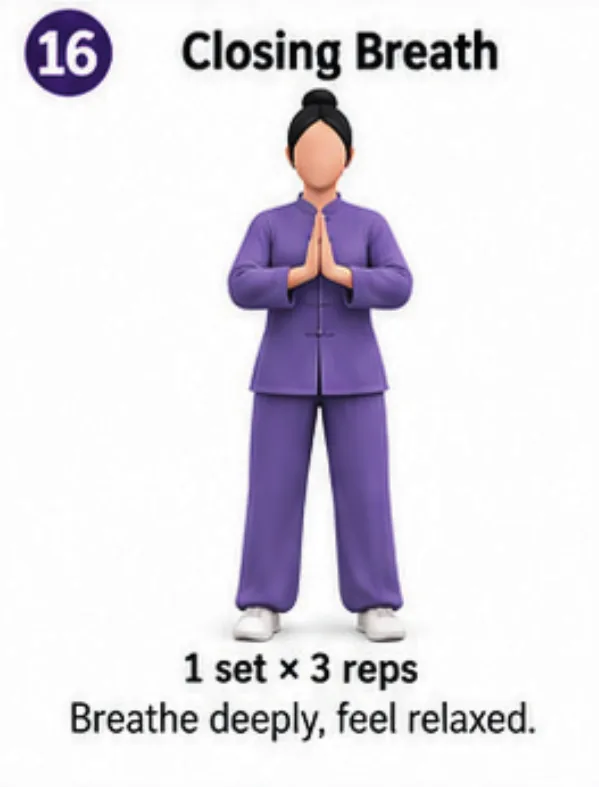
16. Closing Breath
Purpose: Three slow breaths that mirror the opener and mark the session finished — body stretched, breathing calm, day properly begun.
How to perform:
- Stand tall with feet together or hip-width apart.
- Breathe in as your hands float up in front of you.
- Breathe out as they press gently down.
- Finish standing quietly for a breath or two before you walk away.
Recommended practice: 1 set of 3 breaths.
Beginner tip: Take a moment to notice which joints feel different from twelve minutes ago. That noticing is how a routine becomes a habit worth keeping.
A simple 12-minute daily practice
The routine is already designed as a single pass — the table is simply the map of it:
| Time | What to do |
|---|---|
| Minutes 0–3 | Centering Breath, Neck Side Stretch, Neck Rotation, Shoulder Rolls |
| Minutes 3–6 | Arm Circles, Chest Opener, Spinal Twist, Side Bend |
| Minutes 6–10 | Parting the Wild Horse’s Mane, Wave Hands, Forward Fold, Hip Opener |
| Minutes 10–12 | Hamstring Stretch, Calf Stretch, Knee to Chest, Closing Breath |
Done daily, twelve minutes is the whole investment. On days when time is gone, do the first and last rows only — neck, shoulders, twist, and the breaths — and count it kept.
Get the printable chart
All 16 stretches come from our Tai Chi Stretching Exercises Printable PDF Chart — one page with every movement illustrated, in the neck-to-calf order, with its repetitions and 20-second holds, so this stretching routine can live on the wall instead of on a screen.
Frequently asked questions
1. How long should seniors hold a stretch?
Twenty seconds per stretch is the rule this chart uses, and it suits gentle maintenance work well: long enough for the muscle to release into the position, short enough to keep a full routine near twelve minutes. Breathe normally throughout rather than counting breathlessly.
2. Is it better to stretch in the morning or evening?
Both work, for different reasons. Morning stretching answers overnight stiffness and sets the day up; evening stretching suits warmer muscles and can be a touch deeper. The better time is the one you will actually keep — pick it and be consistent for a month.
3. Should stretching hurt a little?
No. A stretch should feel like a broad, gentle pull that eases as you hold it. Sharp, pinching, tingling or joint-localised pain is a stop signal — come out of the position and use a smaller version next time, or have it assessed if it persists.
4. Can I do these stretches every day?
Yes — this is a gentle routine designed for daily use, with a single set of each movement. If a particular area feels worked or tender from yesterday, give that stretch a rest day and do the rest of the sequence.
5. What is the difference between this and a flexibility routine?
Emphasis. This set is a whole-body daily stretch with a one-set rhythm and a strong breathing frame. A flexibility routine works fewer areas more deeply, with every stretch held and repeated. Many people use this one daily and a flexibility session two or three times a week.
6. Do I need a mat or any equipment?
No mat — every movement is standing. You need flat shoes, a clear space and a chair or wall within reach for the balance moments. That is the complete list.
Final thoughts
Sixteen stretches, head to heel, twelve minutes, once a day. Stretching exercises for seniors do not ask for athletic ambition; they ask for regularity, and they repay it in the small currencies of daily life — turning to check the road, reaching the top shelf, first steps that feel like your own again.
Start tomorrow morning. Centre your breath, be kind to your neck, and work your way down. Your calves get the last stretch, and the closing breath gets the final word.
Safety note: This article is general educational information, not medical advice. Stretch only to a gentle pull, never pain; rise slowly from bending; and check with your doctor or physiotherapist first if you have osteoporosis, joint replacements or a spinal condition.