
Rain again. Or ice on the pavement, or a heatwave, or simply a day when going out feels like more than you want to manage. Tai chi indoor walking is the answer a lot of seniors quietly arrive at on their own: take the walking practice inside, slow it down, and let a hallway or a clear stretch of living room become the path.
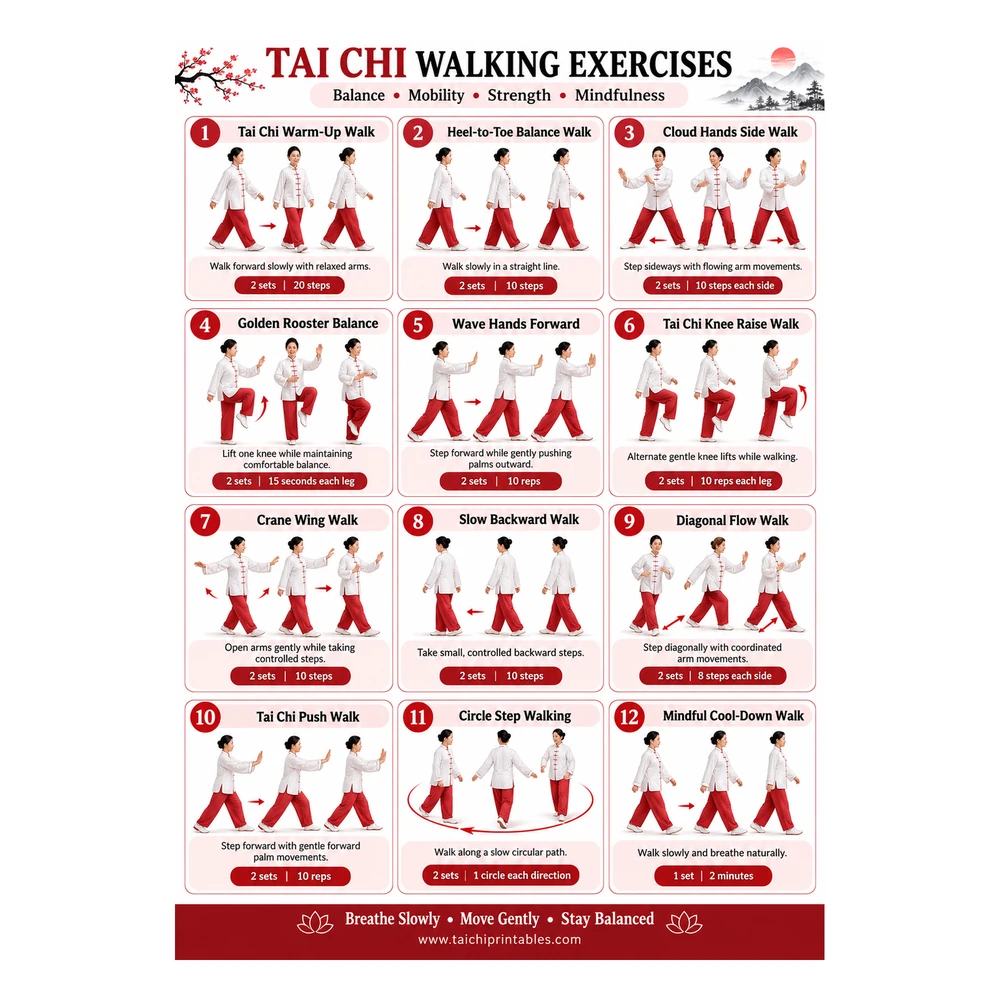
It works because Tai Chi walking was never really about distance. It is about how each step is taken — heel landing softly, weight rolling forward, arms moving with the legs, attention on the ground beneath you. Those qualities need about six to ten paces of clear floor, not a park. The 12 movements below are a complete indoor practice: warm-up, balance walks, flowing walks, turns, a backward walk, and a cool-down, all designed to turn around in a small space.
If you want the full story of the movements themselves — their benefits, variations and the complete technique guide — our main Tai Chi Walking Exercises article covers the same 12 movements in depth. This article is its indoor companion: how to set up the space, adapt each walk to short distances, and build an indoor routine you will actually keep through a long winter.
How much space do you actually need?
So what is tai chi indoor walking, in practice? It needs less space than you think. A clear run of roughly 3 to 4 metres — a hallway, the length of a living room with the coffee table pushed aside — handles every movement in this set. The walks are written in sets of 10 or 20 steps; indoors, you simply walk your available length, turn slowly, and continue until the count is done. Tai Chi has always turned: the Circle Step Walking movement in this very set is built entirely around turning.
A few space notes that make indoor practice pleasant rather than cramped:
- Pick a route with a support line — a wall, a counter, a row of chair backs — along one side, especially for the balance walks.
- Clear the route honestly: shoes, bags, pet bowls and trailing cables move out for the session, not just in theory.
- Hard floors and low-pile carpet both work. Deep-pile rugs do not — they catch toes. If your only space is carpeted, wear firm, flat shoes and shorten your steps.
- Light matters. Practise in a well-lit room; balance is partly a visual skill.
- Keep a sturdy chair at one end of the route as your rest station and your support for the Golden Rooster balance.
6 benefits of walking the Tai Chi way, indoors
1. The weather leaves the decision
No ice, no downpour, no heat advisory to negotiate with. When the walk is indoors, the question is never whether to practise — only when in the day it fits.
2. Support is always within reach
Walls, counters and chair backs run the length of most indoor routes. For the balance movements in particular, practising a hand’s breadth from support changes everything about confidence.
3. Short spaces force good technique
Turning every few steps is not a compromise — it is extra practice. Each turn is a small balance exercise of its own, and indoor Tai Chi walkers get far more of them per session than pavement walkers do.
4. It fits inside ordinary life
Ten minutes while the kettle boils and lunch cooks. A hallway walked slowly five times is a real practice, and real practice — little and often — is what keeps legs and balance honest.
5. No special anything
No treadmill, no gym, no travel, no membership. Flat shoes and a clear floor. The barrier to starting is as low as exercise gets.
6. It pairs with a longer programme when you want one
Many people use these 12 movements as the daily content of a structured walking plan, practising indoors on wet days and outside on fine ones — the same steps, two settings, one habit.
Before you start: safety first
- Walk your route once at normal pace before starting, checking for anything at ankle height you might have missed.
- Wear flat, non-slip shoes indoors too. Socks on hard floors are a genuine slipping risk, and loose slippers are little better.
- Keep support within reach for the balance and backward movements: a wall to trail a hand along, a chair at the end of the route.
- Never walk backwards without first checking the space behind you is clear — every single time, not just the first.
- Turn slowly, in small steps. Quick pivots on one foot are how indoor falls happen.
- Stop if you feel dizzy and sit down. Keep a chair on your route for exactly this.
- This article is general educational information, not medical advice. Check with your doctor before starting if you have a balance condition or a history of falls.
Tai chi indoor walking: the 12 movements
Follow them in the chart’s order. Indoor adaptation is simple: walk the length you have, turn slowly, and continue until you reach the chart’s step count for that movement.
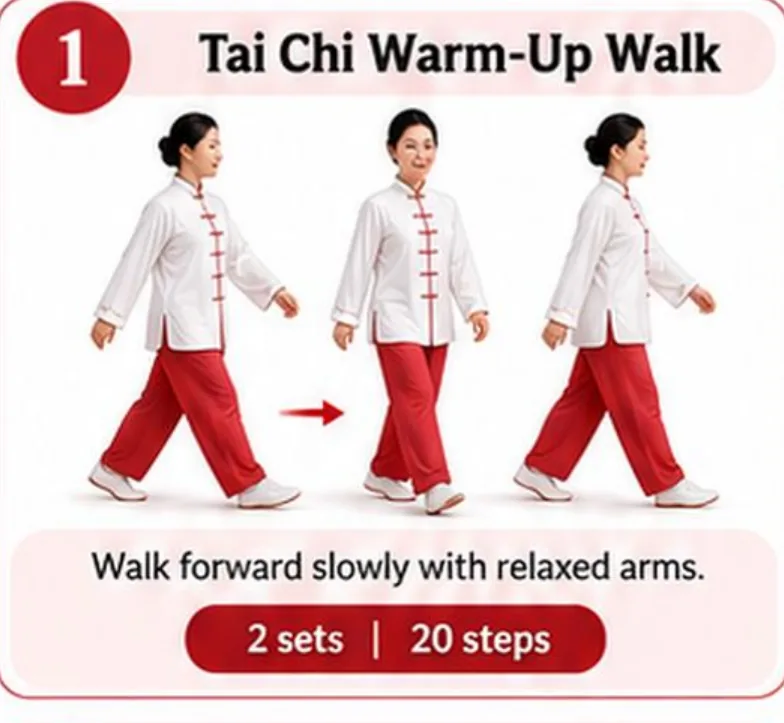
1. Tai Chi Warm-Up Walk
Purpose: An easy opening walk that wakes up the legs and settles your breathing before the balance work begins.
How to perform:
- Walk slowly along your route with soft knees and relaxed arms.
- Land each heel gently and roll through the foot.
- Let your arms swing naturally, opposite to the legs.
- Turn slowly at the end of the room and walk back.
Recommended practice: 2 sets of 20 steps.
Beginner tip: This walk should feel easier than your normal walking pace, not harder. Slow everything down by half.
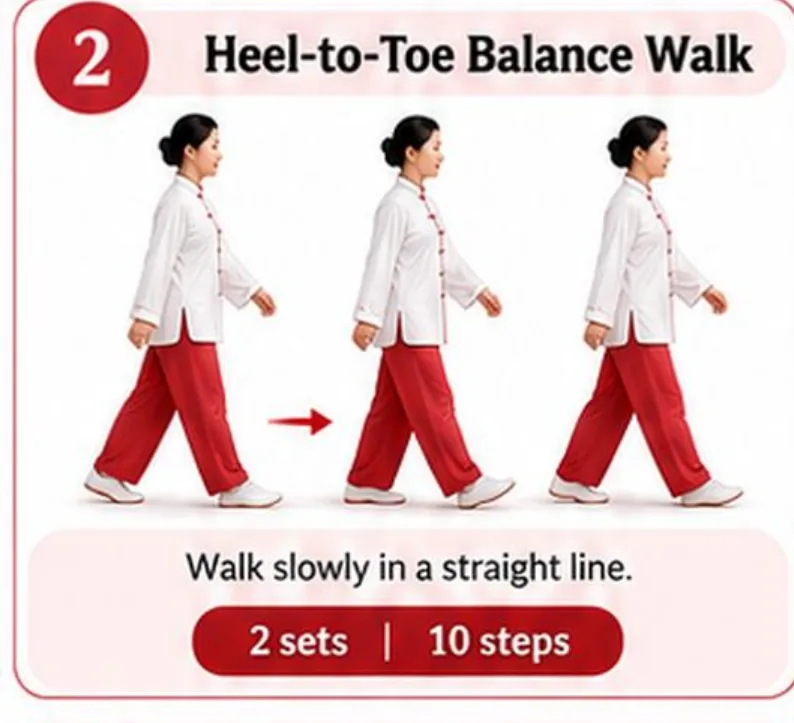
2. Heel-to-Toe Balance Walk
Purpose: The narrow-line walk that anchors the balance part of the session — placed indoors, ideally along a counter or wall.
How to perform:
- Stand beside your support and place one foot directly in front of the other, heel close to toes.
- Step forward in the same heel-to-toe pattern, hand trailing along the support if you wish.
- Walk your room’s length, turn slowly, and walk back.
- Keep your gaze ahead rather than down at your feet.
Recommended practice: 2 sets of 10 steps.
Beginner tip: A hallway is the perfect theatre for this one — a wall on one side and a doorframe procession to count your progress by.
3. Cloud Hands Side Walk
Purpose: Sideways travel with flowing arms — the movement that teaches crab-wise stepping along counters and through narrow gaps.
How to perform:
- Stand sideways along your route, knees soft, hands in front of your waist.
- Step one foot out to the side as both hands sweep across that way.
- Bring the other foot to meet it as the hands change over.
- Travel the length of the room, then lead with the other foot on the way back.
Recommended practice: 2 sets of 10 steps, each side.
Beginner tip: Small steps keep this smooth. The arms should feel like they are smoothing a tablecloth as you travel.

4. Golden Rooster Balance
Purpose: A standing balance pause between walks: one leg lifted, a counted hold, done at your rest-station chair.
How to perform:
- Stand behind your chair, holding the back with both hands.
- Shift your weight onto one leg and lift the other knee a few inches.
- Hold, standing tall, breathing slowly.
- Lower, rest, and repeat on the other leg.
Recommended practice: 2 sets, holding 15 seconds, each leg.
Beginner tip: If 15 seconds feels long today, hold for as long as is steady. The chart’s time is the destination, not the entry fee.

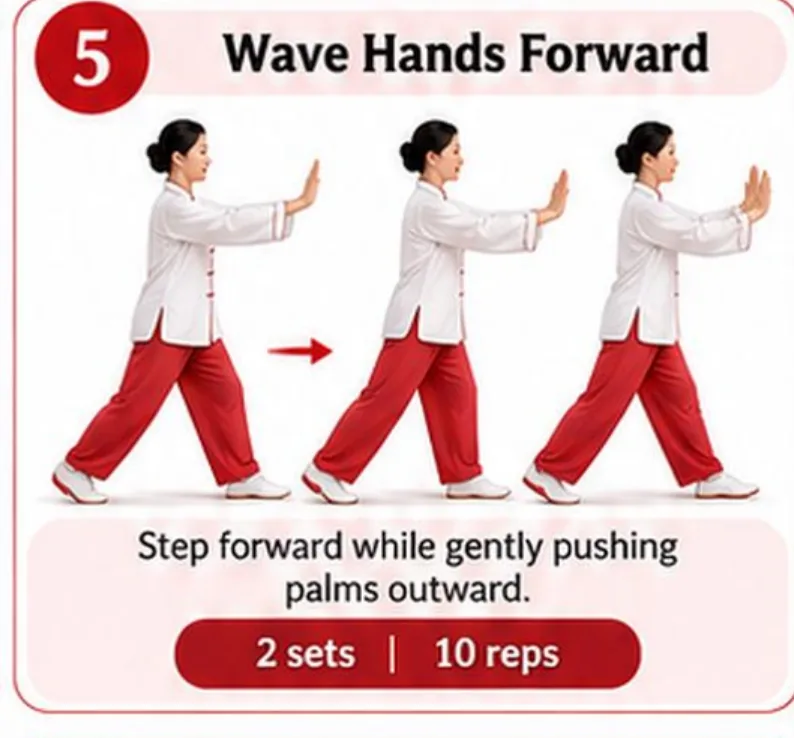
5. Wave Hands Forward
Purpose: Walking forward while the hands wave in slow alternation — coordination of arms and legs at an easy pace.
How to perform:
- Walk slowly forward with soft, rolling steps.
- Let one hand float forward and up as the other sinks, in time with your steps.
- Keep the hands relaxed, as if waving through soft water.
- Turn at the end of the room and continue the pattern back.
Recommended practice: 2 sets of 10 movements.
Beginner tip: Coordinate later — walk first, add the hands when the feet feel settled. Nobody’s first attempt matches hands to steps, indoors or out.
6. Tai Chi Knee Raise Walk
Purpose: A marching-style walk with a deliberate knee lift in each step — leg strength and one-leg balance in motion.
How to perform:
- Walk slowly along your route, beside support if you wish.
- With each step, lift the knee a few inches higher than a normal step before setting the foot down.
- Stay tall; let the lift come from the hip, not from leaning back.
- Turn slowly and walk the return length the same way.
Recommended practice: 2 sets of 10, each leg.
Beginner tip: Knee height is modest by design. A small lift repeated steadily trains more than a high lift done twice and abandoned.

7. Crane Wing Walk
Purpose: Slow steps with the arms opening wide like wings — a spacious, upright walk that opens the chest as you travel.
How to perform:
- Walk slowly forward with deliberate, rolling steps.
- Open both arms wide to your sides as you step, palms angled down.
- Draw them softly back together in front of you as the next step lands.
- Keep the opening and closing in time with the walking, slow and even.
Recommended practice: 2 sets of 10 steps.
Beginner tip: Doorways are the natural limit of wing-span indoors. Open the arms as wide as your room honestly allows and no wider.

8. Slow Backward Walk
Purpose: Controlled reverse walking — attention, ankle strength and rearward balance that forward-only walkers never train.
How to perform:
- First, stand still and look: confirm the whole route behind you is clear.
- Step backwards slowly, toe landing first, then the heel.
- Keep one hand trailing a wall or counter if your route allows it.
- Walk the length, stop fully, turn slowly, and reset.
Recommended practice: 2 sets of 10 steps.
Beginner tip: This is the movement where indoor practice truly shines: a short, known, cleared route makes backward walking safe enough to learn.

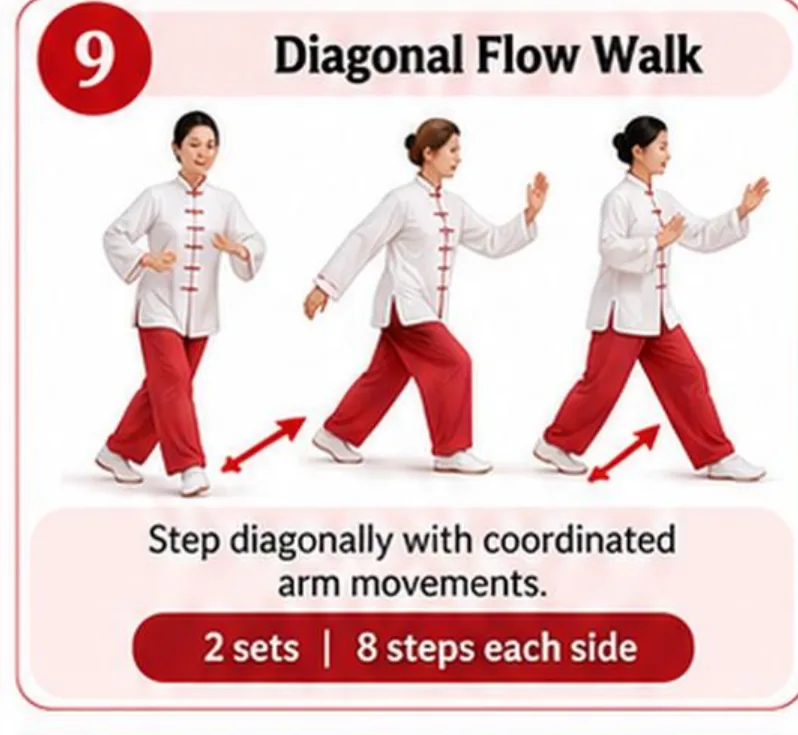
9. Diagonal Flow Walk
Purpose: Stepping diagonally rather than straight ahead — the angled approach you use around furniture and through doorways all day.
How to perform:
- Stand tall and step one foot forward at a diagonal, toward the corner of the room.
- Bring the other foot through and step diagonally to the other side, zig-zagging gently.
- Let your arms flow with the direction changes, staying relaxed.
- Cross the room in diagonals, then turn and zig-zag back.
Recommended practice: 2 sets of 8 steps, each side.
Beginner tip: Small diagonals. The practice is in the direction change, not in covering ground.
10. Tai Chi Push Walk
Purpose: Walking with a soft two-handed push on each step — weight transfer made deliberate, arms and legs sharing one rhythm.
How to perform:
- Walk slowly forward with a short, steady stride.
- As your weight settles into a step, press both palms gently forward, as if pushing soft air.
- Draw the hands back as the next step begins.
- Continue down the room, push and step in one slow rhythm.
Recommended practice: 2 sets of 10.
Beginner tip: The push is a gesture, light as a sigh. If your shoulders rise, you are pushing too hard — soften and slow down.

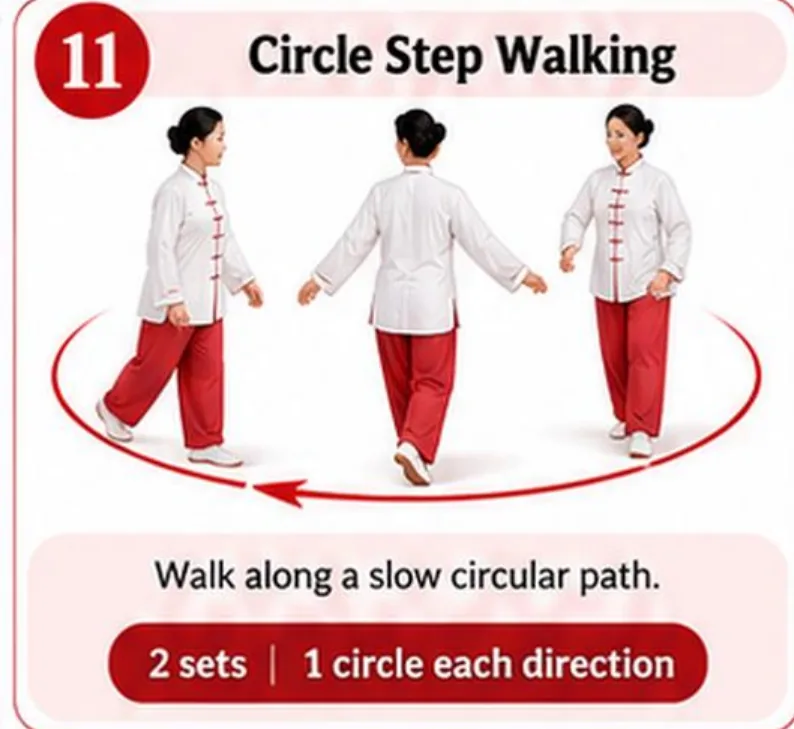
11. Circle Step Walking
Purpose: Walking a slow circle in both directions — continuous turning, the movement that makes small indoor spaces an advantage instead of a limit.
How to perform:
- Choose the clearest patch of floor and mark a gentle circle in your mind — around a rug’s edge works well.
- Walk the circle slowly, taking small curved steps, arms relaxed.
- Complete the circle, pause, and breathe.
- Walk the circle again in the opposite direction.
Recommended practice: 2 sets of 1 circle, each direction.
Beginner tip: If circling makes you dizzy, widen the circle and slow down further — or substitute straight lengths with deliberate turns until it settles.
12. Mindful Cool-Down Walk
Purpose: The closing walk: slowest of the session, attention on the breath and the soles of the feet, bringing everything down gently.
How to perform:
- Walk your route at its slowest comfortable pace.
- Match your breathing to your steps — in for a few steps, out for a few steps.
- Let your arms hang loose and your shoulders drop.
- Finish standing still at your chair for a few breaths before sitting down.
Recommended practice: 1 set of 2 minutes.
Beginner tip: End standing still rather than collapsing into the chair. A quiet finish tells your balance system the session is complete.

A simple 15-minute indoor session
| Time | What to do |
|---|---|
| Minutes 0–3 | Warm-Up Walk lengths, then Heel-to-Toe Balance Walk along the wall |
| Minutes 3–7 | Cloud Hands Side Walk and Knee Raise Walk, with Golden Rooster holds at the chair |
| Minutes 7–11 | Crane Wing Walk, Slow Backward Walk (route checked first), Diagonal Flow Walk |
| Minutes 11–15 | Push Walk, Circle Step Walking both directions, then the Mindful Cool-Down Walk |
Most people settle on three to five tai chi indoor walking sessions a week in bad-weather seasons, mixed with outdoor walks when the day allows. The movements are the same either way; only the scenery changes.
Get the printable chart, and a walking plan
The 12 movements come from our Tai Chi Walking Exercises Printable PDF Chart — one page with every movement illustrated, its instructions and repetitions, made to be followed in a hallway without a screen. And if you like structure around your walking, the 28-Day Tai Chi Walking Challenge turns these same steps into a day-by-day plan — it is in our shop alongside the chart, and many readers use the two together: the plan for the schedule, the chart for the moves.
Frequently asked questions
1. How much space do I need for tai chi indoor walking?
A clear run of about 3 to 4 metres is enough for every movement in this set — a hallway or one length of a living room. You walk the length you have, turn slowly, and repeat until the movement’s step count is done. Circle Step Walking needs only a small clear patch.
2. Is indoor walking as good as walking outside?
For the Tai Chi elements — step quality, balance, weight transfer, arms and attention — yes, because those never depended on distance. What indoors cannot give you is scenery, uneven ground and long continuous distances. The healthiest pattern for most people is both: outside when the day is kind, inside when it is not.
3. What should I wear on my feet indoors?
Flat, firm, non-slip shoes — the same you would wear for a walk outside. Avoid socks alone on hard floors and avoid loose slippers; both are slipping risks, and backward walking in particular deserves proper grip.
4. Can I practise on carpet?
On low-pile carpet, yes, with shorter steps and firm shoes. Avoid deep-pile rugs for walking practice — they catch toes and hide the floor’s feel. If your only clear space is deep carpet, do the standing movements (Golden Rooster, cool-down breathing) there and walk on a harder floor elsewhere in the house.
5. How do I count steps when I keep turning?
Count continuously through the turns; the turns are part of the practice, not interruptions. Many people count a room length as a rough block — if your hallway is five comfortable steps, four lengths is your set of 20. Approximation is fine; consistency is what counts.
6. I have a very small flat. Can I still do this?
Yes — this style of practice was, in a sense, made for small spaces. A single clear length of room serves for most movements, the Circle Step and Golden Rooster need almost none, and side walking travels sideways along a wall. Small rooms change the choreography slightly, not the value of the practice.
Final thoughts
Tai chi indoor walking turns the weather from a decision into a detail. Twelve slow movements, a hallway, a chair at one end — and the walking habit survives the wettest February intact, which is exactly when habits usually die.
Clear your route tonight, put the chair at the end of it, and walk the warm-up length tomorrow morning. The room you already have is the studio you need.
Safety note: This article is general educational information, not medical advice. Keep your route clear and well lit, wear non-slip shoes, check behind you before every backward walk, and stop if you feel dizzy. Check with your doctor before starting if you have a balance condition or a history of falls.