
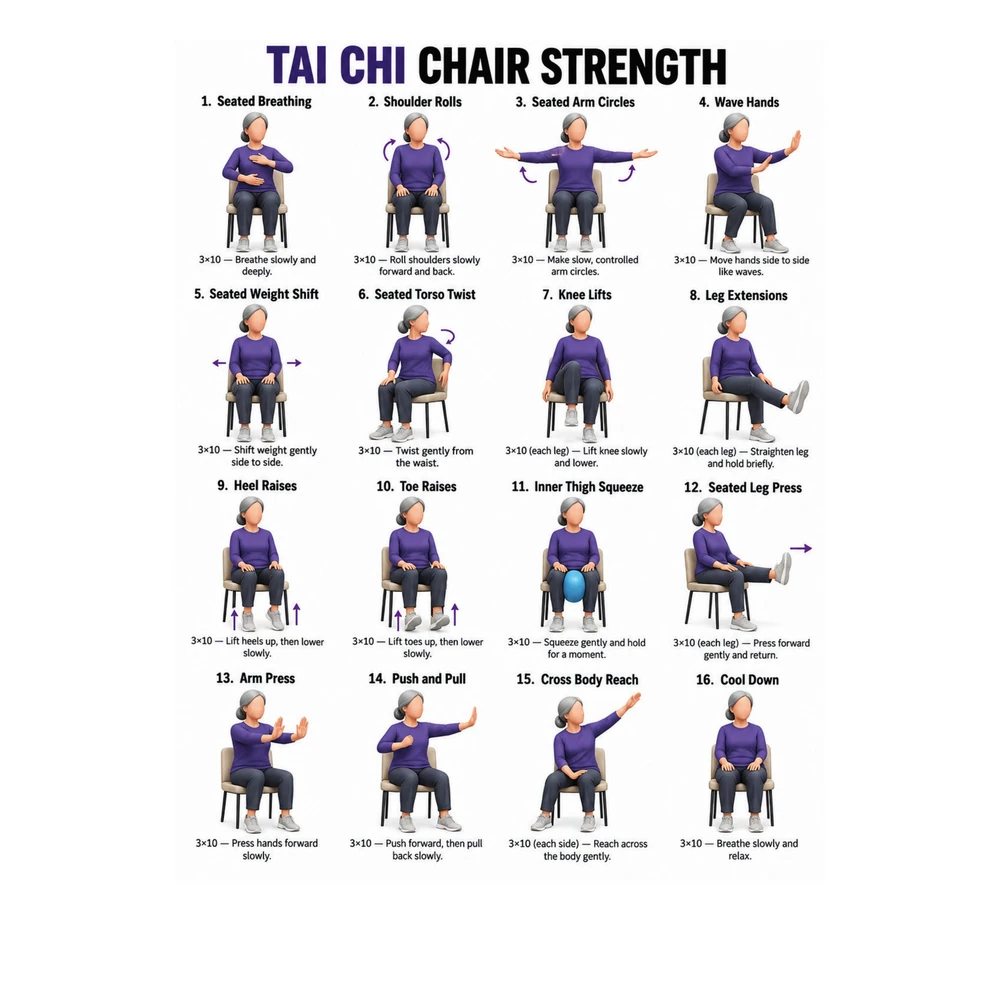
Some days standing exercise is simply not on the cards — a sore knee, a dizzy spell, plain tiredness. A tai chi chair workout meets you where you are: sitting down, feet on the floor, working your arms, legs and trunk in the slow, flowing Tai Chi way while the chair does the balancing for you.
This workout has 16 seated movements. Every one follows the same rhythm — 3 sets of 10 repetitions — so once you learn the pattern, you can follow the whole session without counting anything complicated. It is a strength-oriented routine: gentle resistance from your own body weight, pressing, squeezing and lifting, at a pace that lets you stop whenever you need to.
It differs from a general seated exercise session in feel as much as content. The movements flow. Hands open and close slowly, weight shifts from hip to hip, and breathing runs underneath everything. If you have tried our Chair Tai Chi routine, think of this as its stronger cousin — same calm, more work for the muscles. Both are forms of tai chi chair practice: one leans toward flowing movement, while this one leans toward strength.
What is a chair workout, Tai Chi style?
Most chair workouts borrow their moves from the gym and simply perform them sitting down. A Tai Chi chair workout starts from the other end: it takes Tai Chi’s own movements — Wave Hands, pressing palms, shifting weight, turning the trunk — and adapts the ones that work from a chair. The tai chi chair exercises in this workout then add seated strength staples such as leg extensions, heel raises and an inner-thigh squeeze along the way.
The result is a session that trains arms, shoulders, trunk, hips and legs without asking anything of your balance. That matters, because it means the effort goes where it belongs — into the muscles — instead of into worrying about staying upright.
You need one piece of equipment: a sturdy chair without wheels, on a non-slip floor. For one movement, a soft ball or a cushion to squeeze between your knees. That is the entire kit list.
6 benefits of a seated Tai Chi workout
1. Your muscles work while balance takes the day off
Seated leg extensions, leg presses and heel raises ask real work of the thighs, calves and hips — the muscles of standing up, climbing steps and walking. The chair holds you steady, so the legs can simply get on with it.
2. Arms and shoulders get a full turn
Arm circles, presses and push-and-pull movements cover the shoulders and arms in every direction, the way reaching, lifting and carrying do in daily life.
3. The trunk trains without crunches
Seated twists, weight shifts and cross-body reaches work the waist and trunk muscles while you sit tall — no lying on the floor, no getting down and up again.
4. The rhythm is easy to remember
Sixteen movements, each 3 sets of 10. The uniform pattern is deliberate: learn it once and the whole workout follows the same shape, start to finish.
5. It suits low-energy days
A seated session asks less of your heart and balance than a standing one. It is the routine many people keep for the days when they still want to move but standing practice feels like too much to ask.
6. It builds the habit of finishing
Because it is manageable, people actually complete it — and a completed gentle workout does more for a weekly habit than an ambitious one abandoned halfway.
Before you start: safety first
- Use a sturdy chair with no wheels, placed on a hard, non-slip floor — not on a loose rug. Your feet should rest flat on the floor with your knees at about a right angle.
- Sit tall, a little forward of the chair back, rather than slumped against it. If sitting unsupported is tiring at first, rest against the back between movements.
- Move slowly and breathe normally. Pressing and lifting should never involve holding your breath and straining.
- Mild muscle effort — a working warmth in the thighs or shoulders — is expected. Sharp pain is not; stop any movement that causes it.
- Keep the squeeze item soft: a cushion or a soft ball, never anything hard, and squeeze gently. Skip it entirely if it bothers your knees.
- Stop if you feel dizzy or unwell, and rest. Check with your doctor before starting if you manage a heart or blood-pressure condition, or have had recent surgery — seated exercise still raises the heart rate a little.
- This article is general educational information, not medical advice.
The 16 seated movements
Follow them in order: the session warms up the breath and shoulders first, works through arms, trunk and legs in the middle, and finishes with a cool down. Every movement is 3 sets of 10 on the chart — but hear this clearly: one set of each is a perfectly good workout while you are learning. Build up over weeks, not days.
1. Seated Breathing
Purpose: A slow, settled start that sets the breathing rhythm the rest of the workout follows.
How to perform:
- Sit tall near the front of your chair, feet flat, hands resting on your thighs.
- Breathe in slowly as your hands float up a little in front of you, palms down.
- Breathe out as they sink back down, as if pressing gently on soft air.
- Let your shoulders stay down and your face stay relaxed.
Recommended practice: 3 sets of 10 breaths.
Beginner tip: Count nothing but the out-breath if it helps: a slow count of four out, and let the in-breath look after itself.

2. Shoulder Rolls
Purpose: Loosens the shoulders and upper back — the warm-up every arm movement in this session appreciates.
How to perform:
- Sit tall with your arms resting by your sides.
- Lift both shoulders up toward your ears.
- Roll them back and down in a slow circle.
- After a few circles, reverse the direction.
Recommended practice: 3 sets of 10 rolls.
Beginner tip: Make the circles generous but comfortable. Shrugging hard is not the exercise — rolling smoothly is.

3. Seated Arm Circles
Purpose: Circles take the shoulders through their full comfortable range, forwards and backwards.
How to perform:
- Extend both arms out to your sides at a height that stays comfortable — below shoulder level is fine.
- Draw small circles with your hands, gradually making them larger.
- Circle in one direction, then reverse.
- Lower your arms and shake them gently loose between sets.
Recommended practice: 3 sets of 10 circles.
Beginner tip: Tired shoulders by set two is normal for this one. Lower the arms, rest a breath or two, and finish the set.

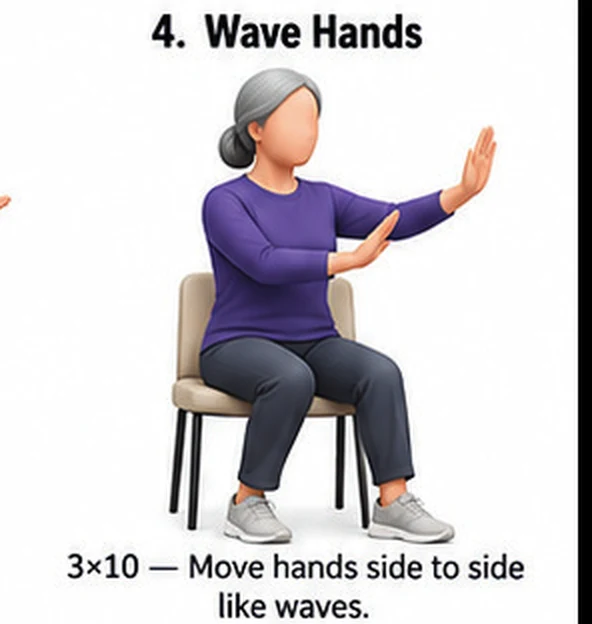
4. Wave Hands
Purpose: A signature Tai Chi flow, seated: the hands sweep side to side while your weight shifts gently from hip to hip.
How to perform:
- Sit tall and raise both hands in front of your chest, palms angled down.
- Sweep them to one side, letting your trunk turn a little and your weight shift to that hip.
- Sweep across to the other side in one continuous motion.
- Keep the movement smooth, as if smoothing a sheet across a table.
Recommended practice: 3 sets of 10 sweeps.
Beginner tip: Let the turn come from the waist, not the neck. Your eyes can stay looking forward while your chest travels.
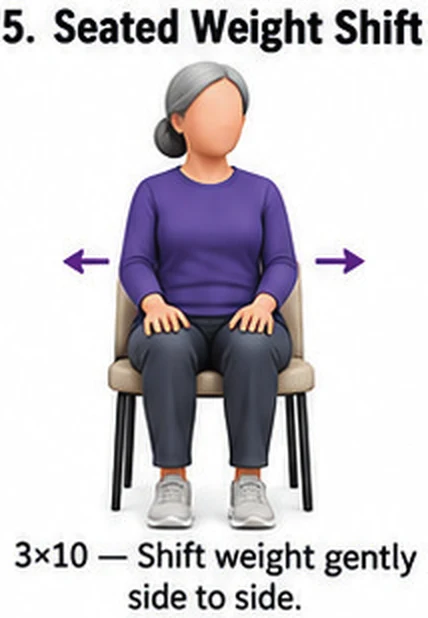
5. Seated Weight Shift
Purpose: Shifting your sitting weight fully from side to side strengthens the trunk’s quiet stabilisers and keeps the hips mobile.
How to perform:
- Sit tall, feet flat and a little apart, hands on your thighs.
- Shift your weight onto your right hip, feeling that side press into the chair.
- Return through the middle, then shift onto your left hip.
- Keep your head level — your weight moves, your posture stays tall.
Recommended practice: 3 sets of 10 shifts.
Beginner tip: Put your palms under your hips for one set if you want to feel the shift clearly. Then do the next set without checking.
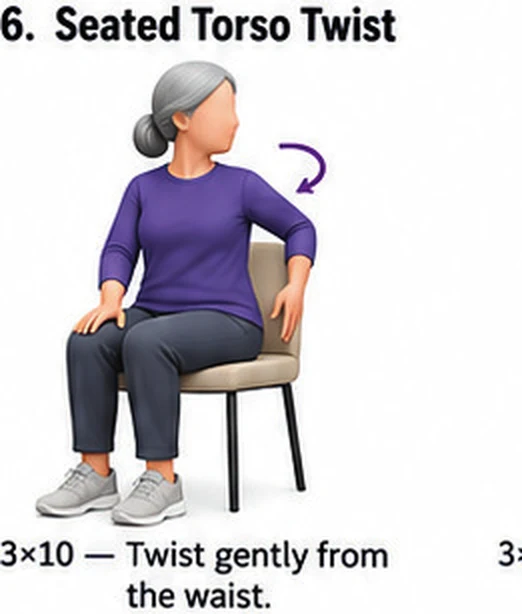
6. Seated Torso Twist
Purpose: A controlled rotation of the trunk — the seated version of the turning you do all day while reaching and looking behind you.
How to perform:
- Sit tall with your feet flat and arms folded loosely across your chest.
- Turn your chest and head slowly to one side, keeping your hips square on the chair.
- Pause where the turn is comfortable, then return to the middle.
- Turn to the other side, just as slowly.
Recommended practice: 3 sets of 10 twists.
Beginner tip: Let your eyes lead the turn. If you have been advised to avoid spinal twists, leave this one out — the workout stands without it.
7. Knee Lifts
Purpose: Lifting each knee in turn works the hip flexors and the front of the thigh — the lifting muscles of marching, stepping and stairs.
How to perform:
- Sit tall near the front of the chair, holding the sides of the seat if you wish.
- Lift one knee a few inches off the chair, keeping your trunk tall.
- Lower it with control and lift the other knee.
- Alternate in a slow, marching rhythm.
Recommended practice: 3 sets of 10, each leg.
Beginner tip: The lift is small at first. If you feel yourself leaning back to lift higher, you have found your limit for today — stay under it.

8. Leg Extensions
Purpose: Straightening the knee against gravity is one of the most direct ways to strengthen the front of the thigh — the muscle that stands you up out of chairs.
How to perform:
- Sit tall, holding the sides of the seat, feet flat.
- Straighten one leg slowly until it is as extended as is comfortable, foot flexed.
- Pause for a breath at the top.
- Bend the knee and lower the foot back to the floor with control. Repeat with the other leg.
Recommended practice: 3 sets of 10, each leg.
Beginner tip: Feel the front of the thigh do the work. If your knee objects to a full straighten, extend only part-way — the middle range counts too.

9. Heel Raises
Purpose: Seated heel raises work the calves and keep the ankles in the habit of pressing the floor away — the last push of every step.
How to perform:
- Sit tall with both feet flat on the floor.
- Press through the balls of your feet and lift both heels as high as comfortable.
- Pause at the top.
- Lower your heels slowly — do not let them drop.
Recommended practice: 3 sets of 10.
Beginner tip: Rest a hand on each thigh and let your arms add a whisper of extra pressure at the top if the basic version feels too easy after a few weeks.

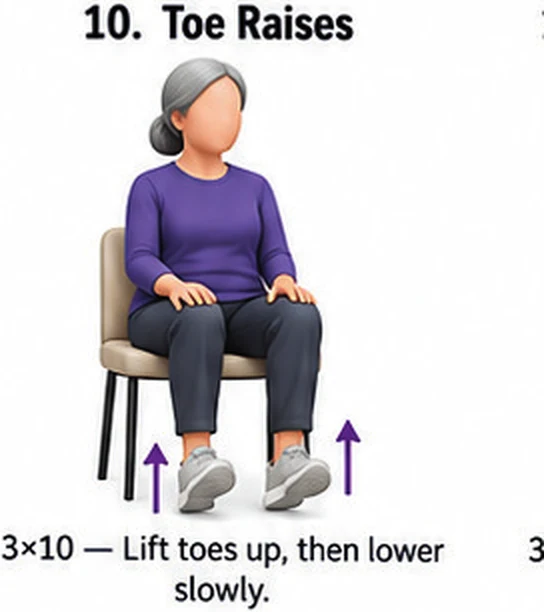
10. Toe Raises
Purpose: The partner movement to heel raises: lifting the fronts of the feet trains the shin muscles that clear your toes over rugs and thresholds.
How to perform:
- Sit with your heels on the floor and feet flat.
- Lift the fronts of both feet up toward your shins, heels staying down.
- Hold for a moment at the top.
- Lower your toes back down slowly.
Recommended practice: 3 sets of 10.
Beginner tip: A quick burn in the shins is this exercise working, not a problem. Rest between sets and it passes.
11. Inner Thigh Squeeze
Purpose: Squeezing a soft ball or cushion between the knees strengthens the inner thighs — the muscles that steady your legs when you stand and walk.
How to perform:
- Place a soft ball or a folded cushion between your knees.
- Sit tall, feet flat on the floor.
- Squeeze your knees together gently, pressing into the cushion for a slow count of two.
- Release — but keep the cushion in place — and repeat.
Recommended practice: 3 sets of 10 squeezes.
Beginner tip: Gentle pressure is enough. Think of holding the cushion firmly, not crushing it — and skip this movement if it aggravates your knees.

12. Seated Leg Press
Purpose: Pressing one foot down and forward against the floor’s resistance rehearses the pushing pattern of standing up and climbing a step.
How to perform:
- Sit tall and set one foot flat on the floor a little ahead of you.
- Press that foot firmly down into the floor, as if beginning to stand on it, without actually rising.
- Hold the press for a slow count of two, feeling the thigh and hip work.
- Release, and repeat before changing legs.
Recommended practice: 3 sets of 10, each leg.
Beginner tip: The foot does not slide — it presses. If your shoe slips on the floor, this is the moment to change into a grippier pair.

13. Arm Press
Purpose: Pressing both palms forward against imagined resistance strengthens the chest, shoulders and arms in the pushing direction.
How to perform:
- Sit tall and bring both palms together in front of your chest, or hold them facing forward, fingers up.
- Press your palms forward and into each other as you slowly extend your arms.
- Keep the press gentle and continuous as the arms straighten.
- Bend the elbows and draw the hands back to your chest.
Recommended practice: 3 sets of 10.
Beginner tip: Breathe out as you press. It stops the breath-holding that creeps into any pushing movement.

14. Push and Pull
Purpose: Alternating a press forward with a drawing-back motion works the front and back of the shoulders in one flowing Tai Chi rhythm.
How to perform:
- Sit tall with both hands in front of your chest, palms forward.
- Push both hands slowly away from you, as if pressing through soft water.
- Turn the palms and draw them back toward you, elbows bending and opening slightly.
- Flow between push and pull without pausing at either end.
Recommended practice: 3 sets of 10.
Beginner tip: Keep the path of your hands level, around chest height. If they drift upward, your shoulders are creeping — let them sink and start the set again.

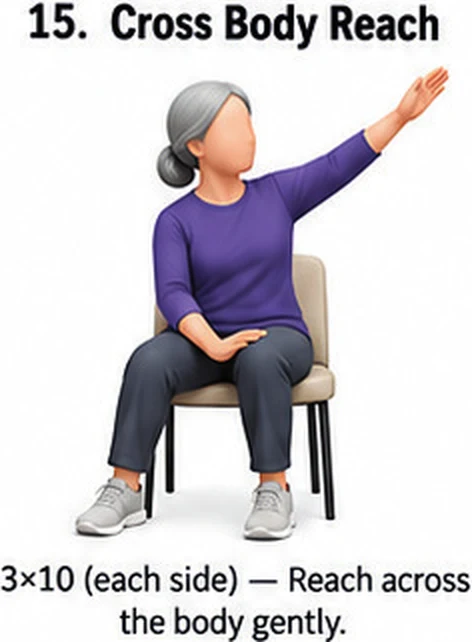
15. Cross Body Reach
Purpose: Reaching across the body trains the trunk’s diagonal muscles and keeps the shoulders used to working across the midline — the pattern of reaching into a car boot or a low cupboard.
How to perform:
- Sit tall with your feet flat and one hand resting on your thigh.
- Reach the other hand diagonally across your body at chest height, letting your trunk turn with it.
- Return to the centre slowly.
- Repeat on one side for the set, then change sides.
Recommended practice: 3 sets of 10, each side.
Beginner tip: The reach should feel like offering something to someone beside you — an easy arm’s length, not a lunge.
16. Cool Down
Purpose: A slow finish of easy breathing and shoulder drops that brings the session’s effort to a close.
How to perform:
- Sit back in the chair if you wish, hands resting on your thighs.
- Take a slow breath in as your shoulders lift slightly.
- Let them drop completely as you breathe out.
- Finish with a few quiet breaths, hands resting loosely, before you stand up — and stand up slowly when you do.
Recommended practice: 3 sets of 10 slow breaths, then rest a moment.
Beginner tip: Sit for a full minute after the last movement. Muscles that have worked like a little blood-flow settling time before you ask them to carry you.

A simple 12-minute workout
| Time | What to do |
|---|---|
| Minutes 0–2 | Seated Breathing and Shoulder Rolls |
| Minutes 2–5 | Arm Circles, Wave Hands, Weight Shifts, and Torso Twists — 1–2 sets each |
| Minutes 5–9 | Knee Lifts, Leg Extensions, Heel Raises, and the Inner Thigh Squeeze |
| Minutes 9–12 | Arm Press, Push and Pull, Cross Body Reach, then Cool Down |
When you are starting out, do one set of each movement in this order and call it the workout. When that feels easy across two or three sessions, build toward the chart’s full 3 sets of 10 — it is a genuinely satisfying session at full length.
Get the printable chart
This workout comes from our Tai Chi Chair Strength Printable PDF Chart — one page with all 16 seated movements illustrated, their instructions and the 3-sets-of-10 repetitions, so you can work through the session with the chart on your lap and no screen in sight.
Frequently asked questions
1. How is this different from ordinary chair exercises?
The strength work is similar — leg extensions, presses, squeezes — but the delivery is Tai Chi: slower, flowing, with weight shifts, turns and breathing woven through it rather than counted like a gym circuit. Many people find that makes it easier to stay with. It is, in short, tai chi in a chair: the same calm approach to movement, practised from a seat.
2. Do I need all 3 sets of 10 from day one?
No. The chart’s rhythm is 3 sets of 10, but one careful set of each movement is a complete starting workout. Add sets over several weeks as the session starts to feel easy.
3. What can I use for the inner thigh squeeze?
A soft ball, a folded cushion or a rolled towel — anything soft that holds a little shape. Never anything hard, and the squeeze should be gentle.
4. Will a seated workout actually strengthen my legs?
Leg extensions, knee lifts, leg presses and heel raises all load the leg muscles against gravity and your own resistance. It is gentle strengthening rather than heavy training — appropriate for maintaining everyday leg strength used in standing up, walking and stairs.
5. How many times a week should I do this workout?
Two or three times a week suits most people, with a rest day between strength sessions. On the days between, a walk or pure movement practice — stretching, breathing, balance work beside a chair — pairs well with it.
6. My chair has wheels. Can I lock them?
Use a different chair if you can. A chair that can roll or swivel is not a safe base for pressing and lifting movements. A plain, sturdy dining chair on a hard floor is the right tool here.
Final thoughts
A tai chi chair workout asks something small of you — a sturdy chair, twelve minutes, a cushion — and gives back a full session: breath, shoulders, arms, trunk, hips and legs, all worked gently from a seat you trust. On the days standing exercise feels out of reach, this is not the compromise option. It is simply the workout that fits the day.
Start with one set of each movement, keep the pressing gentle and the breathing easy, and let the sets build when your body tells you it is ready.
Safety note: This article is general educational information, not medical advice. Stop any movement that causes pain, and rest if you feel dizzy or unwell. Check with your doctor before starting if you have a heart or blood-pressure condition, or have had recent surgery.