

Core Exercises for Seniors: A Gentle Seated Routine for Beginners
When most people hear “core exercises”, they picture crunches on a mat, sit-ups, or holding a plank on the floor. For many seniors, none of that is appealing — and getting down to the floor and back up again may not be realistic at all. What often gets missed is that the muscles around your middle can also be worked sitting in a sturdy chair. This page explains what “core” actually means, then takes you through the four gentle seated core exercises from our chair exercises chart — a side bend, a twist, a knee lift and a posture hold — followed by eight supporting movements borrowed from our balance and stretching guides and clearly labelled as such, and a short routine that puts the core four together. You stay seated throughout: no standing, no floor work, no equipment.
What “core” means, in plain language
Your core is the group of muscles around your trunk: across the front of your belly, around your sides at the waist, and through your back. You use them constantly — sitting up straight in a chair, turning to look over your shoulder, leaning to one side to pick something up, lifting a knee as you climb a step. “Working the core” simply means asking those muscles to do their jobs a little more deliberately.
That is why core exercise does not have to mean sit-ups. In the core routine below, the trunk muscles get used four different ways: bending gently to each side, turning from the waist, drawing one knee up toward your chest, and holding yourself tall with your belly gently pulled in. Each movement is slow, done from your chair, and the repetitions are modest. The first four exercises below are the complete “Core & Back” section of our printable chair exercises chart — nothing added to them, and nothing padded out: the chart has four core exercises, not twelve. The eight movements that follow them come from two of our other guides, and they are labelled as supporting practice when you reach them.
Why this routine is seated
Working from a chair means the chair supports you while your trunk does the bending, turning and holding. There is no balancing, no lying down, and no getting up off the floor at the end. For beginners, and for anyone who finds standing exercise uncomfortable, that makes a core routine much easier to start.
Seated exercise is a recognised starting point, not a compromise. The NHS physical activity guidelines for older adults recommend that adults aged 65 and over do activities that improve strength, balance and flexibility on at least two days a week, and list “sitting exercises” among their example routines. This page covers one small part of that picture.
What you need
- A sturdy chair without wheels, placed on a flat, steady surface
- Comfortable clothing and a little clear space around the chair
- Nothing else — none of these twelve exercises uses weights, a ball or any other prop
Safety first: read this before you begin
These points come from the “Before You Start” page of the chart the core routine is taken from, and they apply to every exercise below:
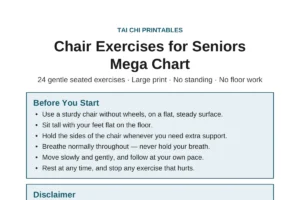
- Use a sturdy chair without wheels, on a flat, steady surface.
- Sit tall with your feet flat on the floor.
- Hold the sides of the chair whenever you need extra support.
- Breathe normally throughout — never hold your breath.
- Move slowly and gently, and follow at your own pace.
- Rest at any time, and stop any exercise that hurts. Stop altogether if you feel pain or dizziness.
- For the stretches in the supporting-practice section, stretch only to the point of mild tension — never to pain, and never bounce in a stretch. (This point is printed on the stretching chart the stretches come from.)
- Check with your doctor before starting a new exercise routine, especially if you have a health condition — the NHS gives the same advice to anyone who has not exercised for some time.
The chart’s four seated core exercises, explained
These are all four exercises from the chart’s “Core & Back” section, in the chart’s own order (exercises 11 to 14 of the full chart). Do fewer repetitions than listed whenever you need to — the numbers are a guide, not a test.
1. Seated Side Bends
Sit tall with your feet flat on the floor. Slide one hand down toward the floor beside the chair while the other arm rests in your lap, so your trunk bends gently to that side. Come back to the centre, then repeat on the other side. The movement comes from your waist — a slow lean, not a slump — and your feet stay flat throughout. Reps: 6–8 each side.

2. Seated Twists
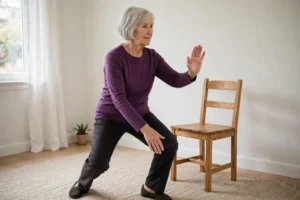
Rest one hand on the chair arm for support. Turn gently from the waist to look over one shoulder, keeping your hips facing forward. Return to the centre, then repeat on the other side. Keeping your hips facing forward is the important detail — your trunk turns, not your whole body in the seat. Turn only as far as feels comfortable. Reps: 6–8 each side.

3. Seated Knee-to-Chest
Hold the sides of the chair to steady yourself. Lift one knee and gently hug it toward your chest with one or both hands, only as far as is comfortable. Lower the foot back to the floor, and switch sides. A gentle hug is enough — if your knee only comes up a little way, that is fine. Reps: hold 10 seconds, 4–6 each side.
4. Sit-to-Attention Posture Hold
Sit tall with your feet flat and your hands resting on your thighs. Gently pull your belly in, as if buttoning a snug waistband, keeping your shoulders relaxed and breathing normally. Hold, then release, rest, and repeat. The detail that matters most is the breathing: your belly is drawn in, but your breath keeps moving — never hold your breath to hold the position. Reps: hold 10 seconds × 5.

Supporting practice: posture and trunk control from our other guides
That is the whole of the chart’s core section — four exercises, no more, and this page will not pretend otherwise. The eight movements below are not extra core exercises from the mega chart. They are supporting movements, taken from two of our other free printables, that ask your trunk to hold you tall, shift and turn under control, and stretch gently: exercises 5 to 8 come from the Balance Exercises for Seniors guide, and exercises 9 to 12 come from the Gentle Stretching for Seniors chart. Think of them as practice that supports the four core exercises above, not as part of the chart’s core section. Some will feel familiar — a turn, a knee hug — because gentle seated guides often share similar movements; each one below keeps the instructions and repetitions of the guide it actually comes from.
5. Seated Marching with Tall Posture
Sit tall near the front of the chair with your feet flat, holding the sides of the chair if you like. Lift one knee a few inches, lower it, then lift the other knee, marching slowly in place while keeping your back straight. The point of the balance guide’s version is the tall posture: your trunk stays upright and steady while your legs do the moving. Reps: 30–60 seconds.

6. Seated Torso Turns
Sit tall with your feet flat and your hands resting in your lap. Turn your upper body gently to one side, hold for a moment, return to the centre, then turn to the other side. Keep your hips facing forward, just as in the chart’s Seated Twists — the turn comes from your trunk, not from swivelling in the seat. Reps: 6–8 each side.

7. Seated Weight Shifts
Sit tall with both feet flat and your hands resting on your thighs. Slowly shift your weight over to one side, then back through the centre to the other side, moving gently and without rushing. Your trunk works quietly throughout, keeping you centred as the weight moves. Reps: 10–12 shifts.

8. Seated Reach and Return
Sit tall with your feet flat. Reach one hand slowly toward the opposite knee, then return to sitting tall. Repeat with the other hand reaching toward the other knee. The reach takes your trunk diagonally across your body; sit tall again between each reach rather than staying leaned over. Reps: 6 each side.

9. Seated Cat-Cow
Sit tall with your hands on your knees. As you breathe out, round your back slowly, letting your shoulders and head drop gently forward. As you breathe in, arch your back gently and lift your chest, looking slightly ahead. Move slowly back and forth between the two positions, following your breath. Reps: 5–6 slow rounds.

10. Seated Spinal Twist
Sit tall with your feet flat and your hands resting on your thighs. Turn gently from the waist to look over your right shoulder, keeping your hips facing forward. You may rest one hand on the chair arm or the side of the chair for support. Return to the centre, then repeat on the other side. Unlike the moving twists earlier on this page, this version is a stretch: you turn, then hold the position. Reps: hold 15–20 seconds each side.

11. Overhead Side Reach
Sit tall with your feet flat. Raise your right arm up toward the ceiling, then lean gently to the left, reaching the arm up and over your head. Keep both hips on the chair and lean only as far as feels comfortable. Come back to the centre, then repeat on the other side. Reps: hold 15 seconds each side.

12. Seated Knee Hug
Hold the sides of the chair. Lift one knee and gently hug it toward your chest with one or both hands, only as far as is comfortable. Keep your back tall rather than rounding forward. Lower the foot back to the floor and switch sides. It is a close cousin of the chart’s Seated Knee-to-Chest (exercise 3 above) — the stretching chart’s version holds for longer and asks you to keep your back tall. Reps: hold 20 seconds each side.

Putting it together: a short seated core routine
Linked together with a warm-up and a finish — both borrowed from the same chart, and labelled so you know where they come from — the four exercises make one short routine:
- Warm up (from the chart’s Warm-Up section): Seated Marching. Sit tall and hold the sides of the chair if you like. Gently lift one knee a few inches, lower it, then lift the other, as if marching slowly in place. 30–60 seconds, alternating knees.
- Seated Side Bends — 6–8 each side.
- Seated Twists — 6–8 each side.
- Seated Knee-to-Chest — hold 10 seconds, 4–6 each side.
- Sit-to-Attention Posture Hold — hold 10 seconds × 5.
- Finish (from the chart’s Cool-Down section): Deep Breathing Finish. Rest your hands on your belly. Breathe in slowly through your nose and feel your belly rise, then breathe out slowly through your mouth, letting your shoulders drop a little more with each breath out. 5 slow breaths.

One round is a complete session. If it feels comfortable and you would like more, rest for a minute and repeat the four core exercises once more; if one round is enough for today, stop there. There is no fixed prescription for how often — the NHS guidelines suggest strength-type activities on at least two days a week for older adults, and this routine can fit that pattern — but your doctor’s advice always comes first, and rest days are part of exercising sensibly.
The eight supporting movements do not need to be squeezed into the same session. Practise them separately, on the same day or a different one, or add two or three after this routine when a day feels good — they come from the balance guide and the stretching chart, as labelled where they appear.

Where these exercises come from — and how to get the full chart
The four core exercises above, plus the warm-up and cool-down, all come from the Chair Exercises for Seniors — Mega Chart, a free printable PDF with 24 gentle seated exercises in large print, arranged in five sections. Its “Core & Back” section is the part the core routine on this page is built around — and four exercises really is the whole of that section. The chart is priced at $0 in our shop, so you check out without paying anything, and you receive both a US Letter and an A4 version.
To get it, go to the Chair Exercises for Seniors — Mega Chart product page, add it to your cart and complete the $0 checkout. Your download links appear on the order confirmation page and in your confirmation email; print at home at 100% scale, in the size that matches your paper.
The supporting movements come from two more of our free printables. The Balance Exercises for Seniors is a printable chart and guide of seated and supported-standing exercises; the four movements used here are from its seated Part 1. The Gentle Stretching for Seniors is a chart of 14 gentle stretches; the four used here are from its seated Upper Body and Back & Hips sections. Both are also priced at $0 in our shop.
For a whole-body routine instead, our free chair exercises routine puts twelve of the chart’s exercises together — arms, legs and stretches as well as core movements. And if slow, flowing seated movement appeals more than exercise sets, the chair tai chi guide covers a complete seated tai chi practice. Both are different from this page: this one is only about the trunk.
Frequently asked questions
Can seniors do core exercises sitting down?
Yes. “Core” describes where the muscles are — around your trunk — not the position you have to be in to use them. Bending to the side, turning from the waist, lifting a knee toward your chest and holding yourself tall can all be done from a sturdy chair, as the four core exercises on this page show.
Do core exercises have to involve sit-ups or crunches?
No. Sit-ups and crunches are floor exercises, and this routine uses none — there is no floor work of any kind, here or anywhere in the full 24-exercise chart. Slow bends, twists, a knee lift and a posture hold are a gentler way of asking the same group of muscles to work.
Are all twelve movements on this page core exercises from the mega chart?
No — and the page is labelled so that this is clear. The mega chart’s “Core & Back” section contains exactly four exercises: Seated Side Bends, Seated Twists, Seated Knee-to-Chest and the Sit-to-Attention Posture Hold. The other eight movements are supporting practice taken from two different products — four from our Balance Exercises for Seniors guide and four from our Gentle Stretching for Seniors chart — and each part of the page says where its movements come from.
Will these exercises help my back pain or improve my posture?
That is not something this page can promise, and no honest exercise chart should. These exercises are general educational information, not a treatment, and they are not presented here as pain relief or as a way to fix posture. If you have back pain, check with your doctor or physiotherapist before starting — they can tell you whether these movements are appropriate for you.
How often should I do this core routine?
There is no single right answer, and your doctor’s advice comes first. As covered above, the NHS guidelines suggest strength-type activities on at least two days a week, and this short routine can fit that pattern. Do fewer repetitions when you need to, build up gradually only as it feels comfortable, and stop if anything hurts.
I have a health condition. Should I do these exercises?
Check with your doctor before starting, especially if you have a health condition, have had recent surgery, or have not exercised for some time — that is the advice printed on the chart itself. If your doctor is happy for you to begin, start with fewer repetitions and stop any exercise that hurts.
A final word
Core exercise does not have to mean mats, planks and getting down on the floor. Four slow movements from a chair — a bend, a twist, a knee lift and a tall, steady hold — are enough to begin, and the supporting movements are there when you would like more practice around them. Print the chart if you would like the full set beside your chair, and start with one round.
This article and the printables it draws on are general educational information, not medical advice. Stop if you feel pain or dizziness, and check with your doctor before starting a new exercise routine, especially if you have a health condition.