
When most people picture tai chi, they picture one thing: a group of people in a park, moving slowly and together, arms floating up and down as if the air were thick. What they are usually picturing is one particular style. Tai chi is not a single fixed routine. It is a family of styles, each developed and handed down by a different Chinese family, and each with its own character.
There are five main family styles: Chen, Yang, Wu, Hao and Sun. They share the same roots — slow, continuous movement, relaxed upright posture, steady breathing — but they differ in stance, pace and feel. If you are choosing a class, following videos, or starting a gentle routine at home, it helps to know roughly what each style involves, so you can pick the one that suits your body and your temperament.
Where the family styles came from
All five styles trace back to the Chen family village of Chenjiagou in Henan province, where tai chi is generally said to have taken shape several centuries ago. For a long time the art stayed within the family and the village. It only began to spread when Yang Luchan, an outsider who had learned from the Chen family, took the practice to Beijing in the nineteenth century and taught it more widely. From his teaching came the Yang style, and from Yang teaching came further branches, each shaped by the person who developed it.
That is why the styles carry family names. Each one is the same inheritance, adjusted over generations to suit different bodies and different ideas about what the practice is for. If you would like the fuller story, our article on the history of tai chi walks through how the art developed and travelled.
Chen style: the oldest of the five
Chen is the original style, and in some ways the most demanding. A Chen routine mixes long, slow, flowing passages with sudden quicker movements, including stamps, jumps and short bursts of released energy. The stance is often low, and the movements use a distinctive spiralling quality, sometimes called silk reeling, where the limbs turn and wind as they move.
It is absorbing to watch and rewarding to learn, but the low postures ask a lot of the legs and knees, and the changes of speed can be hard for a beginner to follow. Chen tends to suit younger or fitter practitioners, and people who are drawn to tai chi’s martial arts side. Older beginners can learn it, especially with a good teacher who adapts the postures, but it is rarely the gentlest place to start.
Yang style: the most widely practised
Yang is the style most people meet first, and the one most commonly taught in community classes, hospital programmes and senior groups around the world. Yang Luchan’s descendants, particularly Yang Chengfu, smoothed the family form out: the jumps, stamps and sudden bursts were taken away, the pace became even from start to finish, and the movements grew larger, rounder and more open, performed from a comfortable upright stance.
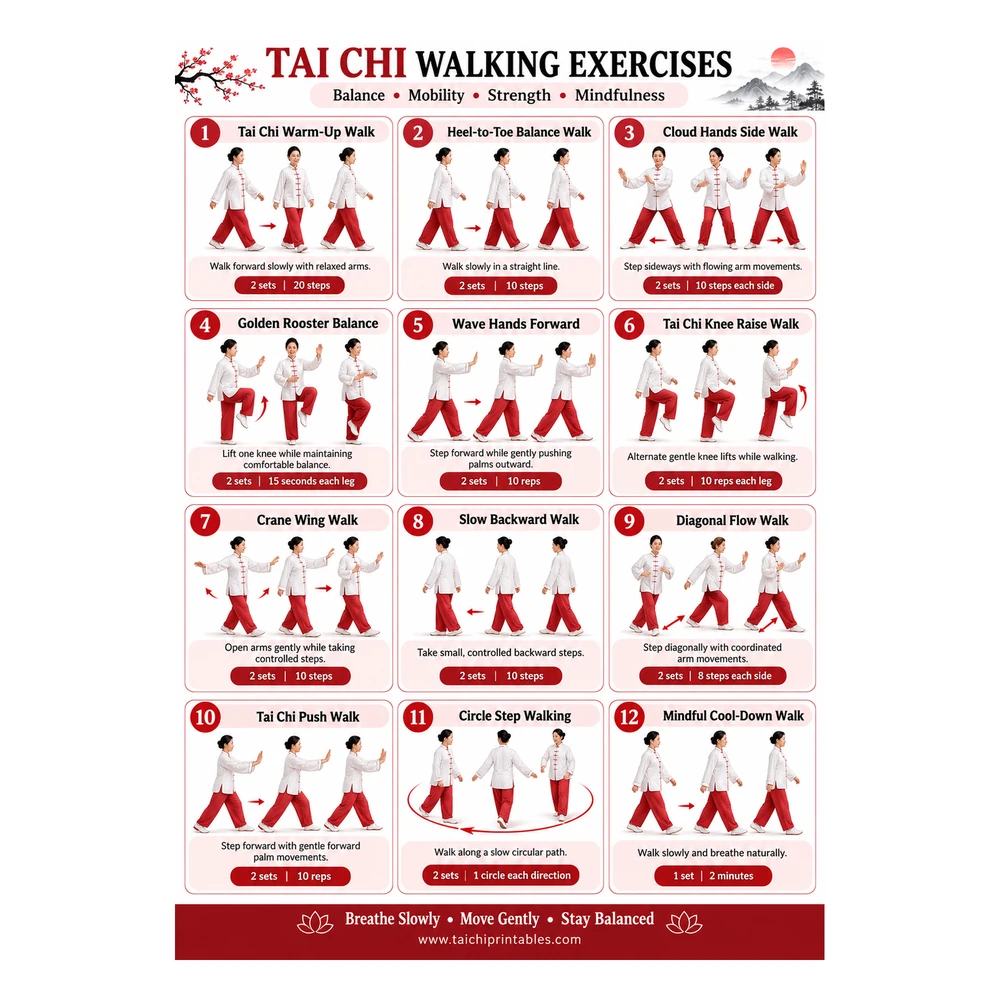
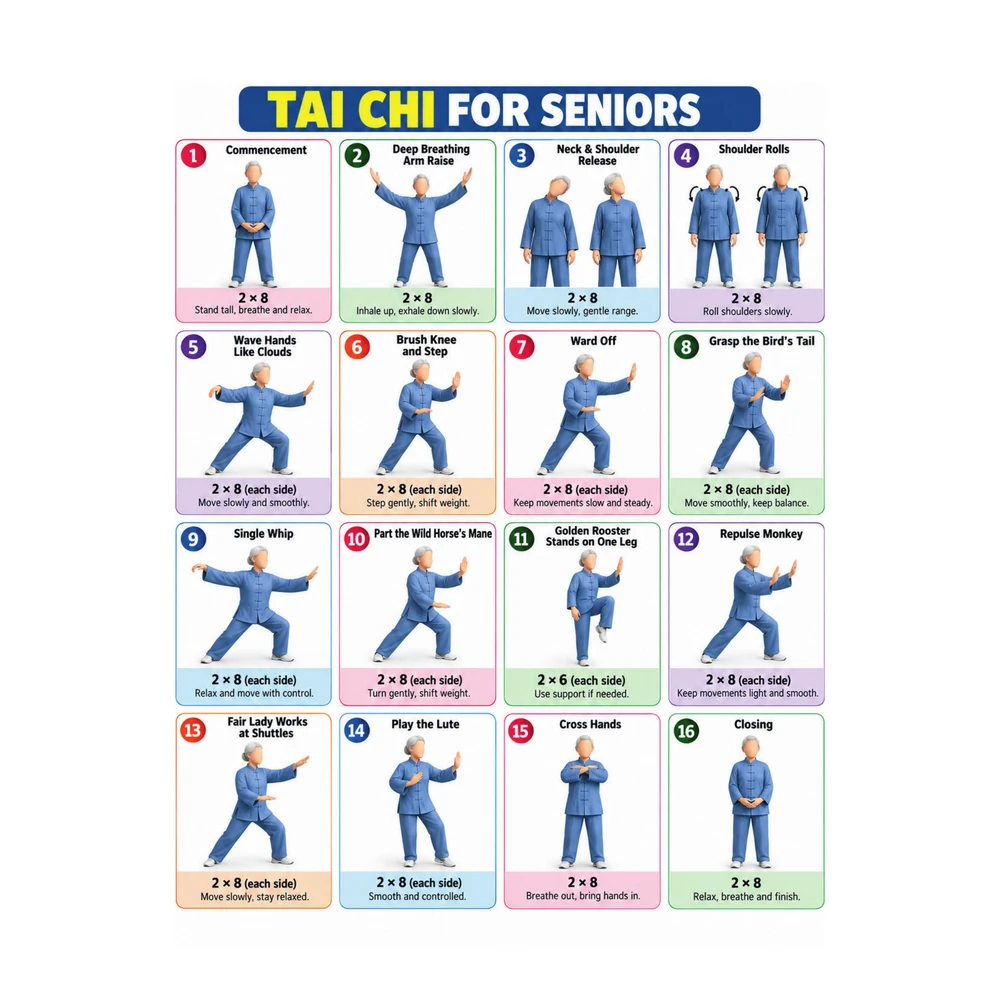
The result is a style that feels calm and spacious. Nothing in it is rushed, and the height of the stance can be adjusted to suit the person practising, which makes it forgiving for stiff knees and uncertain balance. Our guide to Yang tai chi looks at this style in more depth. Most gentle home routines for seniors, including printed charts like ours, draw mainly on Yang-style movements, precisely because they are even-paced and easy to adapt — standing, supported, or seated in a chair.
Wu style: smaller, closer, quieter
The Wu style (developed by Wu Jianquan and his family, from Yang teaching) keeps the same smooth flow but makes everything smaller. The stance is a little higher and narrower, the steps are shorter, and the arms work closer to the body. There is a characteristic slight lean in some postures, and the whole form has a compact, contained quality.
Because the movements take up less room, Wu can be practical if you practise in a small space. It suits people who prefer subtle, understated movement over big sweeping shapes. It is less commonly taught than Yang, so classes can be harder to find, but it is a comfortable style for many older practitioners once they find one.
Hao style: the quiet, inward one
The Hao style — also called Wu/Hao, after its founder Wu Yuxiang (a different Wu from Wu Jianquan; the names are written differently in Chinese) — is the least widely taught of the five. Its movements are small and compact, the stance is relatively high, and the emphasis falls less on the outward shape of the movements and more on the inner sensations that go with them: balance, relaxation, and the feeling of the body settling.
Because it spread less widely, Hao is the hardest style to find a class for, and many practitioners only come across it after years of practice in another style. It is included here so the family is complete, and because its quiet, minimal character appeals to people who find larger forms too showy.
Sun style: light steps, upright posture
Sun is the youngest of the five family styles, created by Sun Lutang, who also practised two other internal martial arts and blended a little of their footwork into his tai chi. Its hallmarks are a high, comfortable stance and nimble, following steps: when one foot steps forward or back, the other foot promptly follows, so you are rarely left stretched out or off balance. The movements open and close around the body in a lively but unhurried way.
Those small, manageable steps and the upright posture are why Sun style is often suggested for older beginners and people who are less steady on their feet. It keeps the flavour of traditional tai chi while asking relatively little of the legs.
If balance is a concern, our tai chi for balance guide looks at the same steady approach in more detail.
Which style suits a beginner?
For most older beginners, the honest answer is Yang or Sun. Yang is the easiest to find — in classes, in videos, and in home routines — and its even pace and open movements are kind to learn. Sun is a close second where it is available, especially if your balance is a concern, because of its high stance and following steps.
That said, the style label matters less than three practical things: a teacher or resource that explains movements clearly, a pace you can follow without strain, and movements you can adapt on a bad day. A Yang class taught too fast will suit you less than a Chen class taught gently and carefully. And whichever style you choose, consistency counts for far more than pedigree — twenty unhurried minutes a few times a week will do more for you than the theoretically perfect style practised once a month.
If you are ready to start, our tai chi for beginners guide sets out the first steps in plain language.
Frequently Asked Questions
What is the most popular style of tai chi?
Yang style, by a wide margin. It is the style behind most beginners’ classes, most online lessons aimed at older adults, and most gentle home routines, because its movements are even-paced, open and easy to adapt.
Which tai chi style is easiest for beginners?
Yang and Sun are generally the kindest starting points. Both use a comfortable upright stance and an even tempo. Chen is usually the most physically demanding, and Hao can be hard to find a teacher for, so most beginners start with Yang and branch out later if they wish.
Is one style better for you than the others?
There is no honest league table. All five styles rest on the same foundations — slow movement, relaxed posture, steady breathing and regular practice — and it is those foundations, practised consistently, that people value. The better question is which style you will enjoy enough to keep doing.
Can I change styles later, or mix them?
Yes, and many experienced practitioners do explore more than one style over the years. As a beginner, though, it is usually easier to settle into one style first, so the movements become familiar and you are not relearning the same posture three different ways at once.
Final thoughts
Chen, Yang, Wu, Hao and Sun are five branches of one tree. Chen is the vigorous original, Yang the open and even style most of the world practises, Wu the compact and quiet one, Hao the inward-looking rarity, and Sun the light-stepped latecomer that suits unsteady legs so well. If you are starting out, begin with Yang or Sun, choose teaching you can follow comfortably, and let regular practice do the rest.
A printed routine can help you keep it up. Our tai chi exercises PDF guide explains how to choose and use a chart.