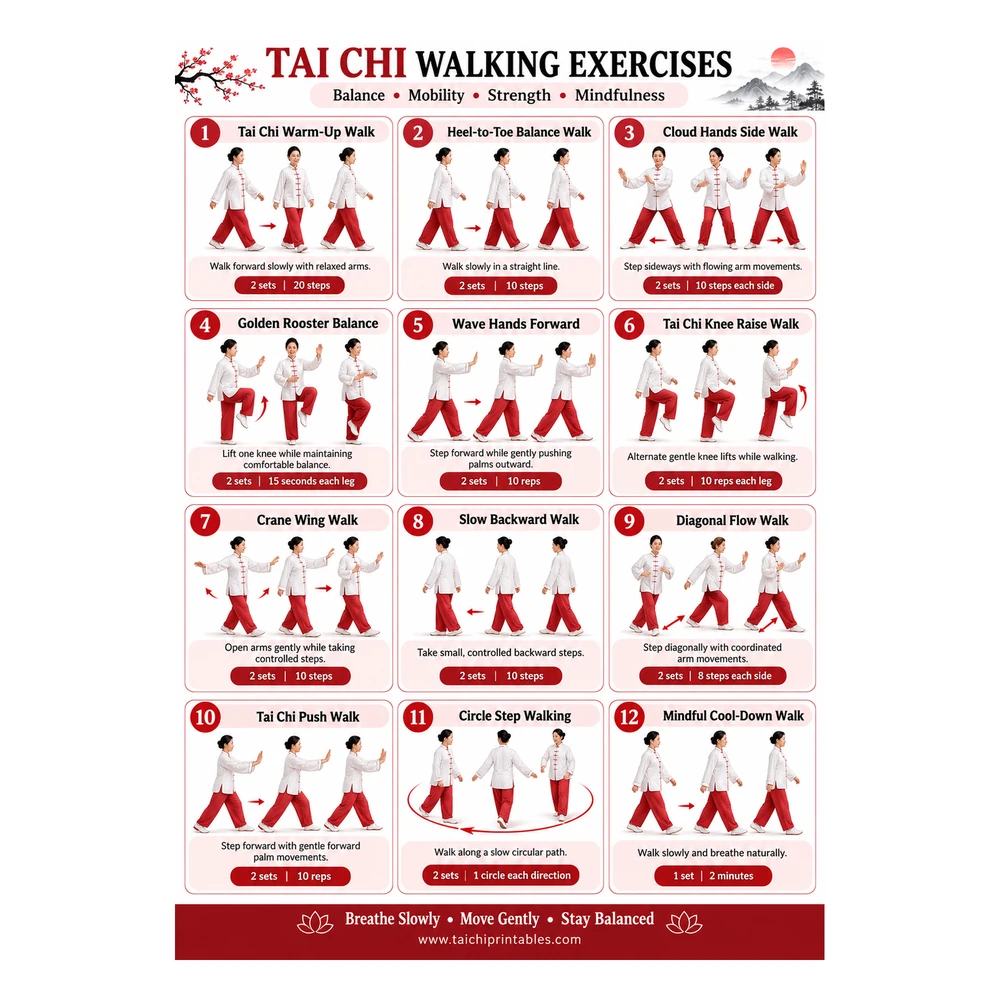

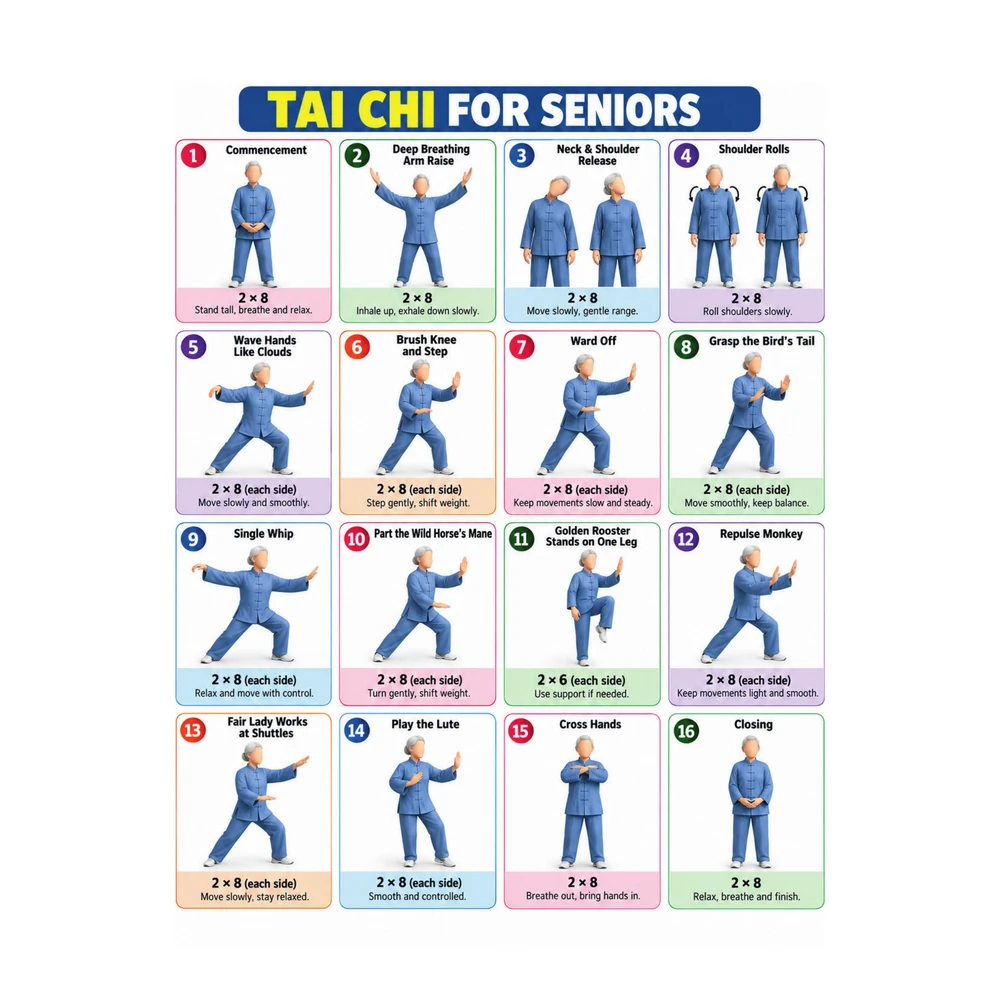
There is something a printed chart does that a video never quite manages. It stays where you put it. It does not buffer, pause for an advert, or disappear behind a login screen. It waits on the wall or the kitchen table, at exactly the page you need, for as long as you need it. For a gentle daily practice like tai chi, that simplicity is a large part of the appeal — and it is why exercise PDFs and printable charts have become such a popular way for older adults to exercise at home.
Not all charts are equal, though. Anyone who has squinted at a cramped, blurry exercise sheet will know that a badly made one is worse than none at all. This article explains what separates a good tai chi exercises PDF from a poor one, how to print it so it stays readable, and how to actually practise from a chart once it is on your wall.
What a good tai chi chart looks like
The whole routine on one page
The single biggest virtue of a good chart is that the complete routine fits on one page. One page means no flipping, no scrolling and no losing your place mid-session. You can see the whole shape of the practice at a glance — where you are, what comes next, and how much is left. For a daily routine you intend to repeat until it becomes familiar, that at-a-glance quality is what turns a sheet of paper into something you actually use.
Large, clear illustrations
Tai chi is learned by shape: where the arms are, which way the body faces, how the weight is placed. A good chart shows each movement as a clear, uncluttered illustration, big enough to read from a couple of paces away — because that is where you will be standing. If you have to walk up to the page and peer at it between movements, the drawings are too small, whatever the seller says about them.
Movements in order, with plain names
The movements should run in the order you perform them, numbered or laid out so the sequence is obvious, and each should carry a short, plain name. Traditional tai chi names are lovely, but a chart that only gives poetic titles and no hint of what the body is doing leaves a beginner guessing. The best charts keep the proper names and arrange them so plainly that the order teaches itself.
Print size you can genuinely read
Text on the chart — names, any counts or timings, any cautions — should be readable at arm’s length and more. Small print is the most common failure of exercise charts, and it is a failure that matters, because the people who most need a gentle routine are often the people least able to read six-point type while standing in their socks.
Red flags: how to spot a poor chart
If you are choosing a tai chi PDF, a few warning signs are worth knowing, because the same complaints come up again and again from disappointed buyers:
- Tiny, dense text. If the preview looks like a newspaper page, it will feel like one when you are trying to follow it mid-movement.
- Cluttered pages. Decorative borders, background patterns and too many panels squeezed in all fight with the one thing you need: clarity.
- Unclear drawings. Sketchy figures where you cannot tell which arm is which, or which way the body is turned, will leave you guessing at every step.
- No clear order. Movements scattered without numbering or flow, so each session starts with working out where to begin.
- Vague contents. A listing that cannot tell you plainly what the chart includes — how it is laid out, what style of practice, seated or standing — is telling you something.
Readability is not a luxury extra on an exercise chart. It is the whole product. A beautiful chart you cannot read is just a picture.
Printing it well
A good file can still be spoiled by a bad print, so a few practical points are worth the minute they take. Our charts are designed for A4 — the standard home paper size in most of the world — and in your printer settings you should choose “actual size” or 100% rather than “fit to page” shrinking, so the illustrations and text stay at the size they were designed at.
Colour printing gives the clearest result, because shading is part of what makes the figures easy to read. That said, a mono print of a well-designed chart should still be perfectly usable; if you print in black and white, use the highest quality setting your printer offers and check the lightest greys have not vanished. Heavier paper or light card makes a chart that survives being handled daily, and laminating it — or slipping it into a plastic sleeve — protects it from kitchen steam, garden air and general life. Many people stick their chart at standing eye height where they practise: a wall, the back of a door, the side of a wardrobe. Wherever you will actually see it every day is the right place.
How to practise from a chart, session by session
A chart rewards a particular way of practising. In your first few sessions, do not try to keep up with anything — there is nothing to keep up with, and that is the point. Work through the movements slowly, glancing at the page as often as you need, accepting that the early sessions will be stop-and-start. That is normal, and it passes.
After a week or so of regular practice, something pleasant happens: you start remembering what comes next. The glances get shorter. Within a few weeks, most people use the chart the way a cook uses a familiar recipe — barely at all, except to check the one movement that always slips their mind. The chart has done its job twice over: it taught you the routine, and it remains on the wall as a quiet prompt to begin.
If you would like to see how a complete routine is arranged, our tai chi for seniors exercises page walks through a full gentle session for older adults, and if standing practice is not for you, the chair tai chi version of the practice shows how the same approach works entirely from a seat.
How our seniors chart is laid out
To make all of this concrete: our seniors tai chi chart puts one complete, gentle routine on a single A4 page. The movements run in order across the page as clear illustrations with their names, designed to be read from standing distance and printed at home without any special equipment. It is standing practice, suitable for beginners, and it assumes nothing except a small patch of floor and a few quiet minutes. There are no accounts to create and nothing to install — you print it, you put it where you practise, and you begin. That is the entire idea, and we think the simplicity is the strength of it.
Frequently Asked Questions
What paper size are tai chi exercise PDFs usually made for?
Most home-printable charts, ours included, are designed for A4, which is the standard paper size in the UK, Europe, Australia and most other countries. If you use US Letter paper, choose the “fit” setting in your print dialogue or expect slightly wider margins — the chart will still print and read perfectly well.
Do I need a colour printer?
Colour gives the clearest result and is what the charts are designed for, but it is not essential. A good mono print on a high quality setting remains readable and usable. What matters more is printing at actual size rather than shrinking the page, so the illustrations and text stay large.
Can I follow a chart if I have never done tai chi?
Yes — that is exactly who a well-made chart is for. Work slowly at first, look at the page as often as you need, and keep your movements small and comfortable. The routine becomes familiar over a couple of weeks of short, regular sessions. Practise beside a sturdy chair if you feel unsteady, and stop if anything hurts.
If you are starting from scratch, our guide to tai chi for beginners guide explains the first steps before you pick up a chart.
Should I laminate my chart?
It is a good idea if the chart will live somewhere humid or be handled a lot — a kitchen, a conservatory, a garden room. A laminated chart or one in a plastic document sleeve wipes clean and lasts far longer. If it lives on a bedroom wall, plain heavy paper or light card is usually protection enough.
Final thoughts
A tai chi exercises PDF earns its place in your home by being clear: one page, big illustrations, movements in order, print you can read from where you stand. Judge any chart by those standards, print it at full size on decent paper, and put it where your practice happens. The technology could hardly be simpler — paper, wall, you — and for a gentle daily routine, simple is exactly right. If balance is your main goal, our guide to tai chi for balance guide pairs well with a printed chart.