

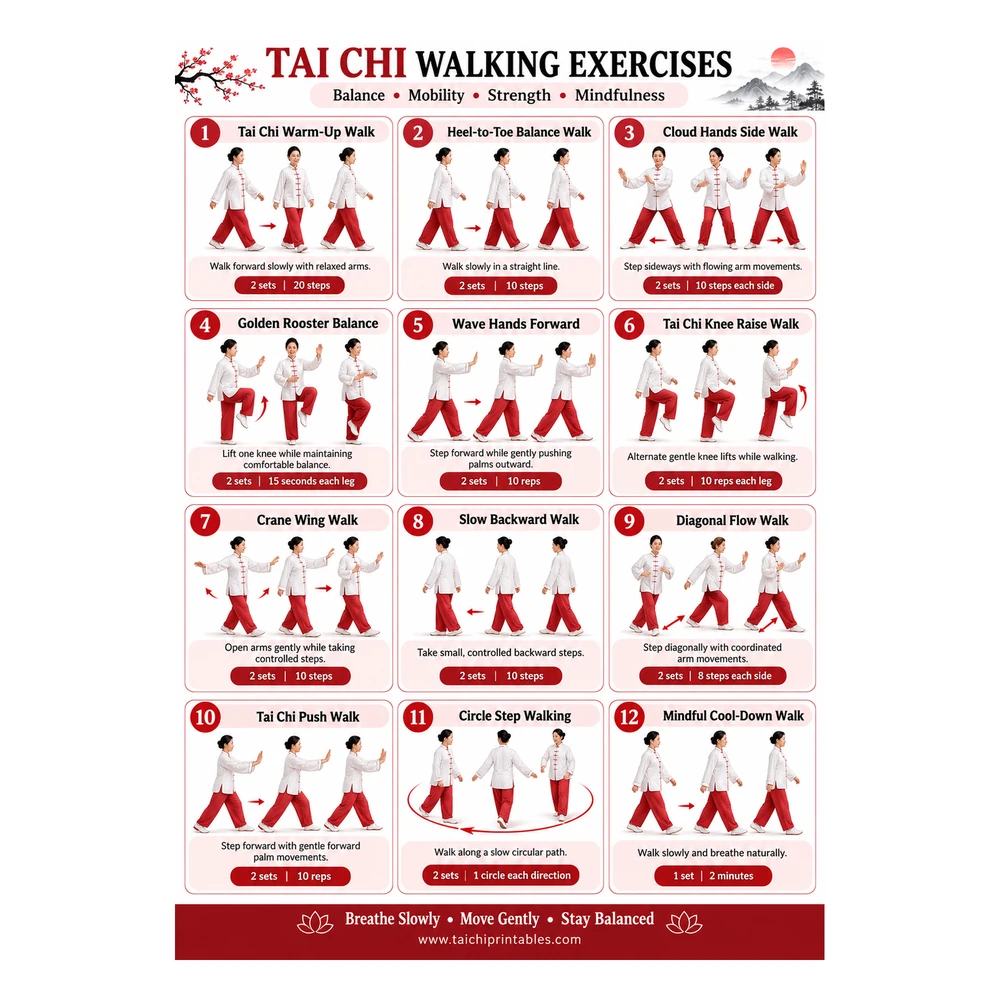
Tai chi walking is a slow, gentle way of moving that focuses on balance, posture and smooth weight shifts. It is often practised as part of Tai Chi, but it can also be learned on its own as a simple daily practice.
Tai chi walking for beginners step by step is a simple way to build confidence in your balance and coordination. You do not need special equipment or a lot of space. A clear area of floor, a sturdy chair nearby and a few minutes are enough to begin.
This guide takes you through the practice in stages, from standing still to walking slowly in a short line. Take your time with each stage and move on only when you feel ready.
What Is Tai Chi Walking?
Tai chi walking is a slow form of walking in which you shift your weight gradually from one foot to the other. Each step is taken carefully, with attention to posture and balance.
Unlike ordinary walking, tai chi walking is not about getting somewhere quickly. It is about noticing how your weight moves, how your feet meet the floor and how your body stays upright.
Many people find it a calming way to practise balance and coordination. It can be done indoors or outdoors, and it can be adapted to suit different levels of mobility.
If you would like a detailed guide, read our guide to how to do tai chi walking.
What You Will Need
Before you begin, gather a few simple items and prepare your space.
- A clear area of floor with no rugs, cables or clutter.
- A sturdy chair nearby for support.
- Comfortable, flat shoes or bare feet on a non-slip surface.
- Loose clothing that allows you to move easily.
- A few minutes without interruptions.
It is a good idea to practise near a wall or sturdy piece of furniture, especially when you are learning.
Safety First
Tai chi walking is gentle, but it still involves balance and movement. These safety points will help you practise with confidence.
- Clear the floor of anything you could trip over.
- Keep a sturdy chair within reach.
- Take small steps rather than long strides.
- Move slowly and avoid rushing.
- Stop if you feel dizzy, unsteady or in pain.
- Wear suitable footwear and avoid slippery socks.
If you have ongoing balance problems or a health condition that affects your mobility, check with a doctor or physiotherapist before starting a new movement practice.
How to Practise Tai Chi Walking Step by Step
The practice is divided into six stages. Each stage builds on the one before it, so it is best to work through them in order.
Stage 1: Standing Stance and Posture
Before taking any steps, it helps to learn a comfortable standing position. This is the foundation for the rest of the practice.
Standing stance practice
- Stand with your feet about shoulder-width apart.
- Place your feet flat on the floor and let your weight spread evenly across them.
- Keep your knees relaxed and slightly bent.
- Let your arms hang loosely by your sides.
- Imagine your head is gently floating upwards while your shoulders stay relaxed.
- Tuck your chin in slightly, rather than jutting it forwards.
- Breathe calmly through your nose and allow your belly to rise and fall gently.
Stay in this position for a minute or two. Notice how your weight feels through your feet. If you feel unsteady, place one hand lightly on a chair.
Stage 2: Weight-Shift Drill
Once you feel comfortable standing, you can practise shifting your weight from one foot to the other. This is the key movement in tai chi walking.
Weight-shift practice
- Stand in your comfortable stance with your feet shoulder-width apart.
- Slowly shift your weight onto your right foot.
- Allow your left heel to lift slightly, while keeping your left toes on the floor.
- Pause for a moment and notice how your balance feels.
- Slowly shift your weight back to the centre, then onto your left foot.
- Allow your right heel to lift slightly, while keeping your right toes on the floor.
Repeat this slow shifting for one to two minutes. Keep your knees relaxed and your movements smooth.
Stage 3: Heel-First Stepping in Place
In this stage, you will practise taking a small step without moving forwards. This helps you learn the heel-first movement used in tai chi walking.
Heel-first stepping practice
- Begin in your standing stance with your weight on your right foot.
- Lift your left heel slightly, keeping your toes on the floor.
- Slowly lift your left foot a small distance off the floor.
- Place your left heel down first, a short distance in front of you.
- Gradually roll through the foot and place the rest of the foot on the floor.
- Shift your weight slowly onto your left foot.
- Repeat the same movement with your right foot.
Take your time with each step. Your feet should move smoothly and quietly, rather than with a sudden drop.
Stage 4: Adding the Arm Movement
Tai chi walking often includes gentle arm movements. These should feel natural and relaxed, not forced.
Adding arm movement
- Begin in your standing stance.
- As you shift your weight to your right foot, allow your left arm to move gently forwards.
- As your weight moves to your left foot, allow your right arm to move gently forwards.
- Continue alternating the arm movement with each weight shift.
- Keep the movements small and relaxed.
- Breathe calmly as you move.
- If your arms feel stiff, lower them and let them hang by your sides.
- Practise the arm movement slowly until it feels comfortable.
Your arms should move in a relaxed way, like a natural swing, rather than being held stiffly in a fixed position.
Stage 5: Walking Slowly in a Short Line and Turning Around Safely
When you feel comfortable with the previous stages, you can begin walking slowly in a straight line.
Walking in a short line
- Choose a clear, straight path of about three to four metres.
- Place a sturdy chair at the end of the path if you need a resting point.
- Begin in your standing stance at one end of the path.
- Take a small step forwards, placing your heel down first.
- Shift your weight slowly onto that foot before taking the next step.
- Continue walking slowly along the path, keeping your steps small and steady.
- When you reach the end, turn around slowly by taking small steps in a circle, rather than pivoting sharply on one foot.
Walk back along the path in the same slow way. You can repeat the walk two or three times if you feel comfortable.
Stage 6: Building Up Minutes Over Two Weeks
As you become more familiar with the practice, you can gradually increase the time you spend walking.
A simple two-week plan
| Week | Sessions per week | Suggested time |
|---|---|---|
| Week 1 | Three or four | Five to 10 minutes |
| Week 2 | Three or four | 10 to 15 minutes |
You can practise at any time of day. Some people prefer the morning, when they feel fresh, while others prefer the afternoon.
Listen to your body and rest when you need to. If you feel tired, stop and sit down.
Common Mistakes to Avoid
It is natural to make a few mistakes when learning. These are the most common ones to watch for.
- Taking steps that are too long.
- Rushing the weight shift.
- Holding your breath.
- Locking your knees.
- Looking down at your feet for too long.
If you notice any of these, slow down and return to the standing stance for a moment.
For more movement ideas, try these tai chi walking exercises.
Frequently Asked Questions
What is tai chi walking for beginners?
Tai chi walking is a slow, gentle walking practice that focuses on posture, balance and smooth weight shifts. Beginners usually start with standing and weight-shift exercises before walking in a short line.
How long should I practise tai chi walking each day?
Five to 10 minutes is a good starting point. You can gradually build up to 15 minutes as you become more comfortable.
Do I need a teacher to learn tai chi walking?
A teacher can be helpful, but many people begin by practising the basic movements at home. You can also look for local classes or online guidance.
Can I practise tai chi walking indoors?
Yes. Tai chi walking can be practised indoors in a clear space. Make sure the floor is clear and you have a sturdy chair nearby for support.
What should I do if I feel unsteady?
Stop and hold onto a chair or wall. Sit down if needed. Reduce the size of your steps and practise the weight-shift drill again until you feel more stable. If you have ongoing balance problems, speak with a doctor or physiotherapist.
A Calm Way to Practise Balance
Tai chi walking for beginners step by step is a gentle way to practise balance, posture and coordination. It does not require special equipment or a large space.
Start with the standing stance and weight-shift drill. Take small steps and move slowly. Over time, you may find that walking feels more steady and relaxed.
Practise regularly, even for a few minutes at a time, and enjoy the calm, focused feeling that comes with slow, deliberate movement.