

Tai chi walking looks simple from the outside: one slow step, then another. The difference is in the details — where your weight sits, how your foot meets the floor, and how your arms and breathing settle into one quiet rhythm. Learn the basic step, and the rest is variations on that single pattern.
This guide teaches the technique itself: the core foot pattern first, then 12 walking movements, each with short steps you can follow on day one. For the background first, read our guide on what tai chi walking is and why people practise it — then come back and put your feet to work.
The Basic Tai Chi Walking Step
Every movement below uses this same foundation, so learn it first.
- Stand tall and settle. Feet hip-width apart, knees soft, shoulders dropped, arms loose. Weight even on both feet; take two slow breaths.
- Shift your weight to one leg. Move fully onto your right foot until the left foot feels light. This full shift is the heart of the practice — never step from a half-loaded leg.
- Reach forward, heel first. Swing the light leg forward and touch down with your heel only, about one foot-length ahead.
- Roll through the foot. Lower slowly from heel to sole to toes, as if testing ice. Let the whole foot arrive before you trust it.
- Transfer your weight completely. Shift forward over the new foot until the back foot is empty and light. Pause for a breath here.
- Lift the back foot from the heel. Heel rises first, then toes; draw the foot forward past your standing leg.
- Place the next heel and repeat. Heel down, roll through, shift fully. Arms can swing gently opposite to your legs, or rest at your sides.
- Breathe with the steps. Breathe in as you shift and prepare; breathe out as you place the foot and settle. Let the breath set the pace.
Try this for a minute or two first — slow is correct; this is how to tai chi walk at its most basic. If you feel wobbly, pause on both feet and restart from step 2.
Before You Start
- Clear your space. You need a flat stretch of floor, about a hallway’s length. Move trip hazards: curled rug edges, cords, stray shoes.
- Keep support nearby at first. Practise beside a wall, sturdy chair, or kitchen counter, so a handhold is always in reach.
- Choose your footwear. Flat shoes with a thin, flexible sole, or bare feet on a non-slip surface. Thick trainers blunt the feel of the roll.
- Warm up gently. A minute of easy marching on the spot and a few ankle circles will do.
- Check with your doctor first if you have a health condition, joint problems, dizziness, or you are returning to exercise after an injury or a long break.
The 12 Tai Chi Walking Movements, Step by Step
Work through these in order: the early ones build the basic step, the middle ones add arm patterns and turns, and the last slows everything down.
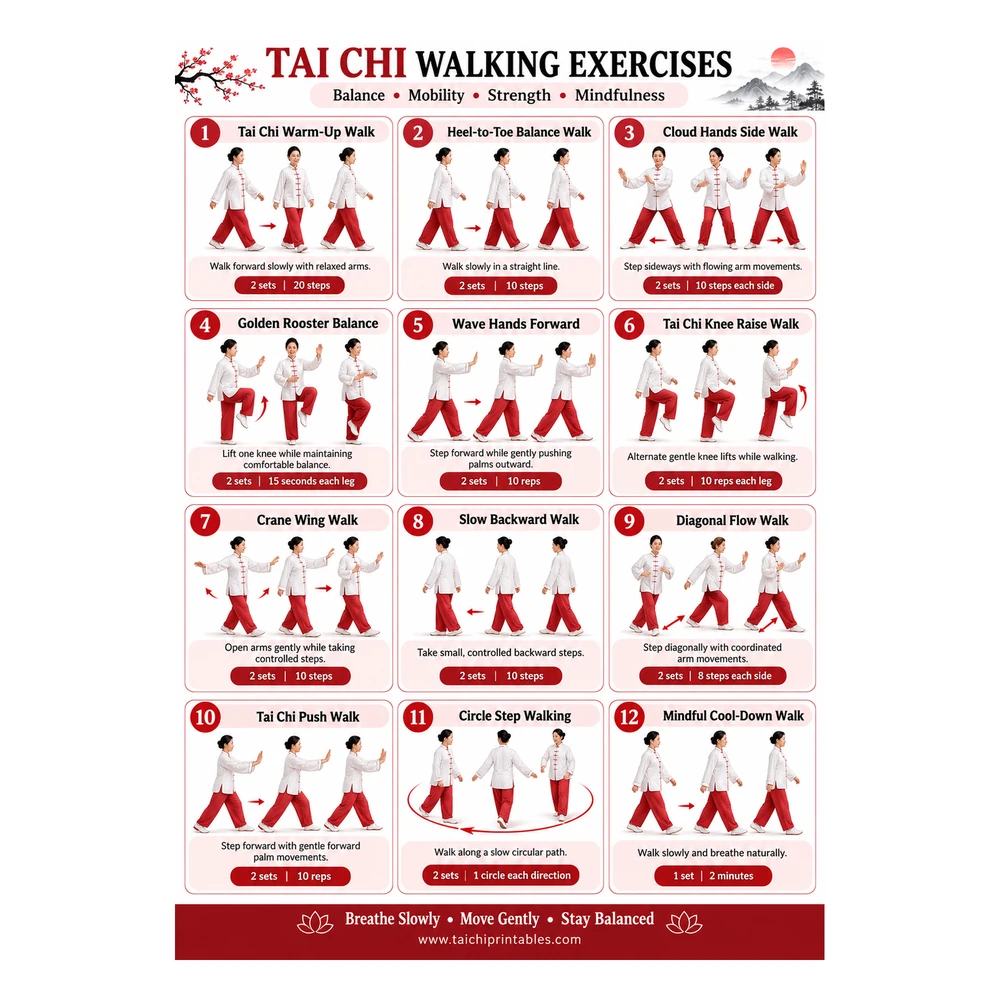
1. Tai Chi Warm-Up Walk
Purpose: To settle into the slow heel-to-toe rhythm before the main practice.
How to Do It:
- Stand with feet hip-width apart, arms relaxed.
- Shift your weight fully onto your right foot.
- Step forward with your left heel, roll through, and transfer your weight.
- Keep walking slowly, then turn carefully and walk back.
Practice: 2 sets | 20 steps
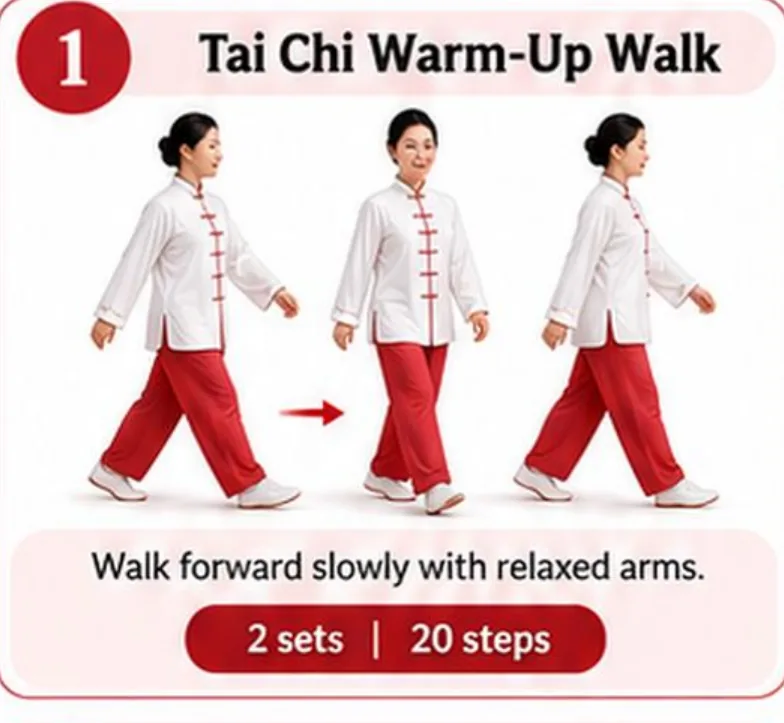
2. Heel-to-Toe Balance Walk
Purpose: To practise placing each foot in a straight line, with control.
How to Do It:
- Stand tall, a wall or chair beside you if you want support.
- Step forward, placing your heel directly in front of the toes of your back foot.
- Roll through the foot and shift your weight fully.
- Repeat with the other foot, slow and deliberate.
Practice: 2 sets | 10 steps
3. Cloud Hands Side Walk
Purpose: To combine sideways steps with a soft, flowing arm pattern.
How to Do It:
- Stand with feet together, hands in front of your waist, palms down.
- Step sideways with your left foot as your hands drift left.
- Bring your right foot in to meet it as the hands float back across.
- Keep stepping sideways, hands moving like slow clouds.
- Reverse direction halfway through.
Practice: 2 sets | 10 steps each side

4. Golden Rooster Balance
Purpose: To practise standing steady on one leg between slow steps.
How to Do It:
- Walk two or three basic steps to find your rhythm.
- Shift all your weight onto your right leg.
- Lift your left knee slightly and hold, arms relaxed or slightly out.
- Lower the foot with control, step forward, and repeat on the other leg.
Practice: 2 sets | 15 seconds each leg

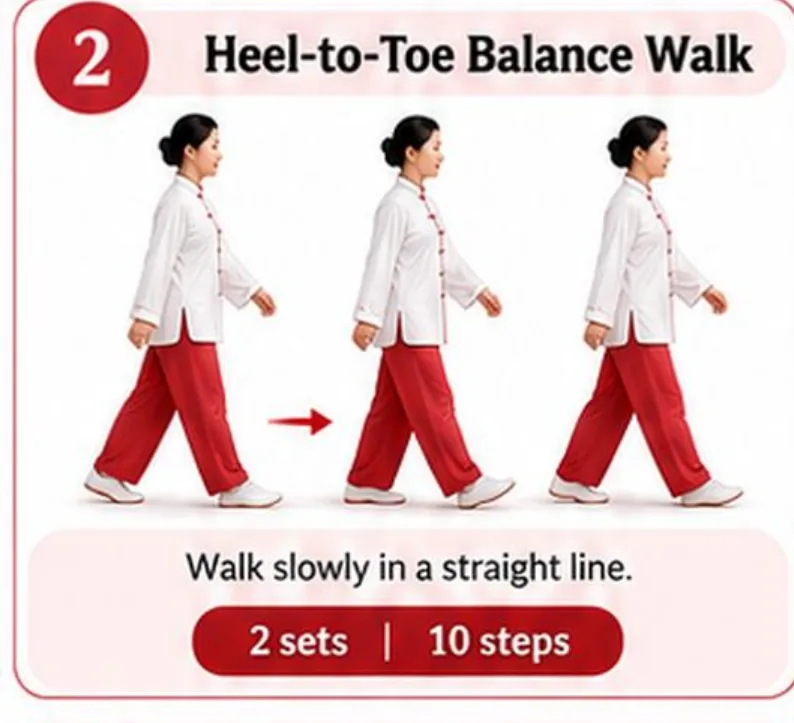
5. Wave Hands Forward
Purpose: To add a gentle forward hand movement to the walking step.
How to Do It:
- Begin walking with the basic heel-to-toe step.
- As you step, let both hands float up in front of your chest, palms away.
- As your weight settles, let the hands sink softly back down.
- Match one wave to each step, loose and unhurried.
Practice: 2 sets | 10 reps
6. Tai Chi Knee Raise Walk
Purpose: To practise lifting the knee slowly while the standing leg stays steady.
How to Do It:
- Shift your weight fully onto your right leg.
- Raise your left knee slowly, only as high as feels controlled.
- Lower it by reaching the heel forward into the next step.
- Roll through, shift your weight, and raise the other knee.
Practice: 2 sets | 10 reps each leg

7. Crane Wing Walk
Purpose: To coordinate a wide, open arm movement with each forward step.
How to Do It:
- Stand tall, arms resting at your sides.
- As you step forward with your left foot, open both arms out like slow wings.
- As your weight transfers, let the arms lower gently.
- Repeat on the right step, arms opening and lowering with your feet.
Practice: 2 sets | 10 steps

8. Slow Backward Walk
Purpose: To practise controlled stepping behind you, toes first.
How to Do It:
- Stand tall, with support nearby until this feels familiar.
- Reach one foot behind you and touch the floor with your toes.
- Roll back through the foot and shift your weight slowly.
- Draw the other foot back the same way, keeping steps short.
Practice: 2 sets | 10 steps

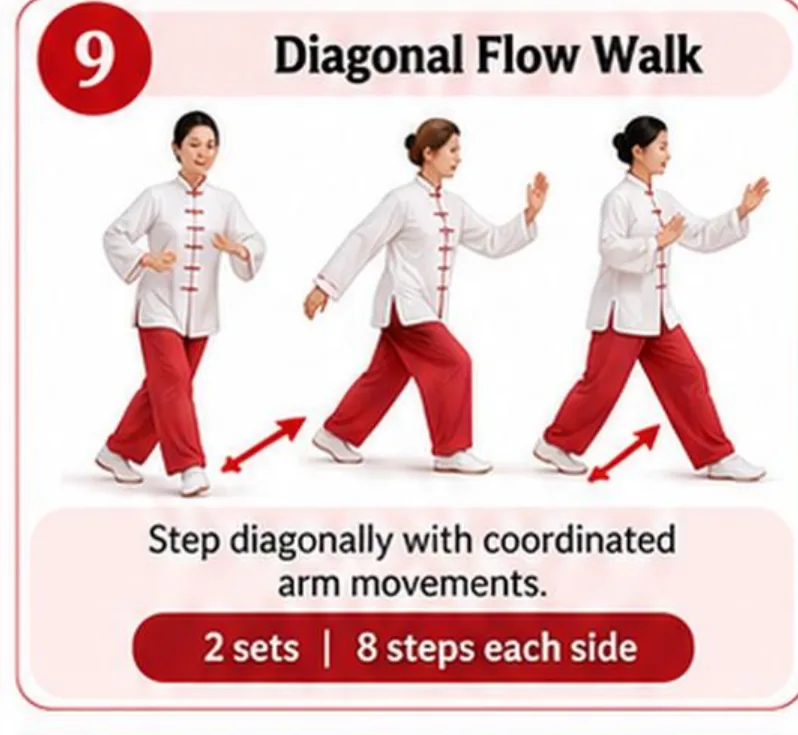
9. Diagonal Flow Walk
Purpose: To practise stepping at an angle while the body stays centred.
How to Do It:
- Shift your weight onto your right foot.
- Step forward and slightly out to the left, heel first, at about a 45-degree angle.
- Roll through the foot and transfer your weight fully.
- Step diagonally to the other side, alternating in a slow zigzag.
Practice: 2 sets | 8 steps each side
10. Tai Chi Push Walk
Purpose: To pair each step with a soft forward push of the hands.
How to Do It:
- Hold your hands in front of your waist, palms facing forward.
- As you step, press both hands gently forward, as if pushing soft water.
- Draw the hands back as your weight settles.
- Repeat with each step, breathing out as you press.
Practice: 2 sets | 10 reps

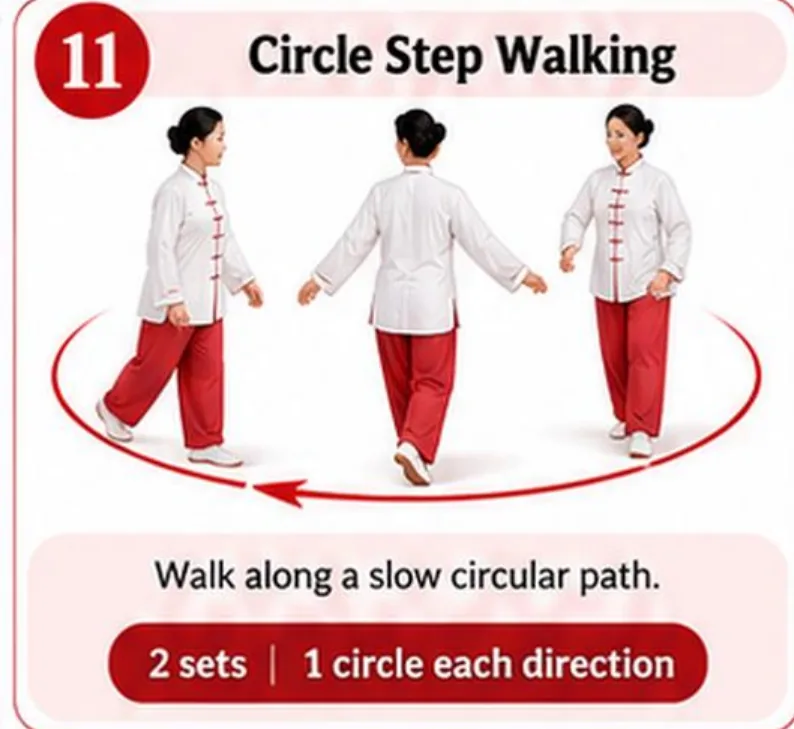
11. Circle Step Walking
Purpose: To practise turning gradually while keeping the slow step pattern.
How to Do It:
- Begin with the basic walking step on a clear patch of floor.
- Angle each new step slightly inward, so your path curves into a wide circle.
- Keep steps short as you walk the full circle.
- Walk the circle again in the opposite direction.
Practice: 2 sets | 1 circle each direction
12. Mindful Cool-Down Walk
Purpose: To close the practice with the slowest steps of the session.
How to Do It:
- Walk at half the speed of your warm-up walk.
- Let your arms hang still and your breathing deepen on its own.
- Shorten your steps gradually as you walk.
- Finish standing on both feet, weight even, for three slow breaths.
Practice: 1 set | 2 minutes

A Simple 10-Minute Practice Session
Once the basic step feels familiar, this session strings six movements together. Rest for a few breaths between each, and use support whenever you want it.
| Time | Movement | Practice |
|---|---|---|
| Minutes 0–2 | Tai Chi Warm-Up Walk | 2 sets | 20 steps |
| Minutes 2–4 | Heel-to-Toe Balance Walk | 2 sets | 10 steps |
| Minutes 4–6 | Cloud Hands Side Walk | 2 sets | 10 steps each side |
| Minutes 6–7 | Golden Rooster Balance | 2 sets | 15 seconds each leg |
| Minutes 7–9 | Tai Chi Push Walk | 2 sets | 10 reps |
| Minutes 9–10 | Mindful Cool-Down Walk | 1 set | 2 minutes |
The timings are a guide, not a test. If a movement needs more practice, stay with it and shorten another. Ten unhurried minutes, done regularly, beat one long, tiring session.
Common Beginner Mistakes
- Rushing the steps. Fix: count slowly to three during each weight shift — if you cannot count, you are going too fast.
- Holding your breath. Fix: breathe out as each foot lands; the in-breath takes care of itself.
- Looking at your feet the whole time. Fix: glance down to check placement, then lift your gaze to a point ahead at eye level.
- Steps that are too long. Long steps make the weight shift lurch. Fix: keep each step to about one foot-length — shorter is steadier.
- Tensing the shoulders. Shoulders creep towards the ears as concentration builds. Fix: every few steps, drop them, shake your arms out, and begin again.
Get the Printable Chart
If you would rather have the movements in front of you than scroll back up this page, the Tai Chi Walking Exercises printable chart puts the whole routine on one page: a one-page A4 printable PDF with 12 illustrated walking movements, each with instructions and repetitions. Prop it by your practice space and follow along step by step.
Frequently Asked Questions
1. How do you do tai chi walking if space is small?
You do not need a long hallway. Walk four or five steps, turn slowly with small steps, and walk back. Some movements need hardly any room at all: Golden Rooster Balance stays on one spot, Cloud Hands Side Walk needs a few steps each way, and Circle Step Walking can be one small, wide circle. A few square metres of cleared floor covers the full set.
2. How slow should it be?
Slower than feels natural at first. One step — shift, reach, roll, transfer — should take roughly three to five seconds. A useful test: you should be able to stop and stand still at any point in a step without wobbling. If you can, your pace is right; slow down further as the pattern settles.
3. Can I hold a chair for support?
Yes. Place a sturdy chair beside you, or walk alongside a counter, and rest one hand on it lightly. Use the hand for balance checks rather than leaning your weight on it. As confidence grows, lift the hand for a step or two, keeping it hovering just above the support. Many people keep a hand nearby for balance movements and walk unsupported otherwise.
4. How often should beginners practise?
Short, regular sessions suit beginners best. Ten minutes on most days builds the habit and teaches the step pattern steadily. You can follow the session above, or work through the 12 movements once each. Rest days are fine; on tired days, stick to the warm-up and cool-down walks.
5. What should I wear, and can I practise barefoot?
Comfortable clothes and flat shoes with a thin sole, so you can feel the heel-to-toe roll. Barefoot is fine on a clean, non-slip floor. Avoid socks on smooth floors — they slide — and thick cushioned trainers, which blunt the feel of each step.
Final Thoughts
Learning how to do tai chi walking comes down to one pattern repeated with patience: shift fully, reach with the heel, roll through the foot, and only then step again. All 12 movements build on that pattern, so every session practises the same skill from a new angle. Start with the warm-up walk and two or three movements; add more as they feel familiar.
Safety Note: This guide describes gentle, low-impact exercise for general practice. It is educational information, not medical advice. Stop if you feel pain, dizziness, or unsteadiness, and rest until you feel fully settled. Practise near support until every movement feels secure, and talk to your doctor before starting if you have a health condition, balance problems, joint issues, or a recent injury.