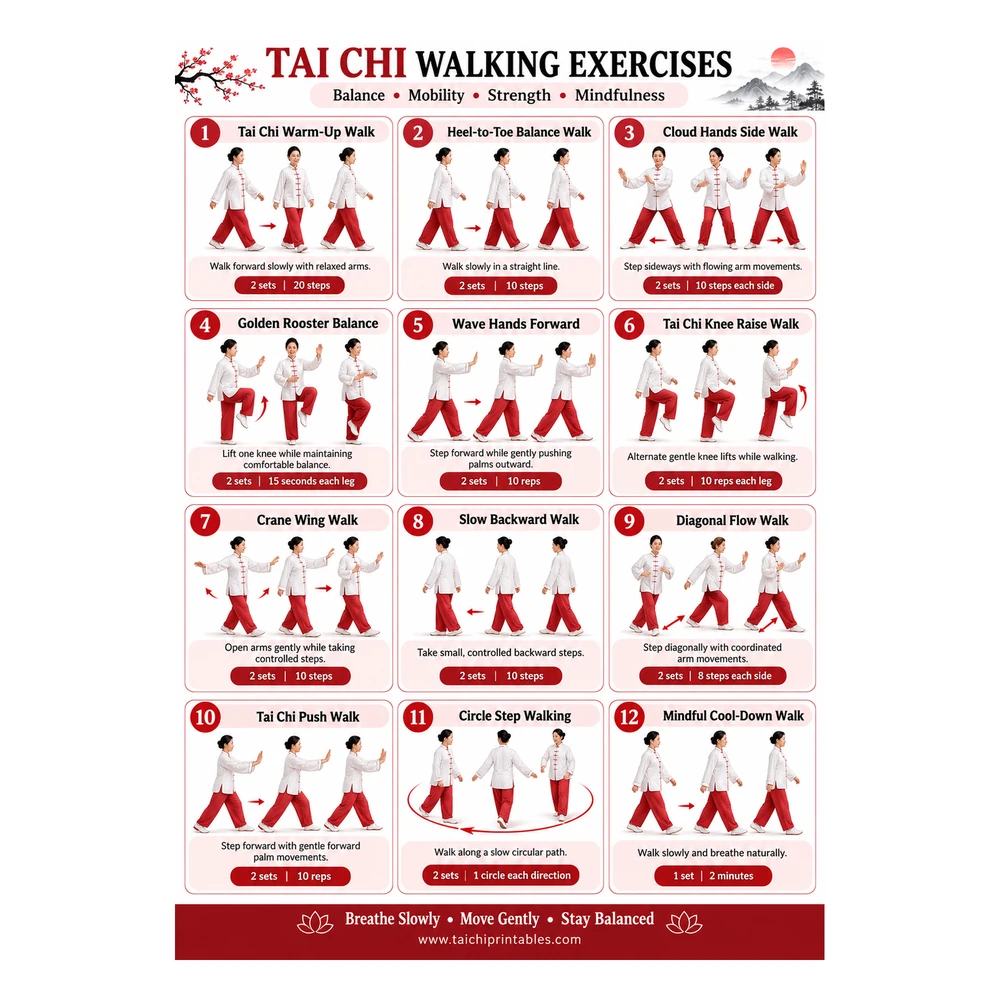

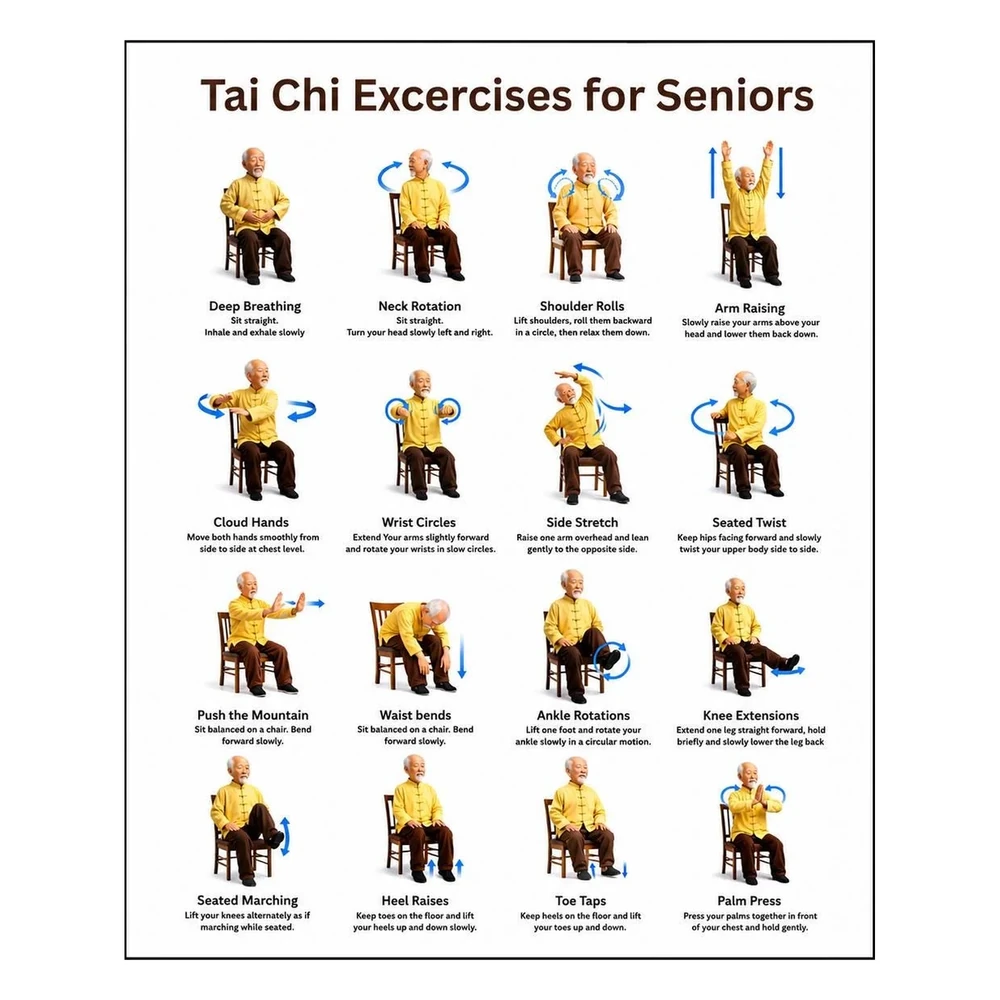
Sore knees shrink your world quietly. The stairs get planned around. The walk with friends gets declined. The gardening happens in shorter and shorter spells, from a stool. And the frustrating part is that most of the exercise you are told to do seems designed for other people’s knees: running pounds them, aerobics lands on them, deep squats load them exactly where they hurt.
Tai chi asks far less of your knees — and seated tai chi, done entirely from a chair, asks almost nothing of them at all. That is why it stays possible for many people long after other activities have been crossed off the list. This article explains why, sets out the rules that keep knees safe within the practice, and is honest about the limits: tai chi is not a treatment for knee conditions, and some knee symptoms need a doctor, not a practice session. What follows is general educational information, not medical advice.
Why knees struggle with ordinary exercise
The knee is a hinge that carries your whole weight, and it complains loudest about three things: impact, deep bending under load, and twisting while loaded. Ordinary exercise is full of all three. Every running step lands with multiples of your body weight. A deep squat bends the knee far while it is carrying you. Changing direction quickly twists a loaded joint. A knee that is already sore, stiff or arthritic experiences each of these as a direct insult, and it usually lets you know about it for the rest of the day.
The result is a trap. The knee hurts, so you move less. Moving less weakens the thigh and hip muscles that support the knee, so the knee copes worse, so it hurts more. Breaking that cycle requires movement the knee can actually tolerate — which is precisely the gap tai chi fits into.
Why tai chi can still be possible
Standing tai chi replaces impact with gradual weight transfer. Your weight eases from one foot to the other over several seconds, with no landing, no jolt and no sudden change of direction. The knee bends involved are shallow — a softening, not a squat — and, most importantly, you choose the depth. On a good day you might bend a little more; on a sore day you can practise almost upright, and the session still counts.
Then there is the seated option, which changes the picture completely. In chair tai chi the chair carries your weight, so your legs can move — lifting, extending, circling gently — without bearing weight through bent knees at all. For someone whose knees rule out standing exercise for now, this is not a consolation prize. It is real, structured movement that keeps legs, trunk and coordination in use while the knees are left in peace. Our Chair Tai Chi article teaches a complete seated routine of this kind, movement by movement.
The knee rules
These rules apply to every standing movement, and they are not optional decoration. They are what make the difference between practice that suits sore knees and practice that stirs them up.
Keep your knees tracking over your toes. When a knee bends, it should point in the same direction as the foot beneath it. Never let the knees collapse inwards, and never twist on a planted, loaded foot — turn by lifting and replacing the foot instead.
Stay shallow. Small bends only. Tai chi done with high, soft knees is still tai chi. Depth is the last thing to add and the first thing to remove on a sore day.
Never push through pain. Mild effort in the thigh muscles is fine. Pain in the joint itself is information: ease off, straighten up a little, or stop that movement. A session that leaves your knees worse that evening was too much, whatever the clock said.
Use support. Practise beside a chair, a table or a wall, and hold on whenever you need to. Support lets you keep the knee bend shallow and the weight shift slow, which is exactly what sore knees want.
Warm up gently. A few minutes of seated ankle circles, gentle seated marching and easy weight shifts prepare the legs far better than launching straight into standing movements.
Build in minutes, not leaps. Start with five or ten minutes. Add a little only when the current amount leaves your knees no worse the next day.
Seated practice: the kindest starting point
If your knees are having a bad month, start seated and feel no need to apologise for it. A seated session works your arms, shoulders and trunk through the same flowing patterns, turns your waist, lifts and extends your legs without loading the knees, and practises the coordination and steady breathing that make tai chi what it is. Many people begin seated, move to a mixture of seated and standing as their legs strengthen, and keep seated sessions in reserve for sore days permanently.
If arthritis is part of your picture — in the knees or elsewhere — our article on tai chi for arthritis looks at practising with that condition in more detail, with the same emphasis on small ranges and honest limits.
What tai chi cannot do — and when to see a doctor
Tai chi cannot repair a damaged knee. It cannot regrow cartilage, mend a torn meniscus, or replace any treatment, medication or surgery you have been advised to have. It is gentle exercise that many sore knees tolerate well — nothing more, and it should never be sold as more.
Some knee symptoms should be assessed rather than exercised around. See your doctor if a knee swells up, if it locks or catches, if it gives way under you, if pain followed an injury or a twist, or if pain is steadily worsening rather than settling. If you have a diagnosed knee condition, ask your doctor or physiotherapist whether gentle or seated tai chi fits your situation before you start — for most people it does, but your knees are yours, and a general article cannot know them.
Frequently Asked Questions
Can I do tai chi if my knees hurt on stairs?
Quite possibly, yes — with the knee rules above. Stair pain usually reflects how much load a bent knee is carrying, and tai chi lets you control exactly that: shallow bends, slow weight shifts, support within reach, and a fully seated version whenever standing feels like too much. If your knee also swells, locks or gives way, get it checked before exercising around it.
Is seated tai chi worth doing, or should I wait until I can stand?
It is worth doing in its own right, and waiting usually helps nothing — the muscles that support your knees only weaken while you wait. Seated practice keeps you moving, builds the habit, and can be a bridge back to standing practice. For many people it remains their main form of tai chi permanently, and there is nothing second-rate about that.
My knee clicks or swells after exercise. What should I do?
Clicking without pain is common and usually not a concern on its own. Swelling after exercise is your knee telling you the session was more than it wanted: shorten the next one, stay shallower, favour seated practice for a while. If swelling keeps happening, or comes with locking, giving way or worsening pain, see your doctor rather than repeatedly testing it.
How deep should I bend my knees?
Only as far as is completely comfortable — for sore knees, that usually means a slight softening rather than anything you would call a bend. Keep your knees behind the line of your toes, pointing the same way as your feet, and straighten up the moment the joint itself protests. In tai chi, shallow and smooth beats deep and strained every time.
Final thoughts
Sore knees close doors one at a time, and most exercise seems to queue up on the other side of them. Tai chi — standing practice with shallow, supported, self-paced movements, and seated practice that takes your weight off your knees altogether — is one of the few doors still open. It will not repair your knees, and nothing in this article has pretended otherwise. But it can keep you moving while other options cannot, and for legs that need their supporting muscles kept in the game, that matters more than it might sound.