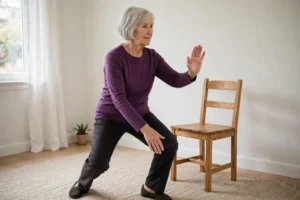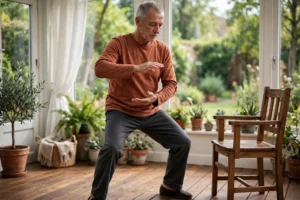


Tai chi walking is a way of walking so slowly and deliberately that each step becomes the exercise. Instead of striding out to get somewhere, you take short, careful steps, placing your heel down first and shifting your whole weight onto one foot before the next step begins. There is no target speed and no distance to cover. Most people practise it at home, walking the length of a hallway and back.
If you have heard the term and wondered what it actually involves — or whether it is something you could do in your own home — this guide explains the practice, shows you the basic step, and outlines a gentle way to build up over four weeks.
What is tai chi walking?
Tai chi walking comes from tai chi practice, but it does not ask you to learn a long sequence of movements. There is really only one movement to learn: the step itself, repeated slowly in both directions along a short path.
Three things make it different from an ordinary walk:
- The steps are short and heel-first. Your heel touches the floor first, then your weight rolls slowly through the foot, from heel to toes.
- Your weight fully shifts before you step again. One foot is completely free before it moves, which makes every step deliberate rather than hurried.
- Your attention stays on the step you are taking. You stand upright and relaxed, breathe calmly, and look ahead rather than down at your feet.
Because the path is short — a clear hallway, or a few metres of clear floor — you walk slowly to the end, turn in a wide, gentle arc, and walk back. A session can be as short as five minutes, and the whole practice happens at a pace where you could stop comfortably in the middle of any step.
Who tai chi walking suits
Tai chi walking suits complete beginners, including older adults, because there is no routine to memorise and no equipment to buy. It works well if you:
- Want a gentle walking practice you can do at home, in a small space, whatever the weather.
- Prefer short sessions — five to fifteen minutes — over long workouts.
- Like instructions that are simple enough to follow from the first day.
- Want to practise near a wall, counter or sturdy chair, so support is always within reach.
It is a standing, walking practice, so it does assume you can walk short distances at home. If standing and walking are difficult for you right now, a seated practice may be the better starting point — our chair tai chi routine covers a complete practice you can do sitting down.
Before you start: setting up safely
A few minutes of preparation makes the practice much steadier. Treat this checklist as part of the exercise, not an optional extra:
- Clear your path. Practise on a clear, flat surface — a hallway is ideal. Move anything you could trip over out of the way first.
- Stay near support. Keep a wall, a counter or a sturdy chair within reach the whole time, so you can steady yourself whenever you need to. Holding on is part of the practice, not a shortcut.
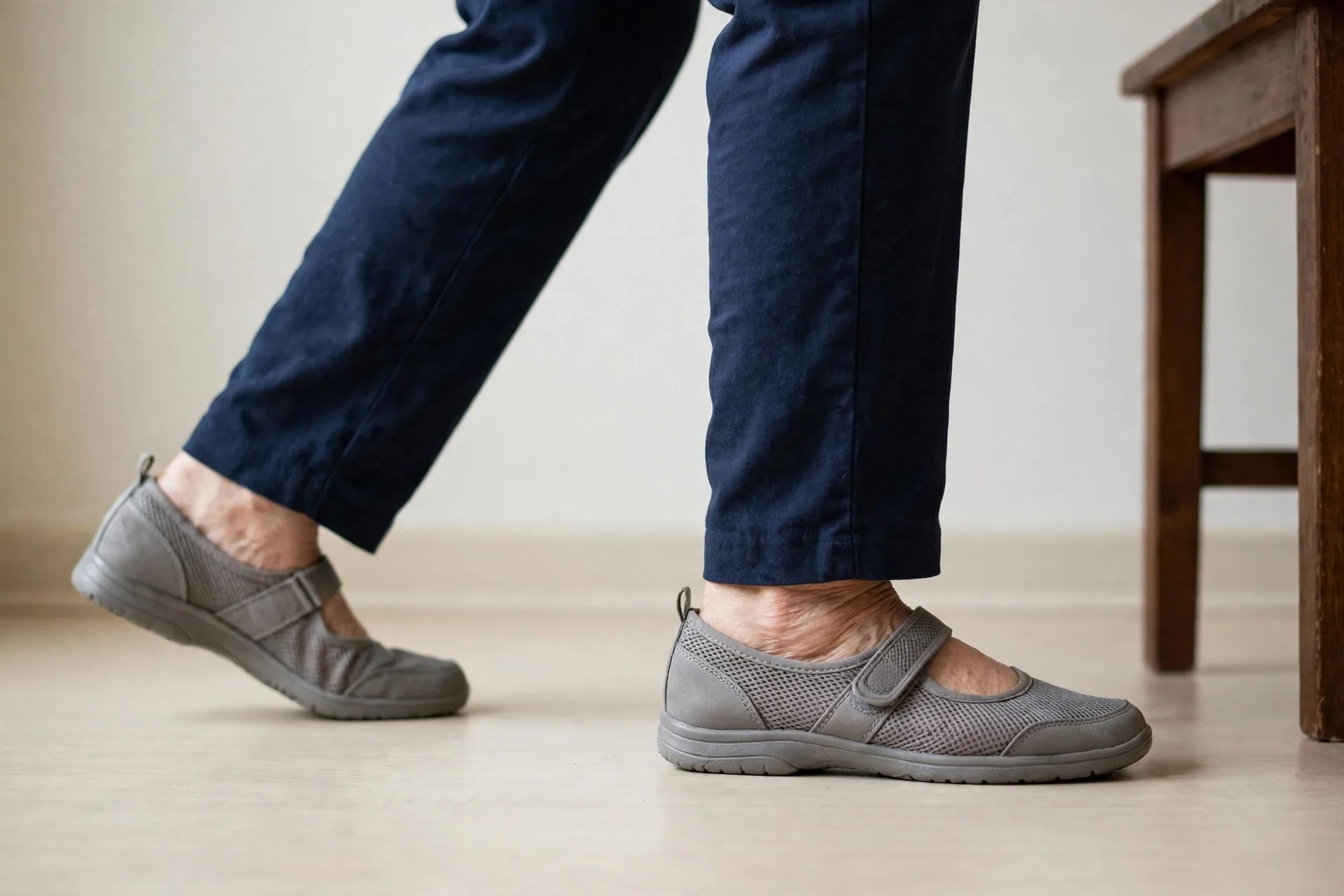
- Wear the right footwear. Flat, non-slip shoes — never loose slippers or socks alone.
- Start short. Five minutes is plenty at first. Build up slowly, week by week.
- Have company if you feel unsteady. If you feel unsteady on your feet, practise with someone nearby.

The basic step, step by step
Stand near your support with your feet about hip-width apart and your weight settled evenly on both feet. Stand tall, as if a gentle string were lifting the top of your head, keep your knees soft rather than locked, and let your shoulders and arms relax. Then:
- Shift your weight fully onto one leg, so the other foot is completely free.
- Lift the free foot just clear of the floor — low and slow is fine.
- Place the heel down first, ahead of you, keeping the step short.
- Roll your weight slowly through that foot, from heel to toes.
- Fully shift your weight onto the front foot before lifting the back foot.
- Repeat on the other side, keeping every step short and unhurried.
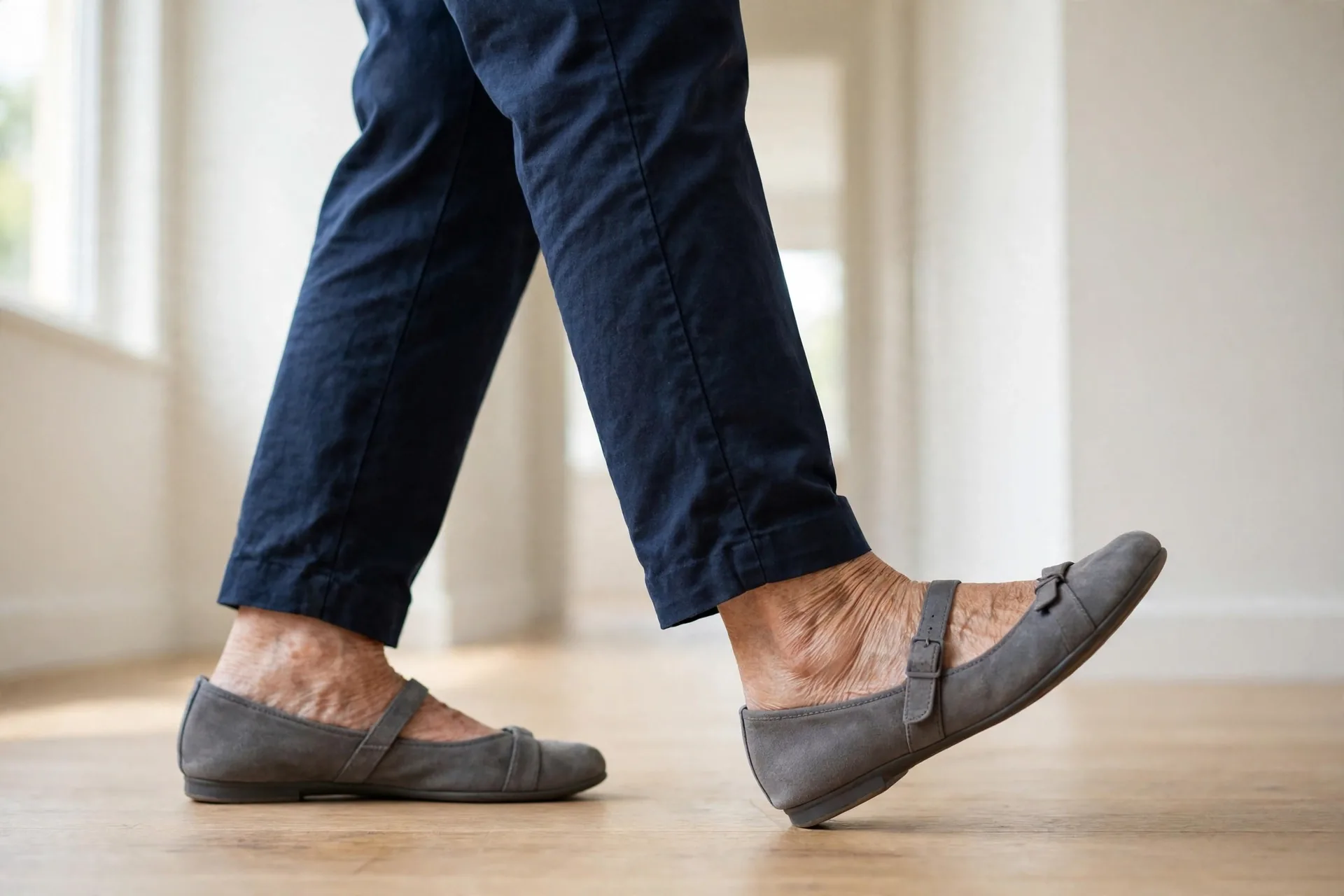
Breathe naturally as you walk — in and out calmly, and never hold your breath. Keep your eyes looking ahead; if you need to check the floor, stop walking first, then look.
Turning: when you reach the end of your path, turn by taking several small steps in a wide, gentle arc, as if walking around a large circle. Never twist or pivot on a planted foot.
Two mistakes catch out most beginners. The first is steps that are too long, which makes you unsteady — halve your step length, shorter than you think. The second is rushing. If you could not stop comfortably in the middle of a step, you are going too fast.
Your first 10-minute session
Once the basic step feels familiar, a first full session can look like this. Keep your support within reach throughout, and rest whenever you need to — resting does not spoil the session.
- Minutes 0–2 — Settle and shift. Stand holding your support and slowly shift your weight from one foot to the other, without stepping.
- Minutes 2–5 — Basic steps. Walk slowly along your path using the basic step, turning in a wide arc at the end.
- Minutes 5–7 — Add a gentle arm swing. Keep the same slow steps and let your arms swing softly and naturally.
- Minutes 7–9 — Heel-to-toe steps. Take even shorter, slower steps, placing heel then toes with extra care.
- Minutes 9–10 — Breathe and finish. Stand still, hold your support if you like, and take slow, calm breaths until your breathing settles.
A gentle 4-week starter plan
You do not need to practise every day. Four or five days a week is a sensible rhythm, rest days are fine, and it is always okay to repeat a week before moving on. Each week has one simple theme:
- Week 1 — Learn the basic step. Sessions of about 5 minutes, basic steps only, holding your support whenever you need it.
- Week 2 — Add the arms. Sessions of about 8 minutes, letting your arms swing gently as you walk. If 8 minutes feels like a lot, split it into two shorter sessions.
- Week 3 — Slower, more careful steps. Sessions of 10–12 minutes, adding heel-to-toe steps and slow, wide turns.
- Week 4 — Put it together. Sessions of about 15 minutes, combining the basic step, the arm swing, heel-to-toe steps and turns.
The minutes are a guide, not a test. Short and often beats long and rare — little and regular is the goal.
Staying safe while you practise
Stop and sit down at once if you feel dizzy, breathless or in pain, and do not start again that day. Feeling tired is a signal to rest, not to push through.
Check with your doctor before starting tai chi walking or any new exercise, especially if you have a health condition or a history of falls. If you know you are unsteady, keep your support within reach for every step and have someone nearby while you practise. There is also an optional backwards-walking variation sometimes taught with this practice — only attempt it when your forward steps feel completely steady, along a counter or wall you can hold the whole way, and skip it entirely if it does not feel safe.
Going further: a printable guide, or a structured challenge
This article covers the essentials, but many beginners find it easier to follow a printed plan than a web page. Two options in our shop serve different purposes:
For the full step-by-step teaching: the Tai Chi Walking printable guide covers the basic step in full detail, posture and breathing basics, the first 10-minute session, the complete 4-week practice plan and a printable practice log you can tick off day by day.
For a structured day-by-day programme: the 28-Day Walking Tai Chi Challenge works differently — instead of one guide you follow at your own pace, it gives you a different guided walking practice for each of 28 days, arranged in four themed weeks. Choose the guide if you want to learn the practice thoroughly; choose the challenge if you prefer being told exactly what to do each day.
And if you would rather practise seated, the chair tai chi guide for beginners and seniors is a complete sitting practice you can start today.
Common questions
How much space do I need for tai chi walking?
Very little. A clear, flat path a few metres long is enough — a hallway is ideal. You walk slowly to the end of your path, turn in a wide arc, and walk back, so a small room works too. Clear away anything you could trip over before you start.
How often, and for how long, should I practise?
Start with about 5 minutes, on four or five days a week, and build up gradually — the 4-week outline above reaches about 15 minutes a session. Short, regular sessions are better than occasional long ones, and it is always fine to repeat a week.
I feel unsteady on my feet. Can I still try it?
Only with care. This is a standing, walking practice, so practise beside a wall, counter or sturdy chair you can hold the whole time, and have someone nearby. If you have a history of falls, check with your doctor first. If standing practice is not right for you at the moment, a seated practice such as chair tai chi is a safer place to start.
Is tai chi walking just ordinary walking done slowly?
Not quite. The steps are shorter, your heel lands first, and your weight shifts completely onto one foot before the next step begins. That deliberate step — plus upright posture, calm breathing and full attention on each movement — is what makes it a distinct practice rather than a slow stroll.
Disclaimer: This article is general educational information, not medical advice. Check with your doctor before starting tai chi walking or any new exercise, especially if you have a health condition or a history of falls. Practise near support, start with short sessions, and stop and sit down if you feel dizzy, breathless or in pain.