
There is a particular stage of life — children grown, work easing off or finished, a bit more time that is actually your own — when many women start thinking about exercise again, and quickly run into a problem. Most of what is on offer feels wrong. Gyms feel intimidating. Fitness classes seem to be run at someone else’s speed. Anything involving getting down on the floor feels like a young person’s game. And yet the wish to move, to feel steadier and stronger and a bit more at home in your own body, is very real.
Tai chi threads that needle rather well. It is a gentle, flowing form of exercise — slow standing movements, soft turns, deep steady breathing — that asks nothing of you except comfortable clothes and a small patch of floor. This article looks at why it suits women over 60 in particular, what you can honestly expect from it, and how to make a start that actually lasts.
Why tai chi fits this stage of life
It is gentle on joints
Tai chi movements are slow and smooth, with no jumping, no jarring and no sudden loading of the knees, hips or ankles. Your feet stay on the ground, your weight shifts gradually, and you are always in control of how deep a bend or how wide a step you take. On a stiff day, you make the movements smaller. On a good day, you let them grow. The exercise adapts to you, rather than the other way round — which, after 60, is exactly how it should be.
There is no floor work
A surprising number of exercise routines quietly assume you can get down onto a mat and back up again without thinking about it. Tai chi assumes nothing of the sort. Everything happens standing, or seated if you prefer a chair version. No mats, no kneeling, no wrestling yourself up off the floor afterwards. For many women, that single fact is what makes tai chi feel possible when other things do not.
You need almost nothing to start
No special clothes — loose, comfortable things you already own are fine. No special shoes; flat, flexible footwear or bare feet on a safe floor both work. No equipment to buy, store or trip over. A tai chi session needs about as much space as a rug. That simplicity matters more than it might sound: the fewer arrangements an activity needs, the more likely it is to happen on an ordinary Tuesday.
It works just as well at home as in a class
Some women love the social side of a class — the regular time, the familiar faces, the cup of tea afterwards. Tai chi classes for older adults exist in most towns and are usually welcoming to complete beginners. But if classes are not for you, or the timing never suits, tai chi practises perfectly well at home: in the living room, the garden, even the kitchen while the kettle boils. Many women do a bit of both — a class once a week for company and correction, and short home sessions in between. Our guide for tai chi for beginners over 60 walks through the very first steps if you are starting from zero.
What you can honestly expect
Let us be straightforward about what tai chi does and does not do, because you deserve honesty rather than a sales pitch.
Tai chi works gradually. You are unlikely to feel transformed in a fortnight, and anyone who promises you that is not being straight with you. What most people notice, over weeks of regular practice, is quieter stuff: moving a little more smoothly, feeling a little steadier on their feet, shoulders that sit lower and looser, a general sense of being more in tune with their body. Many women also say they value the calm of it — twenty minutes in which the mind has to follow the movements, and the usual mental chatter gets a rest.
What tai chi will not do is replace medical care, reverse conditions, or turn back any clocks. It is gentle exercise, with the honest benefits and the honest limits of gentle exercise. Think of it less as a fix and more as a practice — something you do regularly because it feels good and does you good in ordinary, unspectacular ways.
How to start so that it sticks
The women who keep tai chi up are rarely the ones who start with the grandest plans. They are the ones who start small and attach the practice to something that already happens in the day.
- Start with ten minutes. Ten minutes of slow movement is a complete session for a beginner. You can lengthen it later if you want to; you may find ten minutes is enough for good.
- Anchor it to a routine. After breakfast, before lunch, while the evening news is on — a practice tied to an existing habit survives far better than one floating loose in the day.
- Keep support nearby. Practise beside a sturdy chair or worktop, especially while you are learning. It is there if you wobble; most of the time you will not need it.
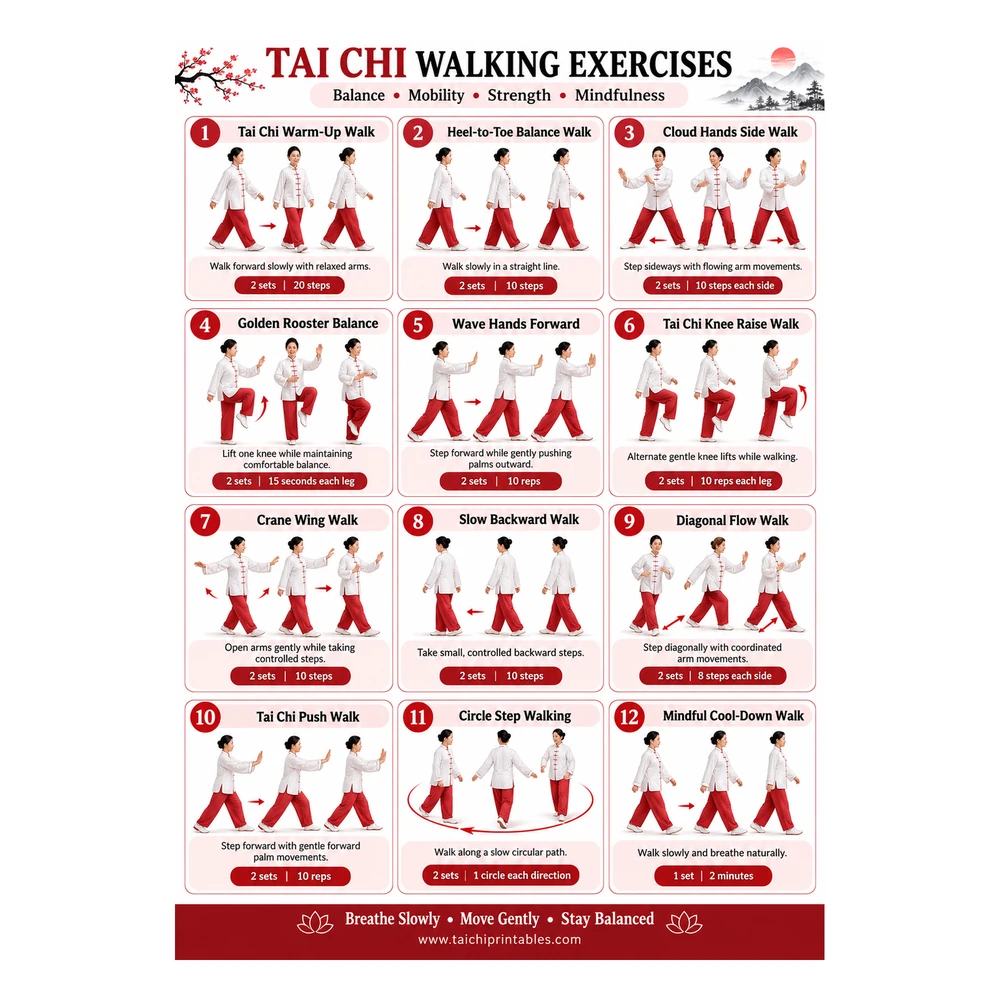
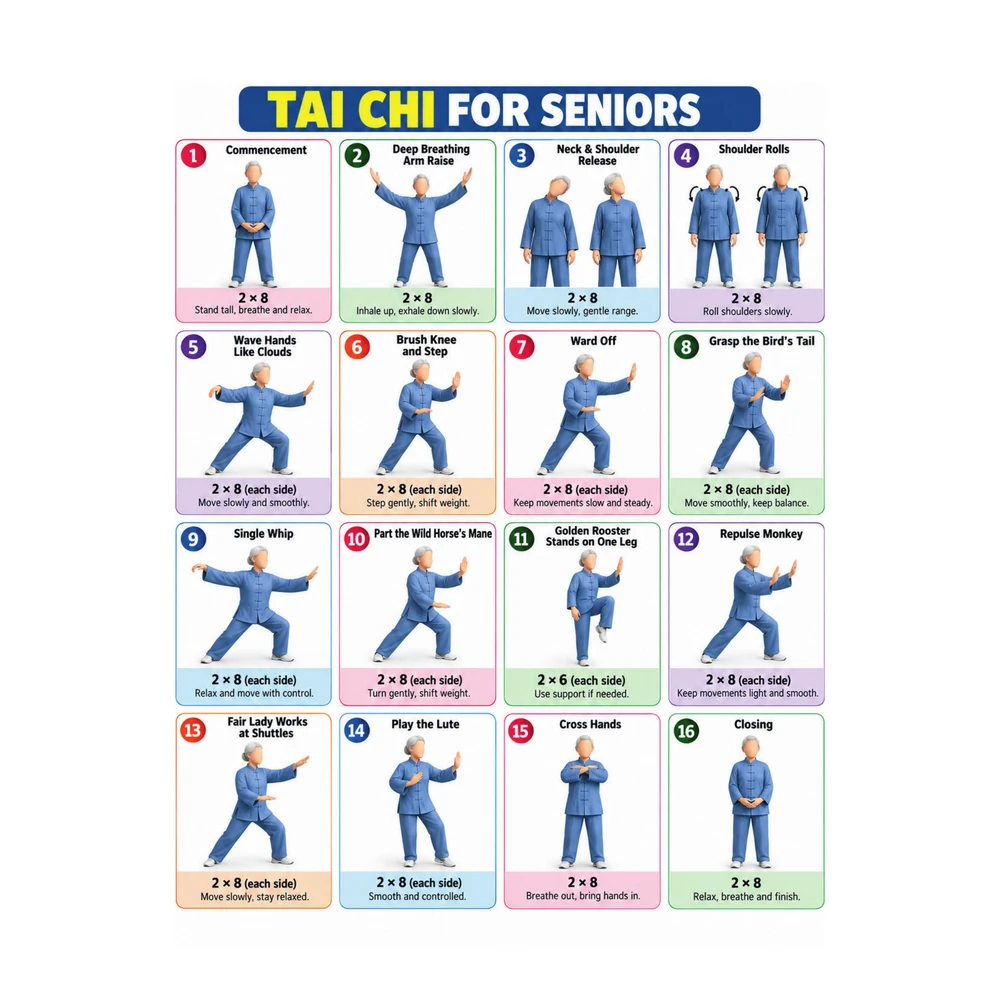
- Follow something structured. A chart on the wall or a set routine takes away the “what do I do next?” problem, which quietly puts more beginners off than any difficulty in the movements themselves. If a structured daily pattern appeals to you, our 28-day tai chi walking challenge shows how a gentle month of practice can be laid out day by day.
- Let stiff days be small days. A five-minute session with small, careful movements still counts. The habit matters more than any single session.
Worries beginners often mention
“I’m not fit enough.” Tai chi does not require a starting level of fitness. It begins where you are, at the pace you set, and you can rest whenever you like. If you can stand — or sit — and move your arms, you can begin.
“I’m too stiff.” Stiffness is a reason to start, not a reason to wait. Movements are done within whatever range feels comfortable, and that range tends to feel easier with gentle, regular use. Never force a movement to look like a picture; your version, at your range, is the right version.
“Isn’t it too slow to count as exercise?” It is gentle exercise, and gentle is not the same as pointless. Your legs are holding and shifting your weight throughout, your posture and balance are working constantly, and your breathing is deep and steady. It will not leave you breathless — it is not meant to. What it offers is movement you will still be doing in six months, which is worth more than a strenuous routine abandoned in week two.
“I’ll look silly.” Everyone in a beginners’ class is concentrating far too hard on their own arms to watch yours. And at home, the only audience is the cat.
Frequently Asked Questions
Is tai chi suitable for women over 60 who have never exercised?
Yes. Tai chi is one of the gentler ways to begin moving again, because you control the pace, the size of the movements and the length of the session. Start with short sessions beside a sturdy chair, wear flat shoes, and stop for a rest whenever you need one. If you have a health condition or have been inactive for a long time, a quick word with your doctor before starting is a sensible precaution.
How often should I practise?
Short and often beats long and rare. Ten to twenty minutes on most days is a good pattern for a beginner, and even five minutes is worthwhile on a busy or stiff day. Regularity is what makes the practice feel easier and more familiar, so aim for a rhythm you can genuinely keep.
Do I need to join a class, or can I learn at home?
Both work. A class offers company, a set time and a teacher who can correct your posture. Home practice offers flexibility and costs nothing in travel or timing. Many women combine the two. At home, following a clear chart or routine keeps sessions structured so you are never left wondering what to do next.
What should I wear?
Loose, comfortable clothes that let you bend and turn, and flat, flexible shoes — or bare feet on a non-slip floor. Nothing needs to be bought specially. If a waistband digs in or a sleeve restricts your arm, choose something else; comfort is the whole dress code.
Final thoughts
Exercise after 60 does not have to mean Lycra, loud music or lying on a mat wondering how you will get up. Tai chi offers something quieter: slow, standing movements that are kind to joints, easy to do at home, and simple to keep going with. Start with ten minutes, a sturdy chair nearby and no expectations of overnight change. Give it a few weeks of regular practice, and judge it by how you move and feel in ordinary life — that is the test that matters.