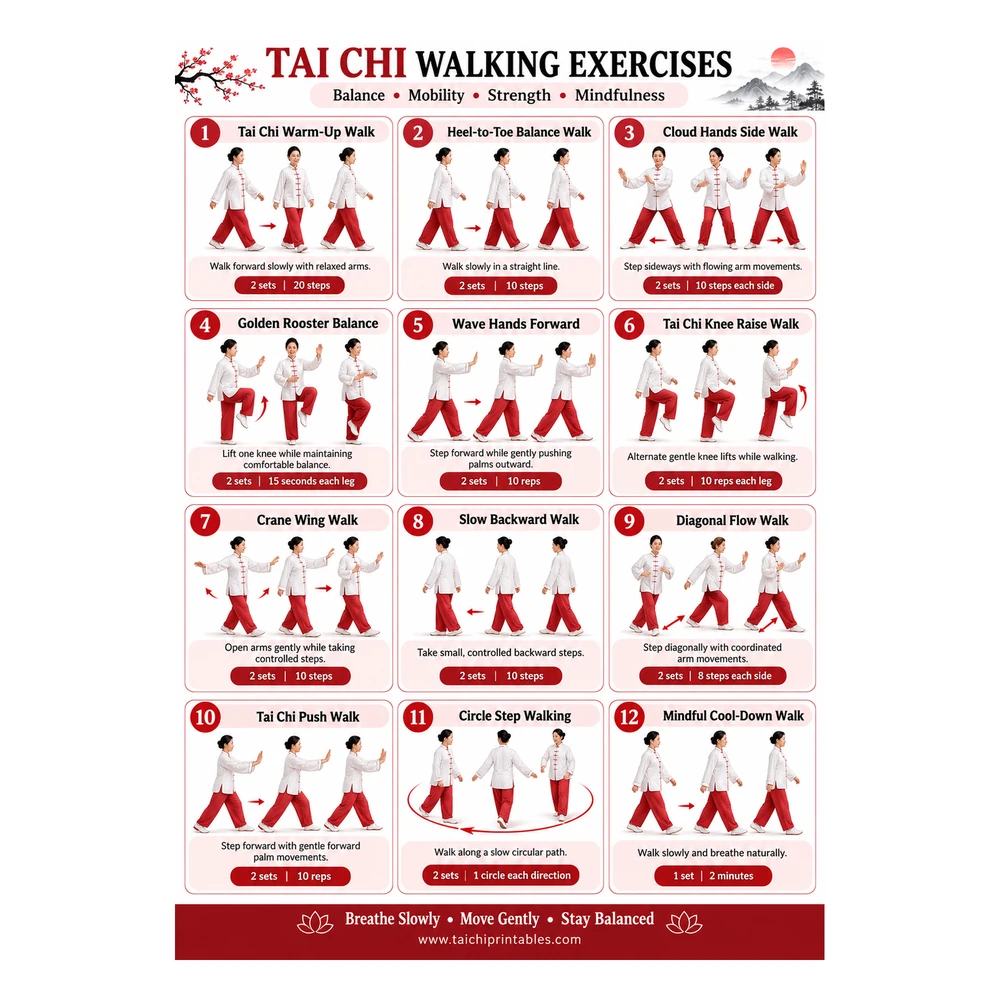

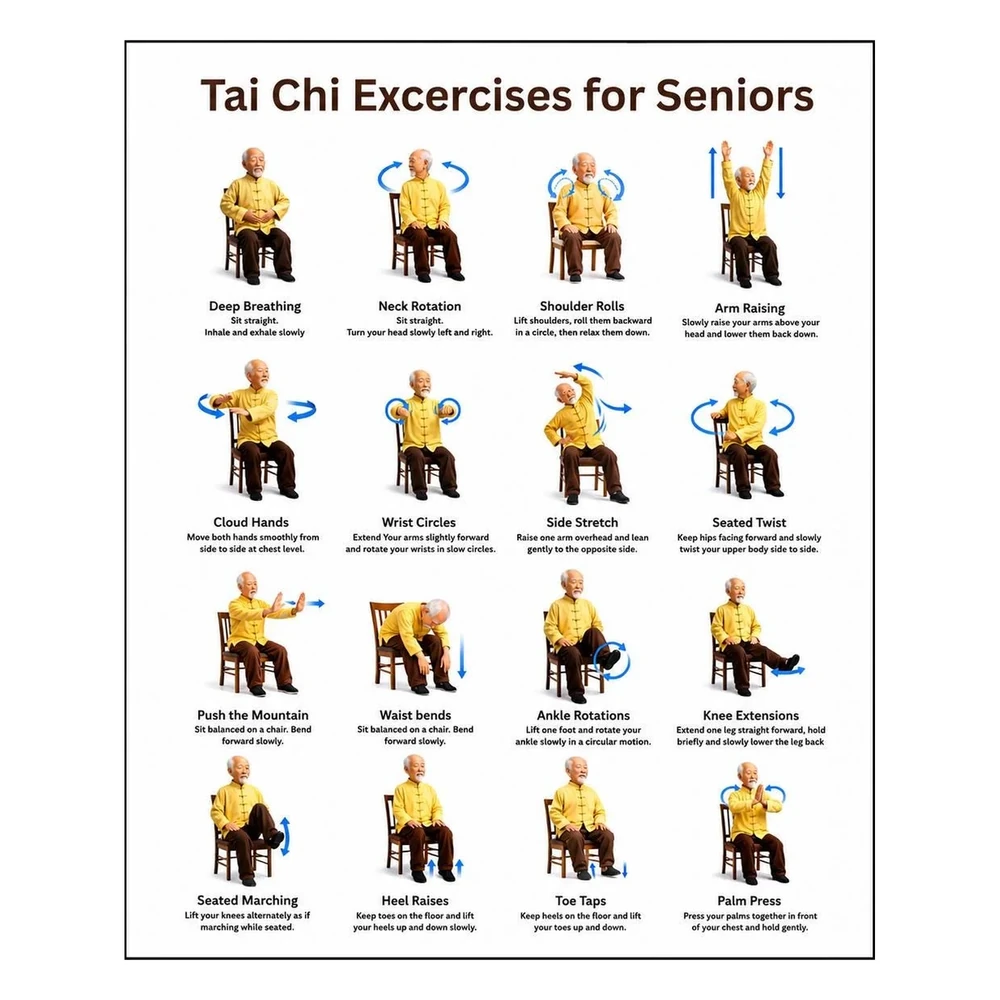
Exercise videos have one flaw that nobody mentions: you have to keep stopping them. You unlock a phone with damp fingers, squint at a small screen, rewind the part you missed, and by the time you are ready, the moment has passed. A printable chart has none of that. It sits where you put it, it is always open at the right page — because there is only one page — and the whole of your routine is visible at a glance.
This guide explains what our printable chair exercises chart for seniors actually covers, how to print it so it stays clear and readable, and how to build it into your day. If you are new to seated exercise altogether, it may help to read it alongside our introduction to the subject, which explains what chair tai chi is and who it is for.
Why a paper chart works so well
Everything is visible at once. On a video, you only ever see the movement you are on. On a chart, the entire routine is laid out in front of you in order, so you always know where you are, what comes next, and how much is left. That sense of the whole shape of a session is surprisingly encouraging.
The pictures are large and still. Each movement is shown in a clear panel that stays put while you study it. You can take as long as you like to work out where the hands go — something a moving image never allows.
There is nothing to operate. No passwords, no updates, no buffering, no battery. For many older adults, the honest barrier to home exercise is not willingness; it is wrestling with a device before the exercise even starts. Paper removes that barrier completely.
It lives where you exercise. Pinned by your chair or kept on the side table, the chart is a quiet reminder that is simply there. Routines survive on visibility far more than on willpower.
What the chart covers
The chart is a complete seated tai chi routine on a single page, designed to be followed from beginning to end while sitting in an ordinary chair. Rather than a list of separate exercises, it flows as one continuous session, and it covers the body in a sensible order.
It begins with seated breathing and posture — settling into the chair, feet flat, back tall but not stiff, and letting the breath slow down before anything moves. From there it moves into gentle arm movements, the flowing raises, openings and circling motions that tai chi is known for, all performed from the chair. The middle of the routine includes chest-opening movements that counteract the rounded, hunched position so many of us sit in, and slow waist turns that rotate the trunk gently from side to side.
Although you stay seated, the legs are not forgotten: the chart includes gentle seated leg movements that work the legs and feet from the chair. There is also neck and wrist care — small, careful movements for two areas that stiffen easily and are often neglected. The session ends with a closing form, bringing the movements down to stillness and finishing as calmly as it began. Our main chair tai chi article explains the thinking behind this kind of seated routine in more detail.
Printing it well
A chart is only useful if you can read it at arm’s length, so printing deserves a few minutes of care.
Paper and size. The chart is designed for A4. Print it at full size rather than shrinking it to fit margins — in your printer settings, look for “actual size” or 100% if the option appears.
Colour. Print in colour if you can. The panels use colour to separate movements and make the sequence easy to follow with a quick glance.
Making it last. A sheet of paper by an exercise chair gets handled daily, so it is worth protecting. Laminating it is ideal if you have access to a laminator — many copy shops will do a single sheet cheaply. A clear plastic document sleeve works nearly as well and has the advantage that you can slip the chart in and out. Some people prefer to pin the unprotected sheet up and simply print a fresh copy when it gets tatty; that is perfectly fine too.
Where to put it. Put it where your eyes naturally fall when you sit in your exercise chair: on the wall opposite, on a door, or propped on a table at reading distance. If you have to go and fetch it from a drawer, it will quietly stop being used.
Using the chart day to day
The simplest approach is usually the one that lasts: sit down at roughly the same time each day, put the chart where you can see it, and work through the panels in order at your own pace. There is no clock involved and nothing to beat. On days when you feel stiff or tired, it is fine to move more gently and skip anything that does not feel right — the chart will still be there tomorrow.
Many people like to keep a plain calendar nearby and mark each day they practise. It is a small thing, but watching the marks accumulate is an honest record of a habit forming, and it is often what carries people through the third week, which is when most new routines falter.
Who a chair chart suits
A seated routine on paper suits anyone who wants structured, gentle exercise without screens: beginners who have never done tai chi, people whose balance makes standing exercise worrying, anyone returning to movement after a quiet spell, and people who simply prefer paper to apps. Because everything is done from a chair, it fits into an ordinary living room with no special equipment and no rearranged furniture.
Safety first
Use a sturdy chair without wheels, ideally with your back supported when you rest, and keep both feet flat on the floor. Move slowly, stay within a range that feels comfortable, and never push through pain — gentle exercise should never hurt. Stop and rest if you feel dizzy, breathless or unwell. If you have a health condition, joint problems, or you have recently had surgery or an injury, check with your doctor before starting, and follow any advice they give you over anything written here. This guide is general information, not medical advice.
Frequently Asked Questions
What do I need besides the chart?
Very little: a sturdy chair without wheels, a small amount of clear floor space around it, and comfortable clothes that let you move your arms and shoulders easily. Flat, secure footwear — or bare feet on a non-slip floor — is better than socks on a smooth surface.
I have never done tai chi. Can I still use it?
Yes. The chart is made for beginners: each movement is shown in a clear panel and the routine runs in a fixed order, so you simply follow it from the start to the finish. Most people find the sequence becomes familiar surprisingly quickly with regular use.
What if I cannot manage every movement?
Then leave that movement out, or make it smaller. Seated tai chi adapts well: a turn can be a few inches instead of a full rotation, and an arm movement can stay low instead of rising high. Work within what feels comfortable on the day, and return to the fuller movement when — and if — it suits you.
How do I keep the chart in good condition?
Laminating it or keeping it in a clear plastic sleeve will protect it from daily handling, spills and curled corners. Kept flat and out of direct sunlight, a protected chart should stay clear and readable for a long time; and since it is a printable file, you can always print another copy if the first one wears out.
Final thoughts
A printable chair exercises chart is a deliberately simple idea: one page, one chair, a complete gentle routine you can see all at once. Print it clearly, protect it a little, put it where you sit, and let it do the remembering for you. The routine itself is calm and unhurried — the chart just makes it easy to begin, and easy to begin again tomorrow.