

It is a fair question, and it deserves a straight answer. Tai chi walking gets shared in videos, mentioned by friends, and recommended with big promises attached. If you are sceptical, you are asking what most sensible people ask before trying anything new: does tai chi walking work, or is it just slow walking with a fancy name? This page will not try to sell you on it. It explains what the practice involves, what “working” can honestly mean, and where its limits are, so you can decide whether it is worth a few weeks of your time.
The short answer: yes, it works as a gentle practice — a calm, repeatable way to walk with more attention, practise your balance and coordination, and build a routine you can keep. No, it does not work as a miracle. Like any gentle exercise done regularly, it gives back roughly what you put into it: steady practice, modest and gradual returns.
What Tai Chi Walking Actually Is
Tai chi walking is a slow, deliberate stepping practice built from a small set of movements. Instead of walking for distance or speed, you take short, careful steps, shift your weight gradually, and pay attention to where your feet land. Arms and breathing are part of it, but nothing is rushed. Most people practise indoors, in a hallway or a clear patch of floor, because it needs little room.
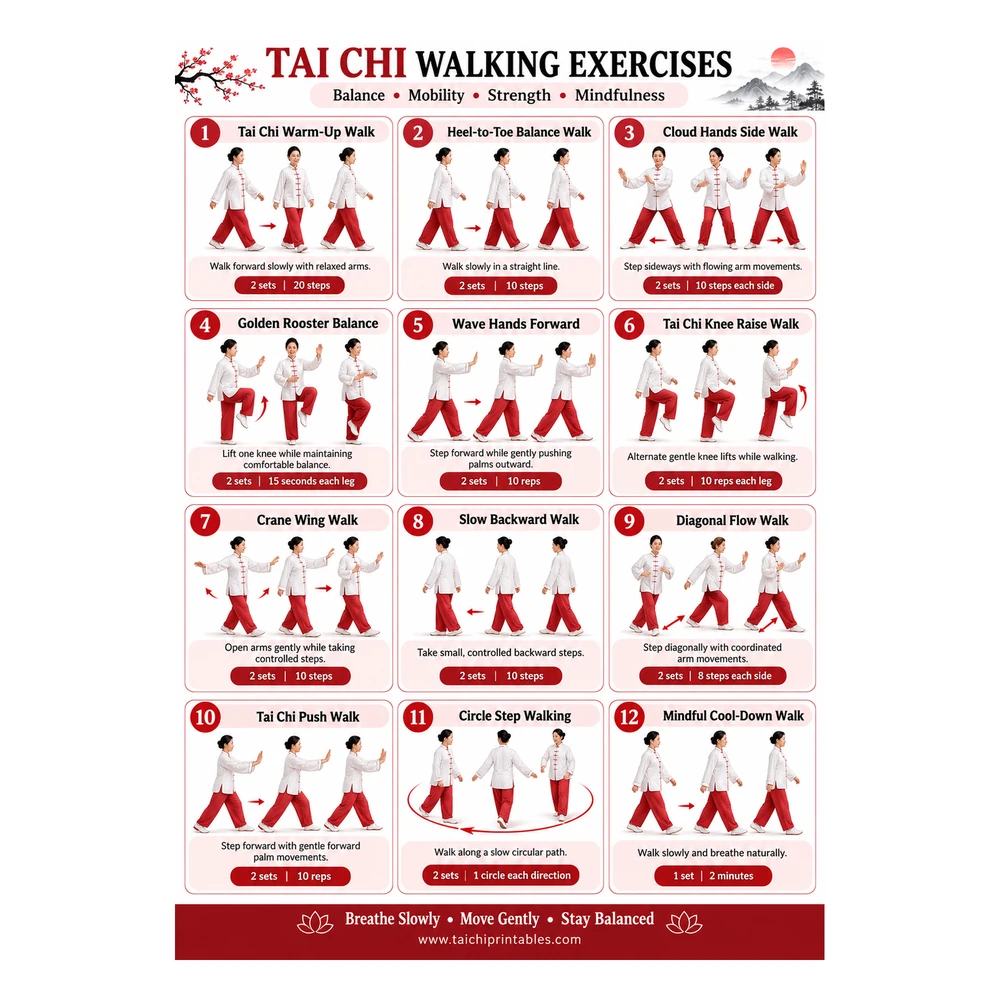
A typical short session is built from set movements like these: Tai Chi Warm-Up Walk, Heel-to-Toe Balance Walk, Cloud Hands Side Walk, Golden Rooster Balance, Slow Backward Walk, and Mindful Cool-Down Walk. Each one is simple to describe — walking slowly in a straight line, stepping sideways while the arms move, standing briefly on one leg with support nearby, walking backwards with care. None of them needs strength; the point is doing each step slowly and staying aware of your balance. If you want the fuller explanation of what is tai chi walking for seniors and how the movements fit together, our guide to what tai chi walking is covers it in detail.
What “Working” Honestly Means
When people ask whether something like this works, they usually mean one of four things.
1. A Regular Gentle Walking Practice
The most basic sense of “working” is simply this: you end up walking regularly, at a pace your body accepts. Many people find ordinary routines hard to stick with because they are tiring, uncomfortable, or boring. Slow stepping is undemanding enough that most people can manage ten minutes without dreading it. A practice you repeat three or four times a week does more for you than an ambitious routine you abandon after a fortnight. That is just how habits work.
2. Balance Practice, One Step at a Time
Every step in this practice is a small balance exercise. You lift one foot, shift your weight slowly, and place the foot down with control. Movements like the Heel-to-Toe Balance Walk and the Golden Rooster Balance make that deliberate. Practised regularly, it is a reasonable way to rehearse the everyday skill of staying steady on your feet. It will not transform your balance overnight, and nobody honest would promise that. It gives you regular, focused practice, which is the part actually in your control.
3. Coordination Between Feet, Arms, and Attention
Some movements ask your arms and feet to do different things at the same time — the Cloud Hands Side Walk is the clearest example. At first it feels awkward, and most people wobble or lose the pattern. After a few sessions it usually feels smoother. The improvement is real but modest and specific: you get better at the movements you practise, and it is not a shortcut to anything else.
4. A Habit You Can Keep
The last meaning of “working” is the least exciting and probably the most important. A short session at home is easy to fit into an ordinary day. If tai chi walking works for you over months rather than days, it will most likely be because it was easy to keep doing, not because any single session felt dramatic.
What It Won’t Do
1. It Is Not a Medical Treatment
Tai chi walking is a form of gentle exercise. It is not a treatment for any condition, it does not replace medicine, and it is not a substitute for advice from your own doctor or physiotherapist. Health concerns belong with a professional who knows your situation; anyone who presents a walking practice as a cure is not being straight with you.
2. It Comes With No Guaranteed Results
There is no honest way to promise that you will feel a specific change by a specific date. People differ in age, health, starting point, and how often they practise. Some notice that sessions feel easier and steadier after a few weeks. Some feel very little difference. Both experiences are normal, and anything beyond steady practice is a hope, not a promise.
3. It Is Not Intense Exercise
This is slow, low-effort movement by design. It will not leave you breathless, and it is not a replacement for more vigorous activity if that is what you want and your doctor is happy with it. If you want a workout that feels like hard work, this is not it.
Is Tai Chi Walking Legit?
Yes, in the ordinary sense of the word. Tai chi walking is a real, long-practised form of gentle exercise, drawn from long-used tai chi stepping patterns. The movements are plain to see, easy to describe, and easy to check: slow steps, controlled weight shifts, simple arm movements, and short balance holds with support nearby.
When people ask “is tai chi walking legit,” they are often really asking whether there is a catch — a secret technique, special equipment, or an expensive programme you must buy before it “counts.” There is not. What makes any version of this practice worthwhile is regular practice. Fancy presentation does not make it work better; the practice itself is the point.
How to Give It a Fair Try
If you are still unsure, give it a short, honest test rather than a leap of faith.
Start with ten minutes, a few times a week, for a few weeks. Wear flat, firm shoes or go barefoot on a non-slip floor, and keep a chair, counter, or wall within reach for support. Pick three or four movements and repeat them. The Slow Backward Walk deserves extra care — do it beside support, in a clear space, and skip it entirely if it feels unsteady.
Keep a simple note after each session: how steady you felt, whether the movements felt smoother, and whether you looked forward to the next one. After three or four weeks, read your notes. They will tell you more than any promise on a page like this one. If you prefer a set daily structure instead of choosing movements yourself, the 28-day challenge guide lays out one structured option, day by day.
Get the Printable Charts
If you would rather follow a chart than remember a routine, the Tai Chi Walking Exercises printable is a one-page A4 printable PDF chart with illustrated movements and written instructions you can keep in view while you practise. For a planned daily sequence, the 28-Day Walking Tai Chi Challenge chart sets the practice out as a 28-day challenge programme chart. Both make the routine easier to follow — the practice itself needs nothing more than a little floor space and your attention.
Frequently Asked Questions
1. Does tai chi walking really work for seniors?
In the plain sense used on this page, yes — does tai chi walking really work as a gentle, repeatable practice that seniors can do at home, in short sessions, with support nearby? It does. It gives you slow stepping, balance practice, and coordination practice in a manageable form. What it will not do is deliver guaranteed results or act as a treatment for anything. Judge it like any new routine: try it steadily for a few weeks and go by how your own sessions feel.
2. How long before I notice anything?
Honestly, it varies, and anyone who gives you an exact number is guessing. The movements themselves often feel less awkward within the first week or two, because you have repeated them. Feeling steadier or more confident tends to be gradual, over weeks, and some people notice very little change. A fair test is three to four weeks of short, regular sessions. If nothing feels different by then, it may simply not be the right practice for you.
3. Do I need any experience or special equipment?
No experience is needed. The movements are basic steps and simple arm patterns. You do not need special equipment either — a clear bit of floor, flat shoes or a non-slip surface, and a chair or counter nearby for support cover everything. Comfortable clothing helps, and that is the whole list.
4. How is this different from ordinary walking?
Ordinary walking is usually about getting somewhere or covering distance at a natural pace. Tai chi walking is about how each step happens: slower, shorter steps, weight shifted gradually, feet placed with attention, and set movements repeated in a small space. Many people do both; this one simply asks more of your attention and balance than of your stamina.
5. Can I do it if my balance is poor?
Many people with unsteady balance start exactly there, but the practice has to be set up carefully: always beside a chair, counter, or wall you can hold, in a clear space. One-leg movements like the Golden Rooster Balance need support in reach, and anything that feels unsafe should be skipped. If you have had falls or have a condition that affects your balance, check with your doctor or physiotherapist before starting.
Final Thoughts
So, does tai chi walking work? As a quiet, repeatable way to practise slow stepping, balance, and coordination at home — yes, provided you actually do it regularly. As a miracle, a treatment, or a guaranteed fix — no, and you should be wary of anyone who describes it that way. It asks little of you: ten minutes, a bit of floor, and some patience. In return it offers a calm routine that many people find they can keep. If that sounds fair, give it a few weeks and let your own experience settle the question.
Safety Note: Practise on a flat, non-slip surface with sturdy support — a chair, counter, or wall — within reach at all times, and stop straight away if you feel dizzy, unwell, or in pain. Take the backward and one-leg movements especially slowly, and skip any movement that feels unsafe for you. If you have a medical condition, problems with balance, or any doubt, speak to your doctor or physiotherapist before starting.