
Fair question. Chair tai chi looks gentle — almost too gentle. You sit down, move your arms slowly, breathe, turn a little from side to side. No sweating, no equipment beyond the chair itself. So it’s natural to wonder whether something this easy can actually do anything.
The honest answer sits in the middle: it’s real movement and, for the right person, a useful way to stay active — but it isn’t medicine or intense exercise, and it won’t fix health problems.
The short answer: Yes, chair tai chi works as a gentle form of seated exercise. It gets your joints and muscles moving, builds a regular activity habit, and lets you practise posture, breathing, and coordination with the chair supporting you. It suits people who can’t stand for long or are starting from very little activity. It won’t cure anything, replace medical treatment, or match standing exercise — and anyone promising more isn’t being straight with you.
What Chair Tai Chi Actually Is
Chair tai chi takes the slow, flowing style of traditional tai chi and adapts it to be done entirely seated. You sit tall on a stable chair — no wheels, flat surface — feet flat on the floor, and work through slow, controlled movements.
A typical session mixes a few simple ingredients: steady, relaxed breathing timed loosely with the movements; slow arm movements — raising, lowering, opening, circling; gentle twists, turning the shoulders and head a little to each side; and seated leg movements, such as lifting a foot or straightening a knee, while the chair takes your weight.
Sessions can be short — ten or fifteen minutes is a normal starting point — and you can rest whenever you like. Our Chair Tai Chi routine post walks through how a complete session is structured.
What It Can Do
None of these points are dramatic — the value is in small, practical things that add up with regular practice.
1. It gets you moving on days when other exercise won’t happen
For someone who finds standing exercise difficult, the real choice often isn’t chair tai chi or a long walk — it’s chair tai chi or sitting still all day. Gentle movement is widely recommended as part of an active lifestyle, and a seated routine removes the usual obstacles — no travel, no special clothes, no standing endurance. A modest session you actually do beats an ambitious plan you keep postponing.
2. It builds a regular activity habit
The movements are simple to learn, and sessions are short enough to fit into a morning or afternoon. Its value comes from repetition, not one heroic effort — and a manageable routine, same chair, same time of day, same sequence, gets repeated week after week.
3. It lets you practise posture and breathing in a supported position
Sitting tall, relaxing the shoulders, and breathing slowly sounds basic, but it’s a skill — many of us spend the day slumped without noticing. Here you practise an upright posture and coordinate breath with movement while the chair supports your back and hips. Over time, you catch yourself sooner when you’re hunched or holding your breath.
4. It keeps joints and muscles working through a comfortable range
Slow seated movements take shoulders, elbows, wrists, hips, and knees through gentle ranges of motion without load or impact, keeping stiff, inactive joints mobile. It won’t build strength like resistance exercise, but your muscles still work — arms lifting against gravity, a leg straightening slowly, the trunk turning — all controlled and low-strain.
What It Can’t Do
The limits matter as much as the benefits. Expect these things, and you’ll be disappointed — or worse, misled.
1. It is not a medical treatment
Chair tai chi doesn’t treat or cure any condition. It isn’t a therapy for arthritis, back pain, balance disorders, or anything else. If you’re managing a condition, it can sit alongside your care as gentle activity — that’s all. Treatment decisions belong to you and your doctor.
2. It is not vigorous exercise
Your heart rate rises a little, but this isn’t cardio training and won’t build significant strength or stamina. If you can walk, swim, or do standing exercise comfortably, those will do more for your fitness. Think of chair tai chi as a starting point or a supplement, not a replacement.
3. It comes with no guaranteed results
Some people feel looser and more confident moving after a few weeks of regular practice. Others notice less. What you get depends on how often you practise and how sedentary you were to begin with. Anyone promising specific results by a set date is guessing — treat promises like that as a warning sign.
4. It doesn’t replace medical advice
Feeling better when you move more is encouraging, but it isn’t a diagnosis, and pushing through pain because a routine is “gentle” is a mistake. New or worsening symptoms need a professional.
Who It Suits — and Who Should Be Careful
Chair tai chi tends to suit people in situations like these:
- You want to be more active, but standing for long is tiring, uncomfortable, or not possible right now.
- You’re returning to movement after a long sedentary spell and want a low-pressure start.
- You use a walking aid, or poor balance makes standing exercise feel unsafe.
Take a little more care if any of these apply:
- You’ve recently had surgery, a joint replacement, or an injury — get your doctor’s or physiotherapist’s go-ahead before starting any new routine.
- You have a heart or lung condition, or mild activity makes you dizzy or breathless — that needs medical guidance first.
- You have severe joint pain. Gentle movement is often still possible, but which movements — and how far — is a question for a professional who knows your case.
If you’re unsure whether it’s appropriate for you, ask your doctor first — a short conversation is worth more than any article’s reassurance, including this one.
How to Tell If It’s Working for You
Progress here is quiet. Judge it by ordinary signs over a few weeks:
- The sessions feel easier. Movements that took concentration in week one feel familiar by week three, and breathing settles into the pace.
- You actually keep practising. The biggest sign of all: still doing it regularly after a month means it’s keeping you active consistently — what matters most.
- Everyday movements feel more familiar. Reaching, turning, standing up from your chair — if these feel a little less stiff with regular practice, that’s a real change, even if a modest one.
- You don’t dread it. A routine you mildly enjoy is sustainable; one you hate isn’t, however good it’s meant to be for you.
If after several weeks you feel no different, that’s useful too: you may need more challenge — standing work, walking, a class — or a doctor’s attention.
Get the Printable Chart
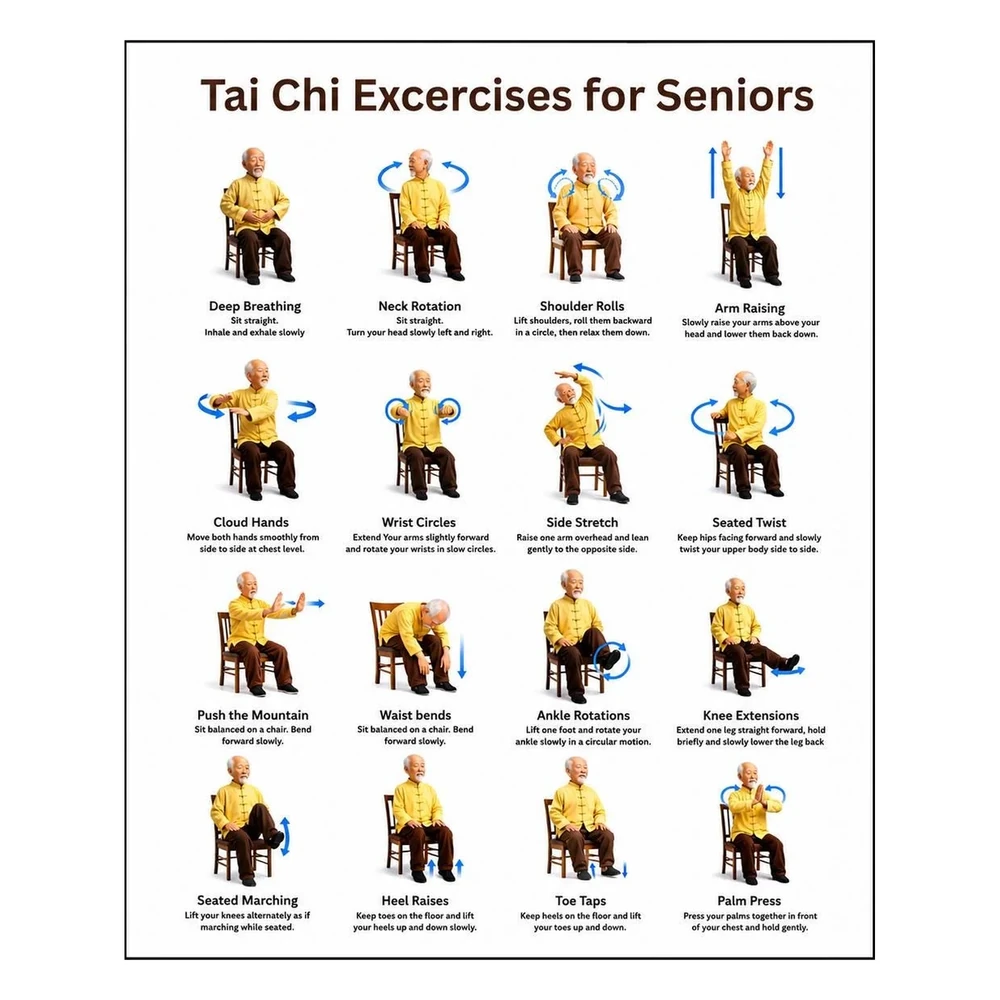
If you’d like a set routine instead of piecing one together from memory, our Chair Tai Chi Exercises for Seniors printable chart is a one-page A4 printable PDF chart of seated chair tai chi exercises, each with an illustration and short instructions. Keep it beside your chair and follow the sequence in order — no screen, no scrolling.
Frequently Asked Questions
1. Does tai chi really work if I’m sitting down?
It works as gentle exercise, yes. Sitting removes the balance and standing-endurance demands, along with the leg and balance training standing tai chi provides — that’s the trade-off. What remains is real: slow, controlled movement of arms, trunk, and legs, coordinated with breathing, in a position you can sustain. For someone who otherwise wouldn’t exercise at all, that’s a trade worth making.
2. How often would I need to practise?
There’s no magic number, but consistency matters more than session length — a short session most days beats one long weekly session. Many people start with ten to fifteen minutes, three or four times a week. Daily is fine too — the intensity is low.
3. Is chair tai chi real exercise?
Yes — it’s low-intensity exercise. Your muscles work to lift and control your limbs, joints move through their range, and breathing deepens. It sits at the gentle end of the spectrum, closer to a stretching and mobility routine than to a breathless workout. “Real” and “intense” aren’t the same thing — and for many people the gentle end is the right place to be.
4. How soon will I notice a difference?
Honestly, it varies. Some people feel looser after the first session; for others, changes build over several weeks. Anyone giving you an exact timeline is guessing. Give it a fair trial over a few weeks and judge by the practical signs above.
5. Can I do chair tai chi if I have bad knees or a bad back?
Many people with achy knees or stiff backs choose seated exercise because it avoids standing and impact, with the chair supporting your weight. But “many people do” isn’t the same as “you should.” If your pain is severe, recent, or unexplained, or you’ve had surgery or a joint replacement, check with your doctor or physiotherapist first and follow their restrictions. And stop any movement that causes sharp pain.
Final Thoughts
So, does chair tai chi work? It works at what a gentle seated routine can honestly do: keeping you moving, building a habit, and practising posture, breathing, and coordination with support under you. It doesn’t work as a treatment, a cure, or a substitute for harder exercise. Judged on what it is — not on inflated promises — it’s a sensible, low-risk way for many older adults to stay active. Start small, practise regularly, and judge it by your own experience.
Safety Note: This article is general educational information only, not medical advice. Chair tai chi is gentle, but it isn’t right for everyone. Talk to your doctor first if you have a medical condition, recent injury or surgery, or any doubt about whether seated exercise suits you. Move within a comfortable range, and stop straight away if you feel pain, dizziness, or unusual breathlessness; if symptoms continue, seek medical advice.