
Watch a tai chi class and your eye goes to the arms — the slow arcs, the turning palms, the movements with the poetic names. But ask a teacher what a beginner should work on first, and they will point downwards. Underneath every graceful arm movement is a stance: a particular arrangement of the feet and legs that carries your weight and decides whether the movement above it is steady or wobbly.
The good news is that there are only a handful of basic tai chi positions, and none of them is as complicated as its name can make it sound. This page explains the main stances in plain English — what each one looks like, what it is for, and how deep a beginner honestly needs to go. Which is to say: not very deep at all.
Why stances matter, and why shallow is fine
A stance does three jobs. It gives you a stable base, so your upper body can relax and move without a background worry about toppling. It decides how your weight is shared between your legs, which is what makes tai chi stepping slow and controlled rather than a series of small falls. And it trains your legs, gently and progressively, in the exact positions daily life asks of them — stepping, turning, reaching, standing on one leg to dress.
Here is the part beginners most need to hear: in tai chi, a high stance is a correct stance. Beginners, older students and anyone with knee trouble practise with their legs only slightly bent, standing tall and comfortable. Deep stances belong to young martial artists training for power. For health and balance, shallow positions done well — weight clear, knees comfortable, breathing easy — are not a watered-down version of tai chi. They are tai chi, practised at the depth your body is for.
Horse Stance
The horse stance is the home position of tai chi, the one everything returns to. Stand with your feet wider than your shoulders, toes pointing forwards or turned out very slightly. Bend your knees a little, as if you were about to sit down on a high stool and changed your mind. Your weight is shared exactly evenly between both feet, your back is straight, and your tailbone feels as though it drops gently towards the floor.
It is called the horse stance because you stand as though sitting on an invisible horse. Its job is stability and leg strength: from here you can turn your waist, shift in any direction, or simply stand and breathe. If you learn only one position, this is a good candidate — the opening standing posture of most practice is a narrower version of it.
Bow Stance
The bow stance is the stepping stance, the shape your legs make in the middle of most forward movements. One foot steps ahead, about a long stride in front of the other. Your front knee bends over your front foot; your back leg stays fairly straight, with the back foot angled out at roughly forty-five degrees. Your weight sits mostly — about two-thirds — on the front leg.
It is named after a drawn bow: the front leg bent like the bow’s curve, the back leg straight like the string. You will use it constantly, because it is simply a controlled, deliberate step, frozen at the moment of arrival. For beginners the step should be shorter and the front knee only gently bent; a small bow stance done with control teaches you more than a long lunge done with strain.
Empty Stance (Cat Stance)
In the empty stance, nearly all your weight — ninety percent or more — rests on one leg. The other foot reaches forwards and rests on the floor with just the ball of the foot or the heel touching, carrying almost no weight at all, like a cat testing the ground before committing to a step. Hence its other name.
This stance is everywhere in tai chi because it is the secret of the slow stepping: your unweighted foot can lift, move and place itself without any lurch, because your weight was never on it in the first place. It is also honest balance training — you are standing on one leg, with the other foot’s light touch as your safety net. Keep that touch. There is no prize for removing it before you are ready.
Back Stance
The back stance is the bow stance’s mirror image. Your feet are in a similar front-to-back arrangement, but this time most of your weight — again, about two-thirds or more — sits on the back leg. Your front foot rests lightly on its heel or the ball of the foot, ready to step, kick slowly, or sweep.
Where the bow stance expresses arriving and settling forwards, the back stance expresses yielding: weight retreating, front foot light and ready. Movements that turn an opponent’s force aside — or, in health practice, movements that simply practise shifting your weight backwards under control — are built on it. Beginners often find it surprisingly demanding on the back leg. That is normal, and it is exactly the kind of quiet leg work tai chi is good at providing.
Golden Rooster Stands on One Leg
This is the famous one: standing on a single leg with the other knee raised, one hand lifted — the postcard image of tai chi. It is also the stance beginners should approach with the most respect, because it removes your safety net entirely.
So, an explicit caution. Practise this stance beside a sturdy chair, a table or a wall, and keep a hand resting on that support for as long as you need it — weeks, months, or permanently. Raise the lifted knee only a little at first; a few inches is plenty. Come out of the stance the moment you feel unsteady rather than wobbling heroically. Balance improves through many small, successful attempts, not through hanging on grimly while your ankle waves about. There is no version of this stance, hand on chair and knee low, that does not count. It all counts.
The knee rule that matters in every stance
One alignment rule protects your knees in every position on this page: your knee should point in the same direction as your toes, tracking over the middle of your foot. The thing to avoid is the knee collapsing inwards, drifting towards your other leg while your foot stays planted. That inward collapse, repeated under load, is what knees object to.
Two habits keep you safe. First, turn your foot and your knee together, as one unit, whenever a stance asks you to angle a foot. Second, keep your bends shallow: a knee bent a little, tracking straight, will get stronger happily for years. If a stance makes a knee ache, stand up out of it, shake the leg gently, and try again higher. Pain is information, and in tai chi the correct response to it is always to adjust, never to endure.
How stances become movement
On their own, stances are just standing in interesting shapes. Tai chi movement is what happens between them: weight pouring slowly from a horse stance into a bow stance, emptying one leg so the foot can step, settling back, turning at the waist. When you watch a practised student, you are watching stances dissolve into one another without a seam.
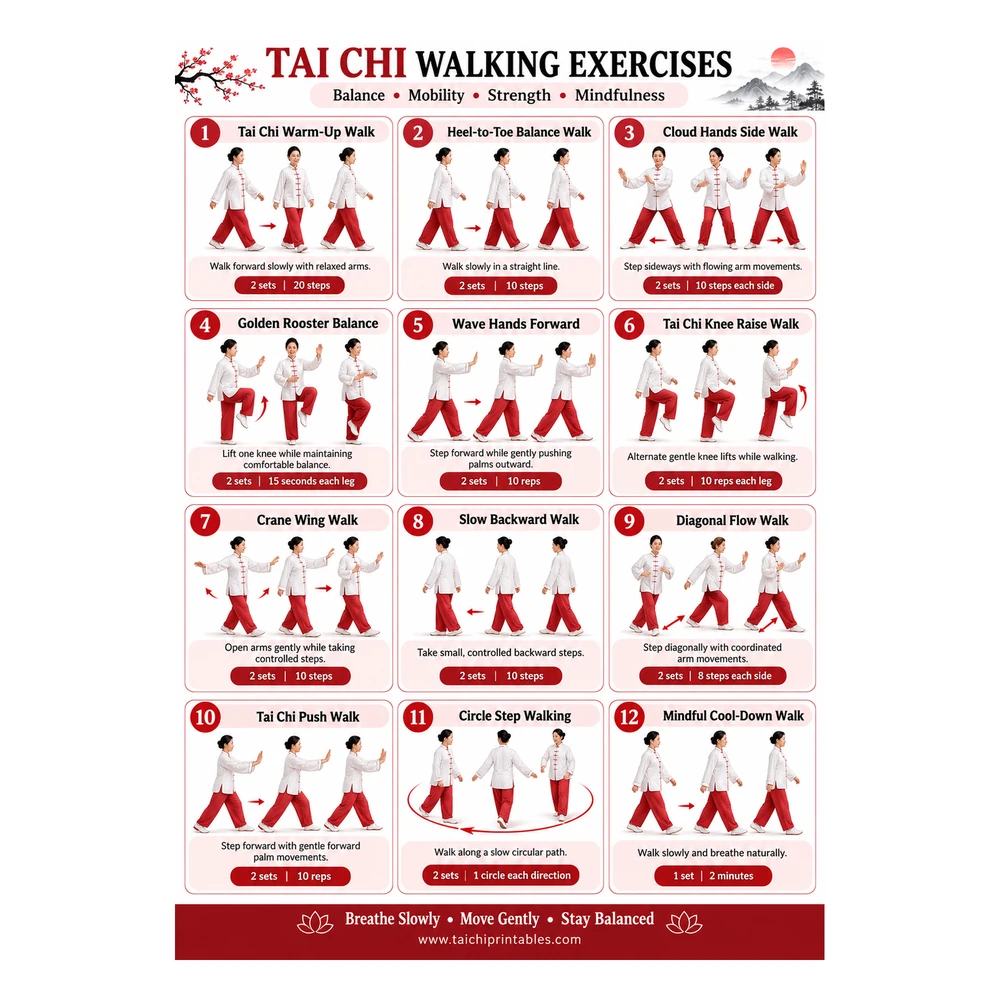
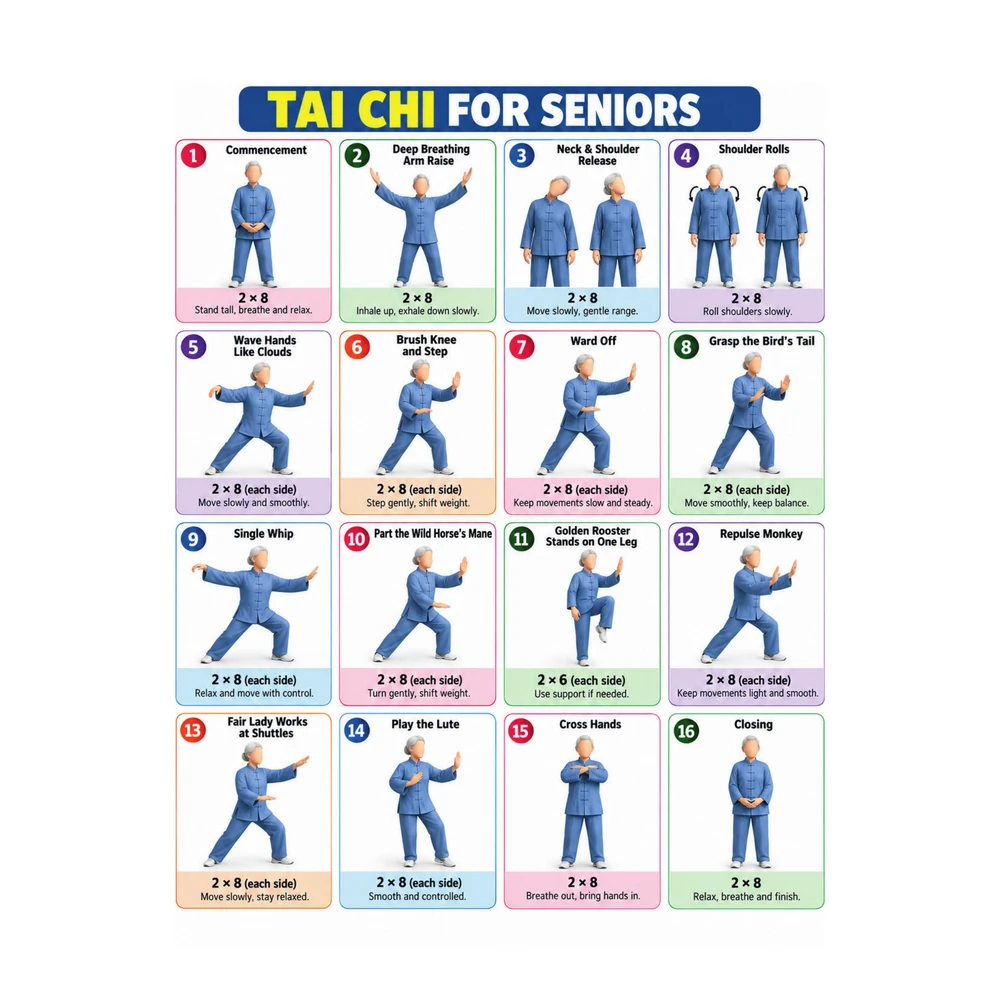
That is why teachers spend time on positions that can look, to a beginner, suspiciously like standing still. If you would like to see how the stances fit into complete movements, our guide to tai chi moves for beginners walks through the basic movements step by step, and the gentle routine in tai chi for seniors exercises shows the stances in action in a full practice. Learn the positions first, at your own depth, and the movements built on them will make sense much faster.
Frequently Asked Questions
How deep should a beginner go in the stances?
Shallow. Much shallower than photographs of martial artists suggest. A slight bend in the knees — enough that they feel soft and unlocked rather than braced straight — is the right depth for most beginners, and for many older practitioners it remains the right depth permanently. You should be able to breathe comfortably, keep your balance without effort and hold a conversation. If you are straining, shaking hard or holding your breath, stand up a little. Depth can come later, gradually, if your body invites it.
My legs shake in the horse stance. Is that normal?
Yes, especially in your first weeks. The horse stance asks your thigh muscles to work in a sustained, unfamiliar way, and mild shaking is simply the feeling of muscles being asked to do something new. It usually settles as your legs strengthen. Stand up, walk a few steps and return when you are ready. What is not normal is sharp pain, or pain in the knee joint itself — stop, adjust your depth, and if knee pain persists, get it checked by a doctor or physiotherapist.
Do I need to hold the stances for a long time?
No. In flowing tai chi practice, most stances are passed through rather than held — you arrive, settle, and move on. Brief standing practice in the horse stance, perhaps thirty seconds to a couple of minutes, is a useful exercise in itself, but long, punishing holds are a martial training method, not a requirement of tai chi for health. If holding a position stops being comfortable, the position has done its work for today.
Which stance should a beginner learn first?
Start with the horse stance, in its narrow, everyday form: feet hip-width apart, knees soft, weight even, breathing slow. It is the foundation under the opening posture of nearly every routine, and it teaches the central tai chi skill — standing in a relaxed, balanced, deliberate way. Add the bow stance next, since it is built into every step, then the empty stance, which unlocks slow, controlled stepping. The back stance and the single-leg stance can arrive in their own time.
Final thoughts
Tai chi positions have grand names and simple bodies. A wide, even stance. A step, arrived at slowly. Weight gathered on one leg so the other can move like a cat testing the ground. Learn those shapes at a height that suits your knees, keep your knees honest over your toes, and stay near a chair for the one-leg work — and you have the foundation the whole art is built on. Everything graceful you have ever seen in tai chi is standing on exactly this.