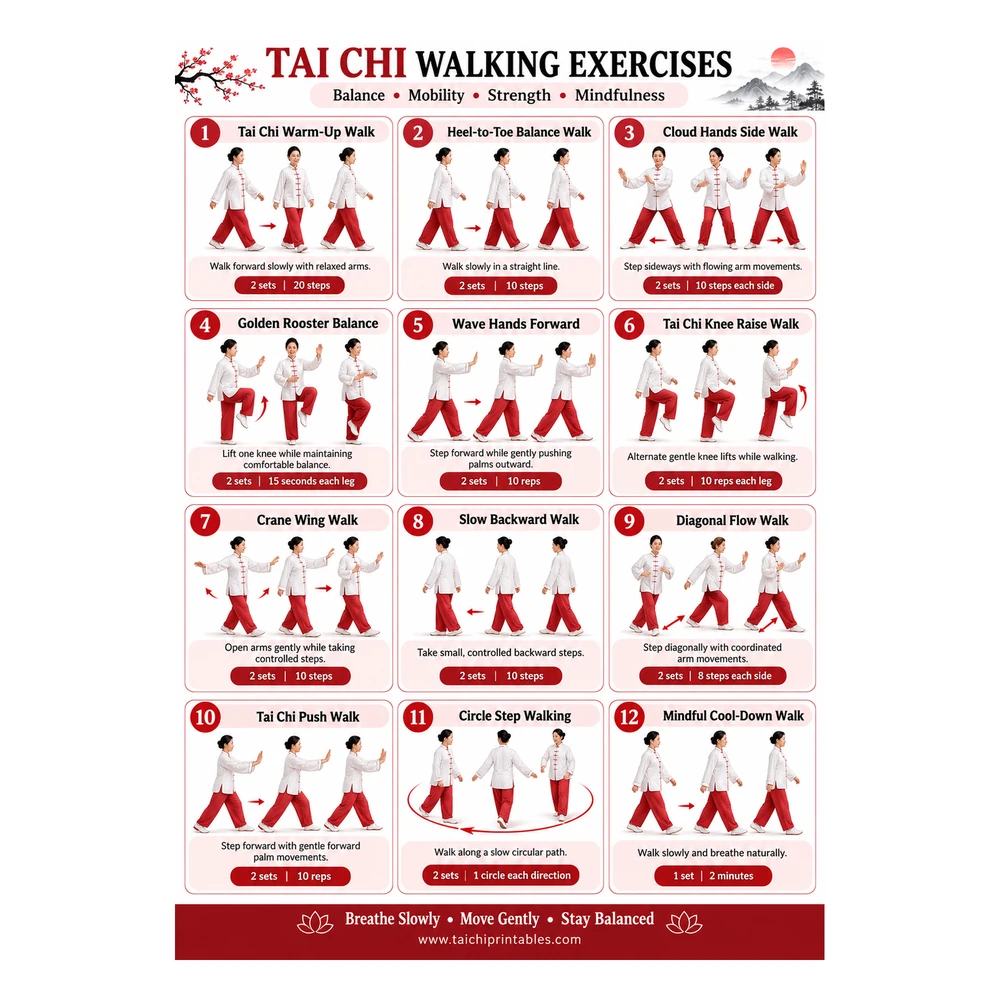

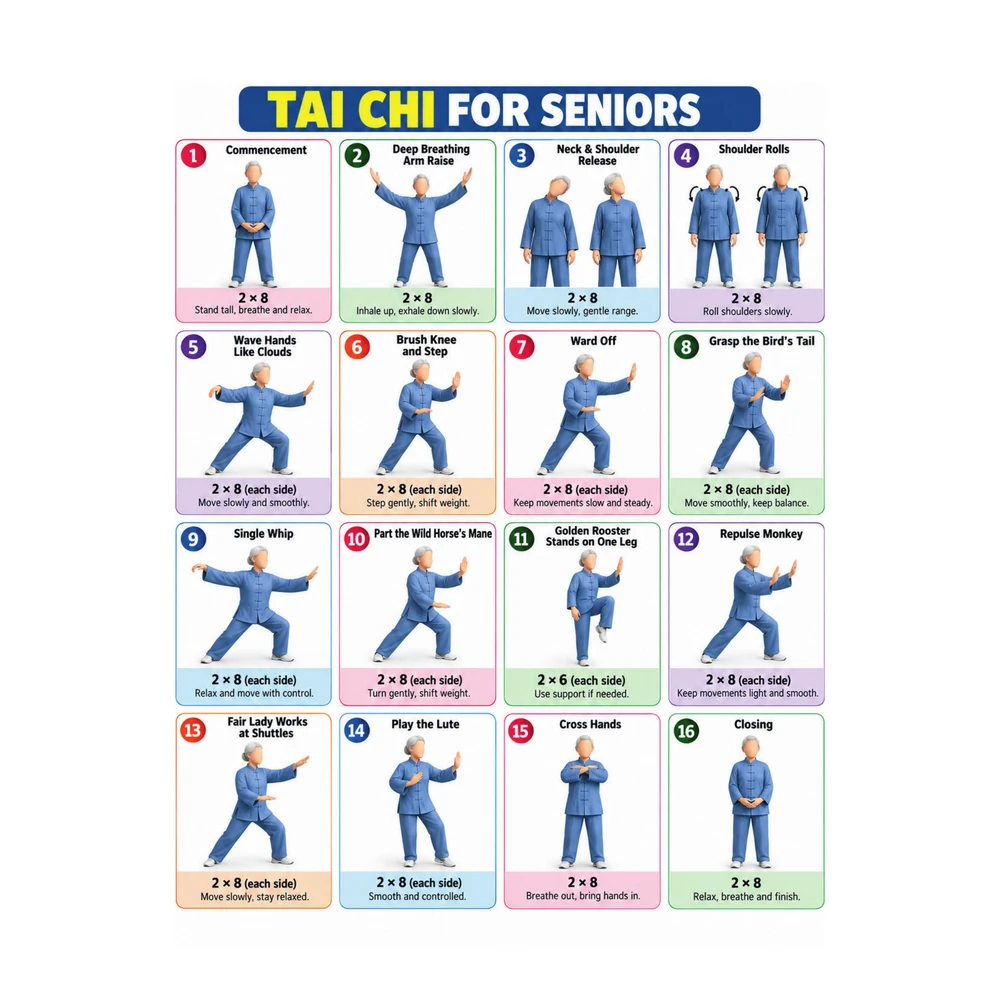
There is a particular kind of stiffness that belongs to the morning. You get out of bed, and for the first few minutes everything feels a size too small — shoulders up around your ears, neck reluctant to turn, back slow to straighten. A gentle tai chi morning routine is a kind way to deal with it: ten unhurried minutes of standing, breathing and slow movement that ease you into the day instead of dropping you into it.
The routine below is built from the four opening movements of our Tai Chi for Seniors practice: Commencement, Deep Breathing Arm Raise, Neck & Shoulder Release, and Shoulder Rolls. They are the calmest movements in the set, they ask nothing of your balance beyond standing comfortably, and together they wake up your breath, your shoulders and your posture in that order. This page teaches each one step by step, and explains how to turn them into a morning habit.
Why start the day with tai chi
Tai chi suits the morning for the same reason it suits beginners: it begins at almost zero. There is no warm-up needed before the warm-up, no equipment, no floor work, and no moment where you are asked to do something sudden. You stand, you breathe, and you move slowly, and the body catches up with the idea of being awake in its own time.
Many people also find that a short practice first thing is the easiest one to keep. It happens before the day can fill up, it takes place in the same spot at the same time, and it gives the morning a small, pleasant structure — practise, then kettle, then breakfast. If you are completely new to this, our tai chi for beginners guide explains how these same four movements fit into a first week of practice.
Before you begin
A few simple preparations make the routine smoother. Practise in a clear space where you can move your arms without knocking anything, with a sturdy chair nearby in case you feel unsteady — early mornings and balance do not always agree. Wear loose, comfortable clothes and flat shoes or firm slippers with grip; avoid socks on smooth floors. Natural light helps you feel awake, so open the curtains first if you can.
Keep everything gentle. Every movement below should feel mild and comfortable, never forced. Breathe normally, rest whenever you like, and stop if you feel dizzy or in pain. If you have a health condition, joint problems or a history of falls, check with your doctor before starting a morning practice. This article is general educational information, not medical advice.
The four opening movements
Work through the four movements in order, at a pace that lets your breathing stay slow. The full set takes roughly ten minutes, including rests. When all four feel familiar, they are also the natural doorway into the complete sixteen-movement routine.
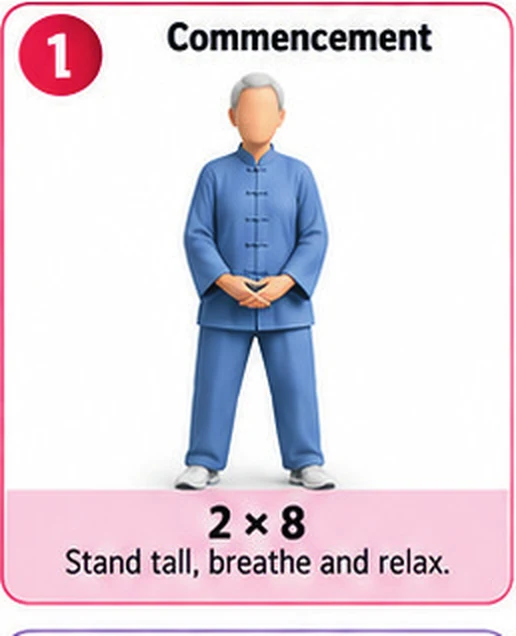
1. Commencement
Commencement is the traditional opening of a tai chi form: a slow raising and lowering of the arms that settles your posture, your breathing and your pace for everything that follows. It is the simplest movement in this routine, and deliberately so — it gives your body a quiet minute to arrive.
- Stand with your feet shoulder-width apart, arms resting by your sides, knees soft.
- Breathe in as you raise both arms slowly in front of you to shoulder height, palms facing down.
- Breathe out as you soften your knees a little and lower your hands gently towards your waist.
- Rise again and repeat, moving as if your arms were floating in water.
Recommended practice: 2 sets of 8.
Let your breath begin each repetition a fraction before your arms do. Breathing leads, arms follow — that ordering is the seed of the whole practice.
2. Deep Breathing Arm Raise
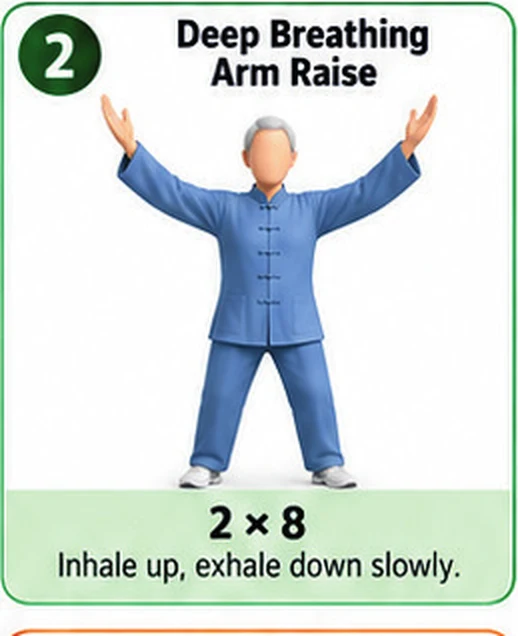
The second movement takes the arms a little higher and ties them to a longer, slower breath. It opens the chest gently and teaches the breathing rhythm that tai chi runs on — which, first thing in the morning, is half the point.
- Stand tall with your feet shoulder-width apart.
- Breathe in slowly as both arms float up in front of you, continuing to about face height, palms turning to face each other.
- Pause for a moment at the top, keeping your shoulders down and relaxed.
- Breathe out as the arms float back down the same path.
Recommended practice: 2 sets of 8.
The arms should rise because the breath rises, not because the shoulders heave. If your shoulders climb towards your ears, lower the height of the raise and try again.
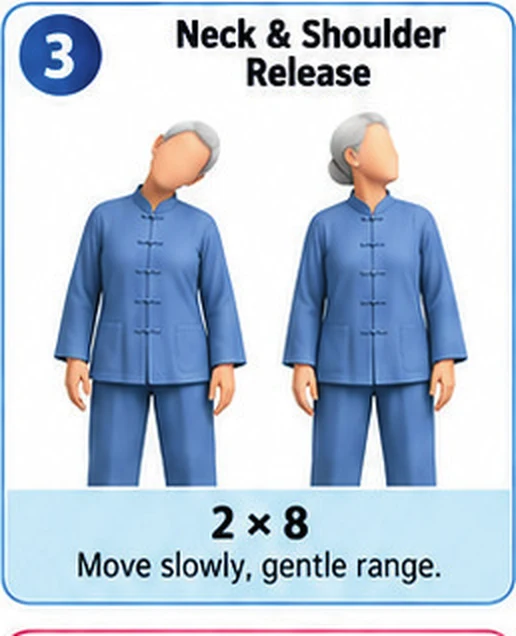
3. Neck & Shoulder Release
Most of us carry the night — and, frankly, the previous day — in the neck and shoulders. This movement is a deliberate letting-go: a rise, a drop, and a few slow turns of the head to remind the whole area that it is allowed to relax.
- Stand tall and let both shoulders rise towards your ears as you breathe in.
- Drop them completely as you breathe out — a real let-go, not a push downwards.
- Turn your head slowly to one side, then the other, a few times, keeping the turns small.
- Finish facing forwards, with your shoulders sitting as low as they will go.
Recommended practice: 2 sets of 8.
The drop is the exercise. Shoulders that only ever rise and hover are the default setting of modern life; practising the release is the whole point.
4. Shoulder Rolls
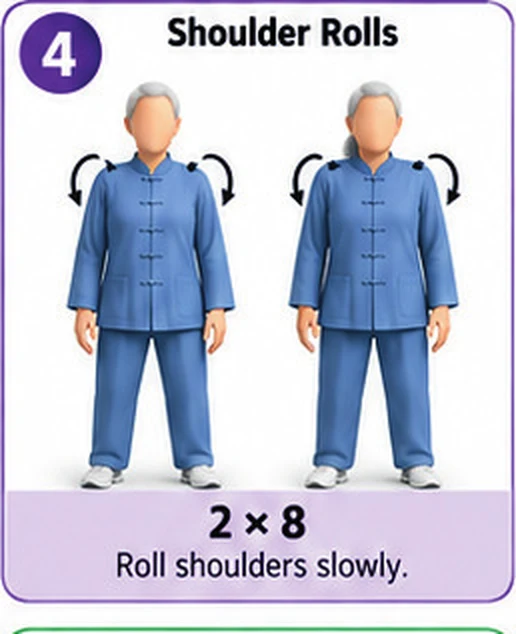
The final movement warms the shoulder joints with slow circles and finishes the morning’s loosening of the upper body. It is a good place to notice how different your shoulders feel compared with ten minutes ago.
- Stand tall with your arms hanging loose by your sides.
- Roll both shoulders in slow circles: up, back, down and forwards.
- Make the circles as large as is comfortable, without forcing them.
- Reverse the direction for the second set.
Recommended practice: 2 sets of 8.
If your shoulders feel crunchy or gravelly at first, you are in plentiful company. Keep the circles slow and comfortable, and they usually smooth out within a few sessions.
Making it a morning habit
The routine itself is the easy part; the habit is the achievement. A few things help. Practise at the same time each morning, ideally straight after getting up or while the kettle boils, so the session attaches to something you already do. Keep the space ready — chair in place, room tidy enough — so there is nothing to set up. And keep the session short enough that you never talk yourself out of it: ten minutes on a busy morning, a little longer when the day allows.
Expect the first few mornings to feel mechanical. That is normal; you are learning movements as well as building a habit. Within a couple of weeks most people find the sequence runs itself, and their attention can rest on the breathing and the pleasant feeling of a body waking up properly.
When the four movements feel like old friends, the natural next step is the full routine they open. Our Tai Chi for Seniors article teaches all sixteen movements in the same step-by-step style, so you can grow your morning session gradually — add a movement or two at a time, and let the practice lengthen as your mornings allow.
Frequently Asked Questions
How long does this morning routine take?
Around ten minutes, including short rests between movements. Each movement is practised for 2 sets of 8, and there is no need to hurry any of it. On a rushed morning, one set of each movement still makes a worthwhile session of about five minutes.
Should I practise before or after breakfast?
Most people prefer practising before breakfast, when the stomach is empty and the house is quiet, but there is no rule. If you would rather eat first, leave a little time to settle and keep everything gentle. The best time is the one you will repeat tomorrow.
Can I do this routine if my balance is poor?
Yes, with your chair honestly within reach and used without hesitation. All four movements are done standing still with both feet on the floor, and holding the Chair with one hand during any of them is perfectly acceptable. If your balance problems are new or getting worse, have them checked by a doctor before relying on any exercise routine.
What if I wake up too stiff for even this?
Make everything smaller. Raise the arms halfway, shrink the shoulder circles, take longer over the breathing. The movements are meant to meet the morning body where it is, not where you wish it were. If stiffness is severe, new, or comes with pain, treat that as a question for your doctor rather than something to exercise through.
Do I need the full sixteen-movement routine as well?
Not at all. These four movements make a complete, self-contained morning practice, and many people stay with them happily for months. The full routine is there when you want more — it continues from exactly where this session ends, so nothing you learn here is wasted.
Ten quiet minutes
A tai chi morning routine is not a project or a performance. It is four slow movements beside a chair: arms floating up on a breath, shoulders dropping, a few gentle circles, and a body that feels more awake than the one that got out of bed. Do it tomorrow, and the day after, and let the small repetition do its work.
Safety note: Practise beside support, stop any movement that causes pain, and rest if you feel dizzy. Check with your doctor before starting if you have a health condition or a history of falls. This article is general educational information, not medical advice.