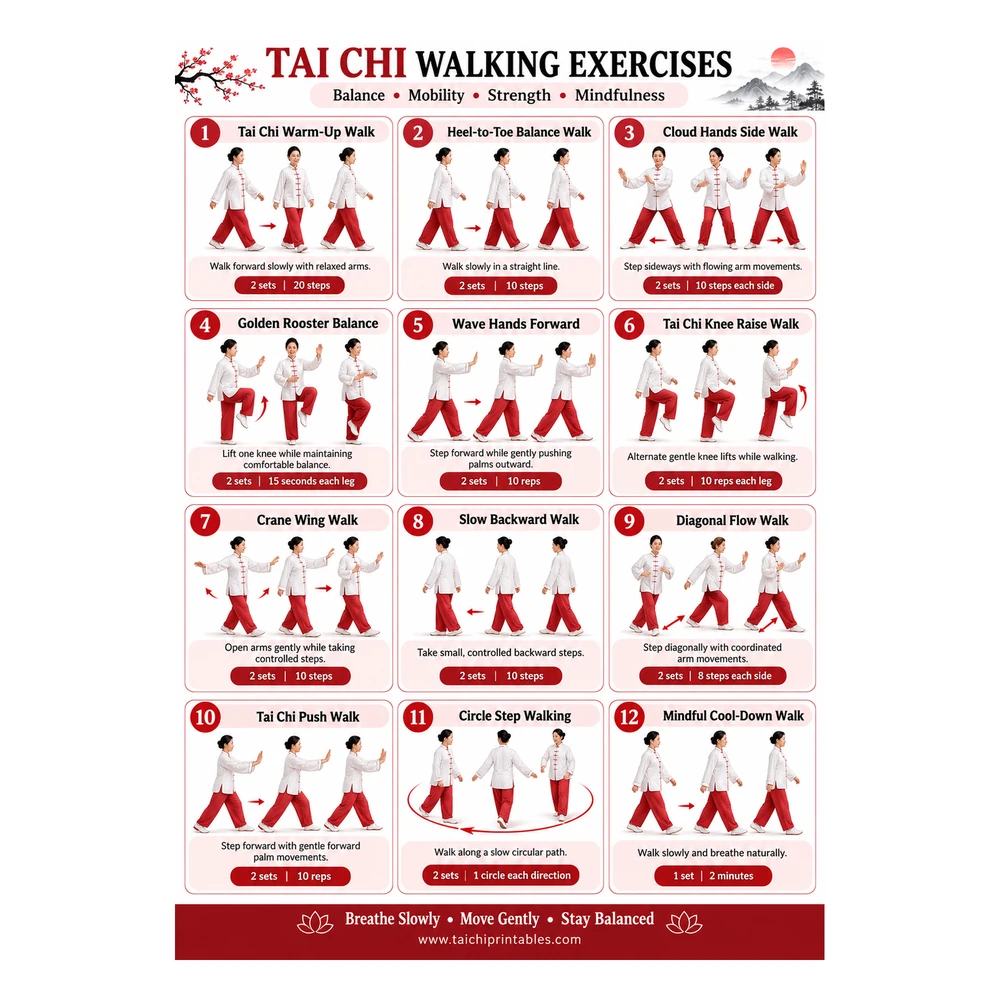

Stiff shoulders in the morning. A back that feels tight after sitting. Reaching the top shelf takes a little more effort than it used to. Most of us know the feeling — and hard workouts are rarely the answer on a stiff day.
That is where tai chi for flexibility comes in. This routine takes 16 classic tai chi postures and turns each one into a short, gentle stretch. You hold every position for just 20 seconds, breathe, and move on. No floor work, no special equipment. Think of it as stretching exercises for seniors, shaped by the slow, flowing style of tai chi.
Below are all 16 stretches in order, with simple steps and a tip to make each one easier. A 10-minute version sits near the end.
What Is Tai Chi for Flexibility?
Tai chi is a slow movement practice built on relaxed, flowing postures. In a regular class you flow from posture to posture without stopping. Here we do something slightly different: you settle into each posture, hold it gently for 20 seconds, and let the muscles stretch while you breathe.
Nothing is forced. A tai chi stretch should feel like a mild, pleasant pull — never sharp, never pain. These are standing postures based on everyday movements: reaching, turning, stepping, shifting your weight. The order below works through the body in sequence — shoulders and arms, waist and spine, then the hips (where dedicated hip stretches like Play the Lute come in), then legs.
6 Benefits of a Gentle Flexibility Practice
1. Moving More Comfortably Day to Day
Reaching, turning to check a blind spot, bending to tie a shoe — daily life asks a lot of your joints. A regular gentle routine keeps those movements familiar and manageable.
2. A Calmer Start on Stiff Mornings
Many people feel stiffest first thing. Ten quiet minutes of slow stretches gives the body a gradual start.
3. Better Awareness of Your Posture
Holding a posture for 20 seconds gives you time to notice slouching, leaning, or tensing up — awareness that tends to follow you through the day.
4. A Routine That Fits Real Life
The full set takes under fifteen minutes, needs no equipment, and can be shortened on busy days. Short and simple makes it easy to repeat.
5. Steady, Supported Standing Practice
Most of these stretches are done standing, with gentle weight shifts that keep your legs awake. A chair or countertop nearby keeps it all feeling secure.
6. A Quiet Few Minutes for Your Mind
Slow breathing and one hold at a time is a restful combination — a pause for the head, too.
Before You Start: Safety First
- Never force a stretch. Move only as far as feels comfortable, and ease back if the pull gets strong.
- A stretch should feel like mild tension only — never pain, pinching, or sharpness.
- Breathe normally during every hold; never hold your breath.
- Keep a stable support nearby — a sturdy chair, a countertop, or a wall.
- Clear a small space and wear shoes or socks with grip.
- If you have a health condition, a recent injury, or any doubt, check with your doctor first.
16 Tai Chi Stretches for Flexibility
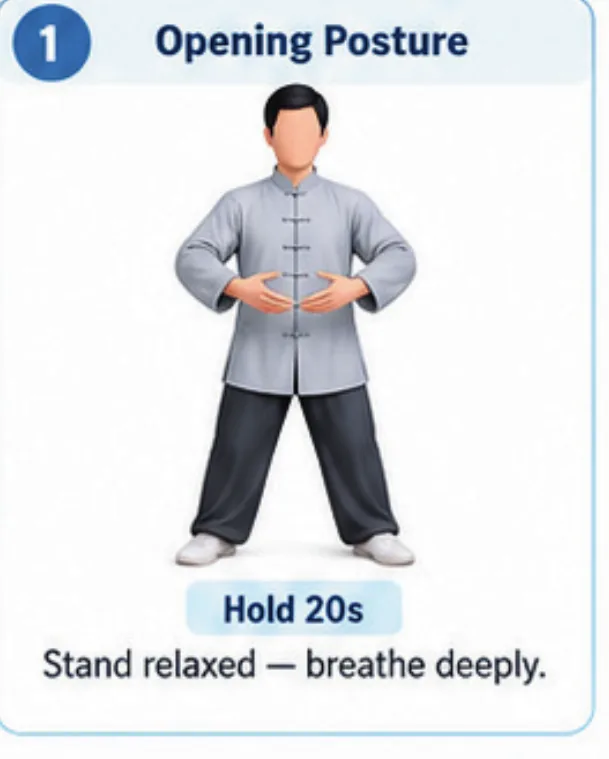
1. Opening Posture
Purpose: A quiet standing start; settles posture and gently stretches the shoulders and arms.
How to Perform:
- Stand with feet hip-width apart, knees soft.
- Float both arms up in front of you to shoulder height, palms down.
- Keep shoulders low, stand tall, breathe slowly.
Recommended Practice: Hold 20 seconds.
Beginner Tip: Rest fingertips on a chair back if standing feels wobbly.
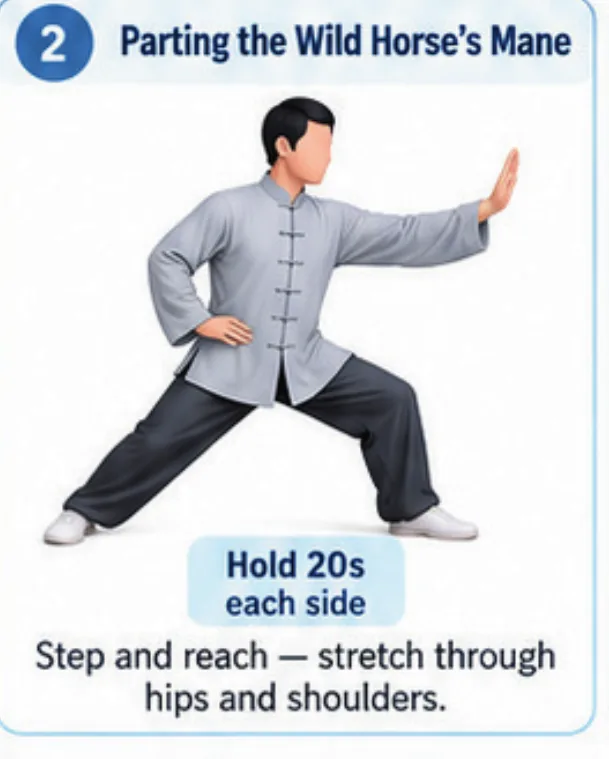
2. Parting the Wild Horse’s Mane
Purpose: Opens the chest and shoulders, with a gentle turn through the waist.
How to Perform:
- Shift weight onto one leg; step the other foot out at a slight angle.
- Raise one arm beside your head; rest the other hand low near your hip.
- Turn your waist a little toward the raised arm.
Recommended Practice: Hold 20 seconds each side.
Beginner Tip: A smaller step makes the stance much steadier.
3. Wave Hands Like Clouds
Purpose: A soft side stretch for the waist and shoulders, with slow weight shifts.
How to Perform:
- Stand with feet slightly wider than hips, hands before your chest.
- Shift weight to one leg as hands drift sideways, like clouds crossing the sky.
- Pause at the end of the drift, feeling the pull along your side.
Recommended Practice: Hold 20 seconds each side.
Beginner Tip: Keep the sideways movement small; comfort matters more than range.

4. Brush Knee and Twist
Purpose: A gentle spinal turn stretching the waist, shoulders, and backs of the legs.
How to Perform:
- Take a comfortable step forward with one foot.
- Sweep the opposite hand down past your knee, as if brushing it clean.
- Push the other hand softly forward at chest height; settle into the stretch.
Recommended Practice: Hold 20 seconds each side.
Beginner Tip: Brushing your thigh instead of your knee is fine.

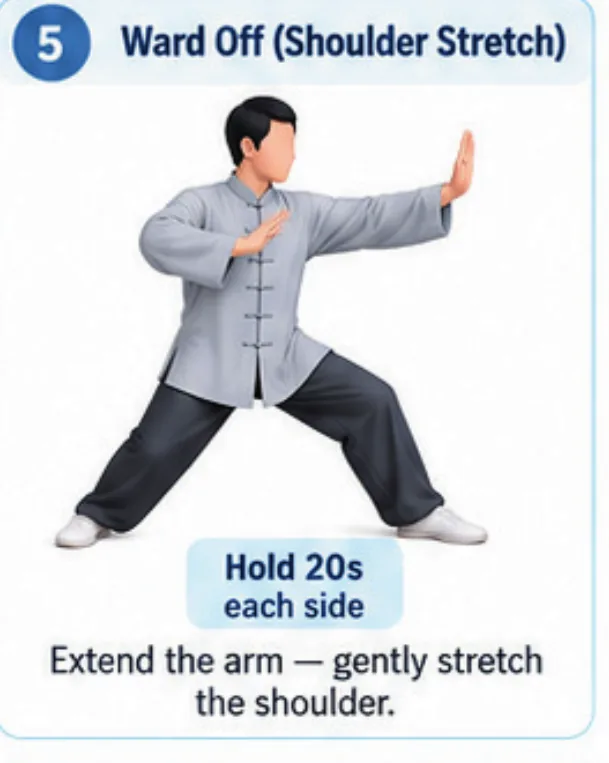
5. Ward Off (Shoulder Stretch)
Purpose: A simple stretch across the shoulder and upper arm, in a calm standing frame.
How to Perform:
- Stand tall, feet hip-width apart.
- Raise one forearm before your chest, palm facing you, as if holding a large ball.
- Rest the other hand under that elbow; feel the pull across the shoulder.
Recommended Practice: Hold 20 seconds each side.
Beginner Tip: Keep shoulders dropped away from your ears.
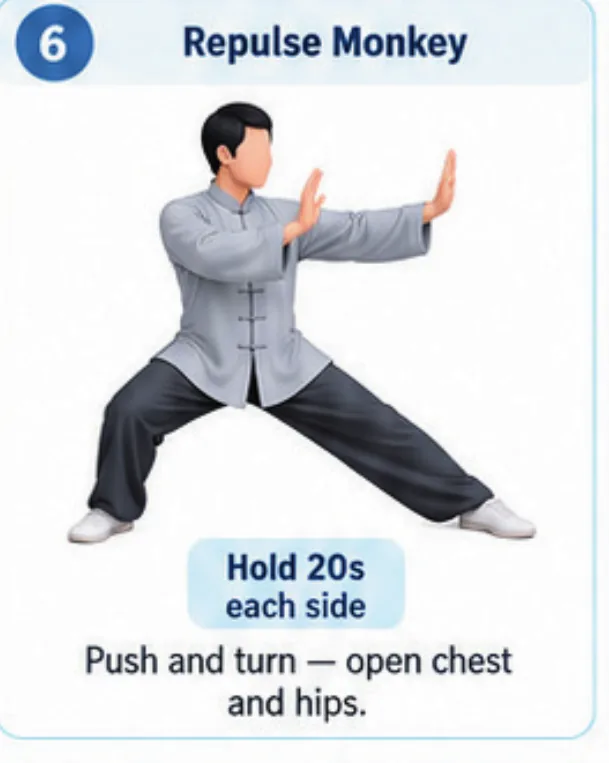
6. Repulse Monkey
Purpose: Stretches the shoulders and upper back as one arm reaches behind you.
How to Perform:
- Take a small step back with one foot.
- Reach that same-side arm behind you, palm up, as if pushing something away.
- Rest the other hand forward at chest height; turn your head toward the back hand.
Recommended Practice: Hold 20 seconds each side.
Beginner Tip: Keep the backward reach modest — a small turn is enough.
7. Grasp Bird’s Tail (Spinal Twist)
Purpose: A standing spinal twist stretching the spine and waist, arms drawn across the body.
How to Perform:
- Step one foot forward into a short, soft stance.
- Bring both arms across your body at chest height, one hand holding the other wrist.
- Rotate your waist gently toward the front leg, hips facing forward.
Recommended Practice: Hold 20 seconds each side.
Beginner Tip: Twist from the waist, not the neck.

8. Single Whip (Side Stretch)
Purpose: A long side stretch — ribs, waist, and outer hip — with one arm extended wide.
How to Perform:
- Step into a wider stance, both knees soft.
- Extend one arm far out to the side at shoulder height.
- Rest the other hand before your lower belly; lean slightly toward the extended arm.
Recommended Practice: Hold 20 seconds each side.
Beginner Tip: Keep both knees bent; locked legs make this harder, not better.

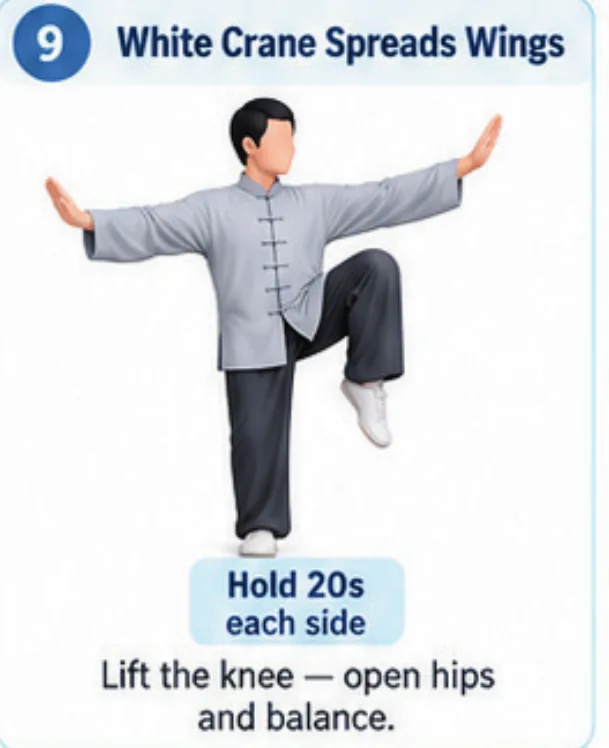
9. White Crane Spreads Wings
Purpose: Opens the chest and front of the shoulders, one leg resting lightly for support.
How to Perform:
- Shift weight onto one leg; rest the other foot’s toe lightly on the floor.
- Raise one arm beside your head, palm facing out.
- Press the other hand gently down near your hip; lift your chest and breathe.
Recommended Practice: Hold 20 seconds each side.
Beginner Tip: Keep that toe on the floor — it is your built-in support.
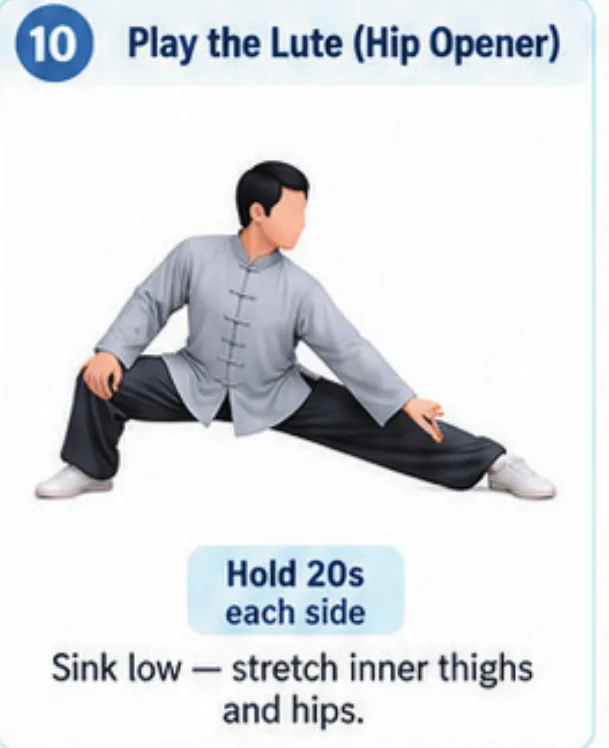
10. Play the Lute (Hip Opener)
Purpose: A hip opener stretching the front and inside of the hip.
How to Perform:
- Shift your weight onto one leg.
- Rest the other heel on the floor ahead, knee soft, turned slightly outward.
- Hold both hands at chest height, as if cradling an instrument; sit your weight back slightly.
Recommended Practice: Hold 20 seconds each side.
Beginner Tip: Hold a chair if the heel-rest position feels unsteady.
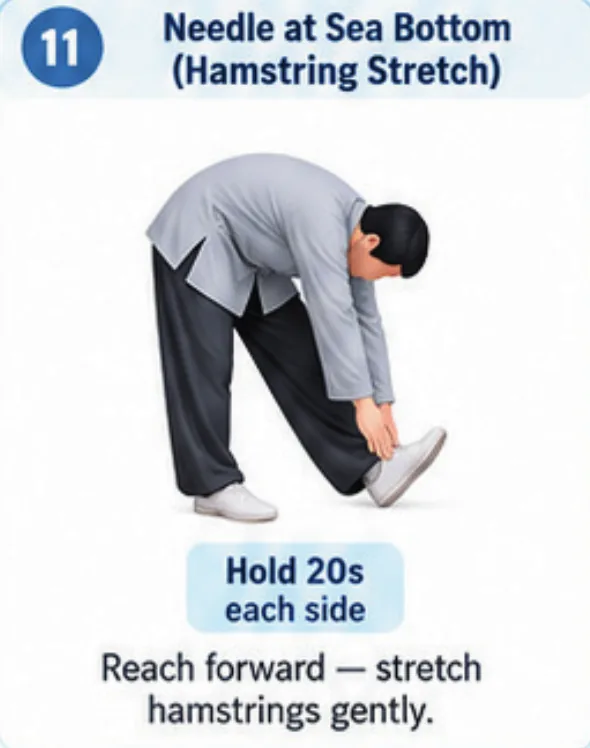
11. Needle at Sea Bottom (Hamstring Stretch)
Purpose: A forward reach stretching the hamstring — back of the thigh — and lower back.
How to Perform:
- Step one foot forward, heel down, toes pointing up.
- Sit your hips back slightly, back long rather than rounded.
- Reach both hands toward the front shin; stop at a mild pull.
Recommended Practice: Hold 20 seconds each side.
Beginner Tip: Hands resting on your thigh work just as well.
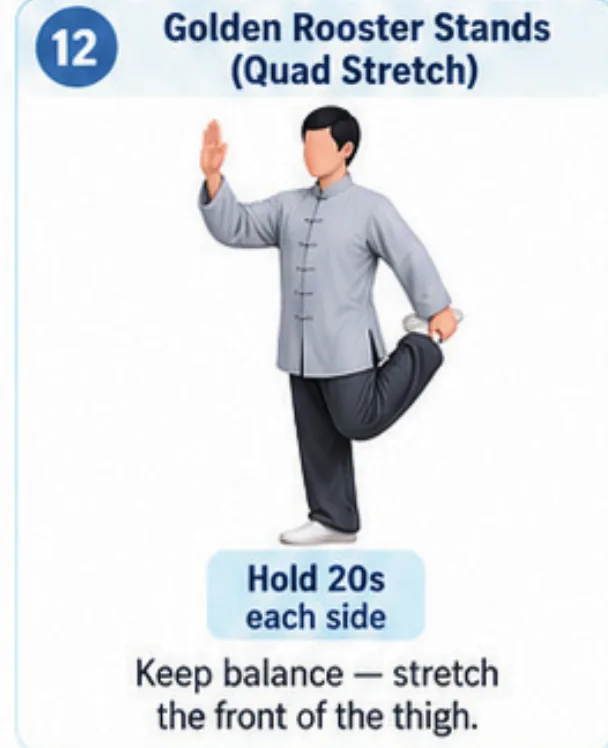
12. Golden Rooster Stands (Quad Stretch)
Purpose: Stretches the quad — front of the thigh — of the raised leg.
How to Perform:
- Stand beside a chair and hold it with one hand.
- Shift weight onto the leg nearest the chair.
- Bend the other knee, lifting that foot slightly behind you, knee pointing down.
Recommended Practice: Hold 20 seconds each side.
Beginner Tip: The foot only needs to lift a few inches.
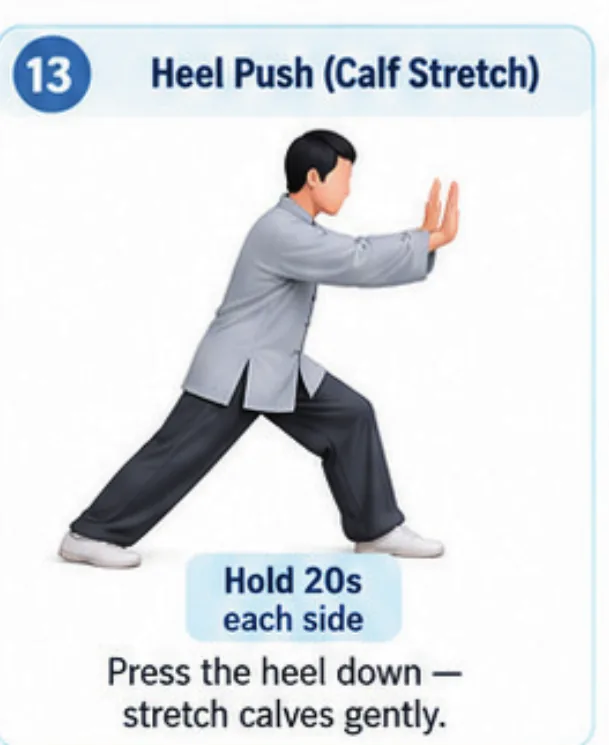
13. Heel Push (Calf Stretch)
Purpose: A steady stretch for the calf of the back leg, in a short forward stance.
How to Perform:
- Step one foot back, heel pressed into the floor.
- Bend the front knee slightly; lean your weight gently forward.
- Rest hands on your front thigh or a chair; feel the pull in the calf.
Recommended Practice: Hold 20 seconds each side.
Beginner Tip: If the pull feels strong, bring the back foot closer.
14. Dragon Looks Back (Spinal Stretch)
Purpose: A slow look over the shoulder, stretching the spine and neck in gentle rotation.
How to Perform:
- Stand with feet hip-width apart, hands on your waist.
- Turn head and shoulders slowly to one side, as far as feels easy.
- Let your waist follow a little, hips forward, chin level.
Recommended Practice: Hold 20 seconds each side.
Beginner Tip: Move your eyes first and let your head follow.

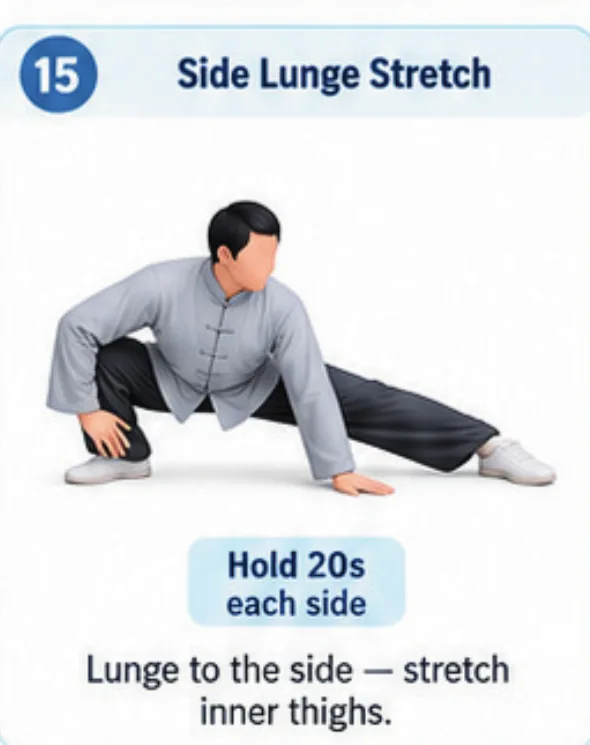
15. Side Lunge Stretch
Purpose: Stretches the inner thigh and hip of the straight leg.
How to Perform:
- Take a wide stance, toes pointing forward.
- Bend one knee and shift your weight over that leg.
- Keep the other leg straight, foot flat, hands resting on the bent thigh.
Recommended Practice: Hold 20 seconds each side.
Beginner Tip: A shallower bend gives a kinder stretch.
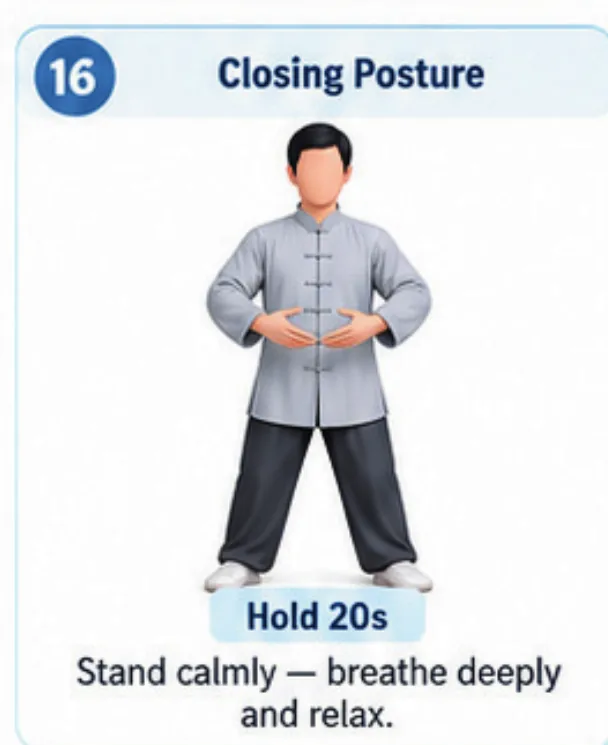
16. Closing Posture
Purpose: A quiet finish; brings posture back to centre and relaxes the whole body.
How to Perform:
- Bring your feet back to hip-width apart.
- Lower your arms slowly until they rest by your sides.
- Stand tall with soft knees; take a few slow breaths.
Recommended Practice: Hold 20 seconds.
Beginner Tip: Stay a little longer if you like — the finish need not be rushed.
10-Minute Sample Practice
Short on time? This set keeps the same full-body shape — shoulders, spine, hips, legs — in about ten minutes, a good example of how stretching exercises for seniors can shrink to fit a busy morning. People often ask which are the best stretches for flexibility; the honest answer is usually the gentle ones you can repeat several times a week — which is exactly the principle this shorter set follows.
| Stretch | Hold |
|---|---|
| Opening Posture | 20 seconds |
| Wave Hands Like Clouds | 20 seconds each side |
| Grasp Bird’s Tail (Spinal Twist) | 20 seconds each side |
| Single Whip (Side Stretch) | 20 seconds each side |
| Play the Lute (Hip Opener) | 20 seconds each side |
| Needle at Sea Bottom (Hamstring Stretch) | 20 seconds each side |
| Heel Push (Calf Stretch) | 20 seconds each side |
| Closing Posture | 20 seconds |
Rest a few breaths between stretches; repeat the set if the first round felt good.
Get the Printable Chart
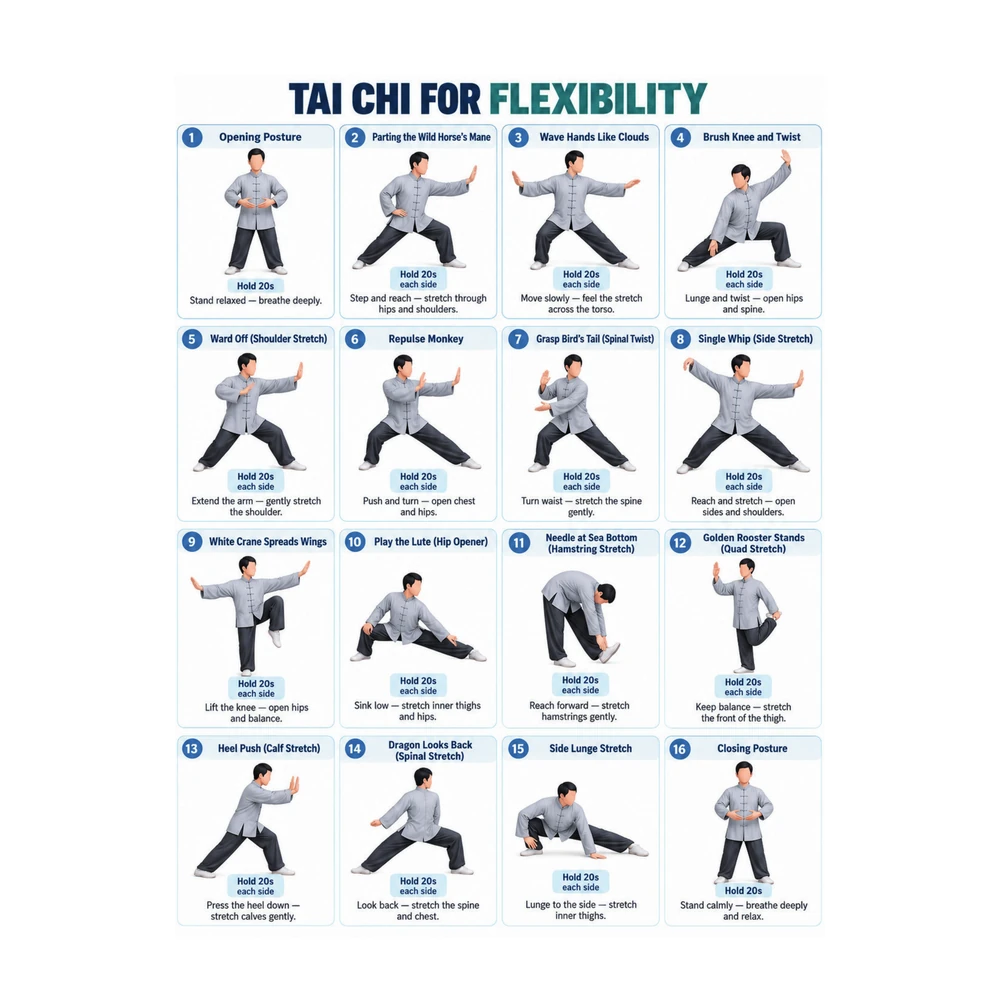
If you would like the whole routine on one page — for the fridge door or your practice spot — the printable chart lays out all 16 stretches in order, each one illustrated, each one held for 20 seconds. It is a one-page A4 printable PDF, so the full sequence stays in front of you.
Tai Chi for Flexibility — Printable PDF Chart
Frequently Asked Questions
1. How often should I do this routine?
Three or four sessions a week is a sensible start. Gentle stretching suits most days, so daily practice is fine too — keep it easy and rest when tired.
2. Do I need any experience with tai chi?
No. Each posture is a simple standing stretch with plain steps, and the 20-second holds give you time to settle in. Start with the sample practice if 16 feels like a lot.
3. Can I do these stretches sitting in a chair?
Several arm and waist stretches — Wave Hands Like Clouds, Ward Off, Dragon Looks Back — adapt well to a sturdy chair. The leg stretches are best done standing with support nearby.
4. What should a stretch feel like?
A mild, steady pull is right. Sharpness, pinching, or pain is not — ease off at once. You should be able to breathe slowly through every hold.
5. How long does the full routine take?
With 20-second holds per side and a few breaths between stretches, roughly twelve to fifteen minutes. The 10-minute sample above covers shorter days.
6. What should I wear, and where should I practise?
Comfortable clothes you can reach and turn in, plus shoes or socks with grip. Any small clear space works, as long as a chair or countertop is within reach.
Final Thoughts
Flexibility work does not need to be long or complicated to be worth doing. Sixteen quiet postures, twenty seconds at a time — a routine that fits an ordinary morning. Start gently, repeat it often, keep it comfortable. Small, regular sessions tend to stick.
Safety Note: Stretch only within a comfortable range, and stop at once if anything hurts. These stretches are a general, gentle practice; they are not a substitute for medical care, and suitability varies from person to person. If you have a health condition, a recent injury, joint problems, or any concern about whether this routine is right for you, consult a healthcare professional before you begin.