
Introduction
If you have ever wanted to try something gentle for your body and mind, qigong exercises might be just what you are looking for. You will also see the name written as qi gong exercises — it is the same practice. There is nothing fancy about them. No special equipment. No need to be flexible. Just a little space, a bit of time, and a willingness to slow down.
If you are new to this, you are in the right place. This is a simple introduction to gentle qigong movements that anyone can try at home. You do not need to learn a long sequence or remember lots of names. We will go through eight basic movements, one at a time, and you can take them at your own pace.
What Is Qigong?
Qigong is an old Chinese practice that brings together gentle movement, posture and quiet breathing. The word qigong is pronounced “chee-gong”, and it has been part of everyday life in China for many years.
The idea is simple. You move slowly, you breathe in a relaxed way, and you try to let your body unwind as you go. That is really all there is to it. There are no sudden movements, no straining, and no need to push yourself.
Some qigong is practised as a fixed set of pieces — the best known is the Eight Brocades, called Baduanjin (also written Ba Duan Jin), a sequence of eight pieces worked through in order. The beginner movements on this page are not that set; they are a simpler starting point that you can learn one at a time.
Practitioners traditionally believe Qigong helps the body’s energy, called qi, move more smoothly. That is a traditional view, not a medical claim. For most people today, it is simply a calm, gentle way to move and breathe.
Qigong and Tai Chi — What Is the Difference?
People often ask about the difference between Qigong and Tai Chi, and it is a fair question. They are both gentle Chinese movement practices, and they do share some of the same slow, flowing ideas.
Tai Chi is usually taught as a longer set of connected movements. These forms grew out of martial arts and follow a more structured pattern. You learn a sequence and practise it step by step.
Qigong, on the other hand, is usually simpler. It is made up of shorter, repeated movements and more focus on breathing and relaxation. It does not follow the same long choreographed forms. If Tai Chi is like learning a gentle dance, Qigong is a little more like learning a few easy stretches and breathing exercises that you can return to again and again.
If you want to learn more about this, read our article Qigong vs. Tai Chi: What Is the Difference?
Basic Principles for Beginners
Before we get to the movements, there are a few simple things worth keeping in mind. They will make the whole practice feel easier and more comfortable.
1. Go Slowly
There is no rush. In fact, the slower you go, the better the movement tends to feel. Try to move as though you were performing under water; smooth, unhurried and without effort.
2. Breathe Naturally
You do not need to force your breath or hold it in a certain way. Breathe in through your nose and out through your mouth, or in and out through your nose. Whatever feels easy. As you get more used to the moves, your breathing may naturally start to match them.
3. Relax Your Shoulders
Many of us carry our tension up in our shoulders, even when we do not notice. Try checking in every now and then. Are your shoulders rising toward your ears? Let them drop. Keep them loose and relaxed.
4. Move Within Your Comfort Zone
Only stretch as far as feels comfortable. If a movement feels too far or too high, keep it smaller. There is no prize for stretching further.
5. Use Support If You Need It
There is no shame in holding on to a chair or keeping one nearby. Balance can vary from day to day, and a bit of support can make you feel much steadier.
Before You Begin
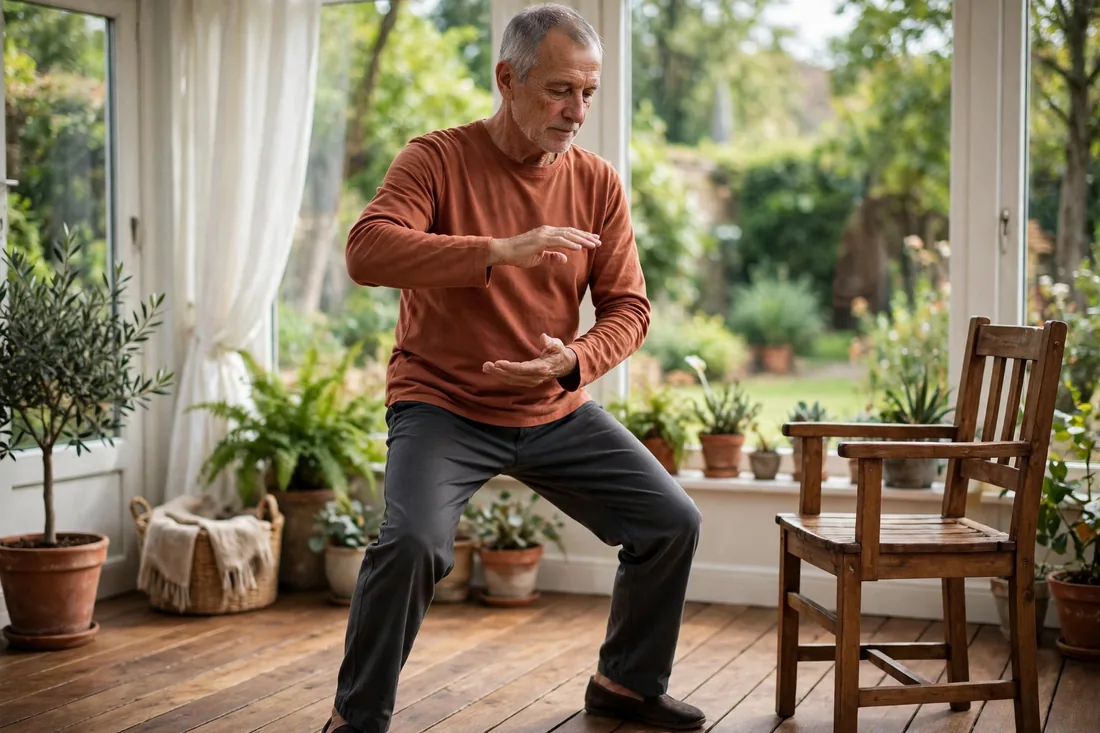
You do not need a lot of space for most of these qigong exercises for seniors and beginners. A clear area in your living room, a quiet corner in the garden, or any flat space where you can stand comfortably will work just fine.
Wear supportive, comfortable shoes if you are on hard flooring. If you prefer bare feet on a soft surface, or carpeted floor, that is fine too. The key thing is to feel stable.
Here are a few things to check before you start:
- Wear supportive, comfortable shoes.
- If you prefer bare feet, be sure to use a non-slip surface.
- Choose a clear, flat space where you can move without bumping into furniture.
- Keep a sturdy chair nearby for balance.
- If standing feels difficult, many of these movements can be adapted while seated. You can still get something from them sitting in a chair, so do not feel that standing is the only option.
The 8 Beginner Qigong Movements
1. Standing Posture — A Quiet Place to Begin
These qi gong exercises begin with stillness, which might feel strange at first. Most of us are used to jumping straight into movement. But standing quietly for a moment helps you slow down, notice how you are breathing, and feel a little more settled before you start.
Stand with your feet about shoulder-width apart. Let your knees bend just a little, so they are not locked. Drop your shoulders and let your arms hang loosely at your sides. Look straight ahead, not down at the floor.
Take a few slow breaths. You do not need to breathe in a special way. Just let your breathing settle on its own. If your mind wanders, bring it back to your feet on the floor for a moment.
A good starting point: Stand quietly for five or six slow breaths, or for about a minute if that feels comfortable.
2. Opening and Closing — Moving With the Breath
If you have ever watched Qigong, you may have seen this slow opening and closing movement. It is one of the best qigong for beginners movements because it is simple, and it gives you something easy to focus on.
Start in your standing posture. As you breathe in, lift your arms up and out to the sides, as if you are gently opening a curtain. Keep your elbows soft and your hands relaxed.
As you breathe out, bring your arms slowly back in front of your body, as if you are holding a large, soft ball. Let your shoulders stay down. There is no need to stretch or strain.
Move at the pace of your breath, not faster. If your arms get tired, lower them and rest for a moment.
Try 6–8 slow repetitions.
3. Raising the Arms — Lifting the Sky
This one is often known as “Lifting the Sky”, and the name fits. It feels like a long, slow stretch after sitting for a while.
Starting from your standing posture, breathe in as you slowly raise both arms in front of you to about shoulder height. Keep your palms facing down and your fingers relaxed.
Breathe out as you lower your arms back down. Take your time. It is not a race, and there is no finish line to reach.
Do not lift your shoulders toward your ears. That is one of the most common mistakes people make, and it can make your neck feel stiff. Keep your shoulders low and your movements smooth.
Try 6–8 slow repetitions.
4. Gentle Arm Circles — Loosening Up
Once your arms have warmed up a little, slow circles can help them feel looser. This is one of the most relaxing gentle qigong movements, and it works well even if you have stiff shoulders.
Stand in your posture and let your arms hang loosely. Begin with small, slow circles, letting your hands float around. After a few circles, change direction.
If the circles would be too much for you, keep the movements smaller and lower, at about waist height. That is completely fine. The aim is comfort, not a perfect shape.
You can also do this while seated if that suits you better.
Try 6–8 circles in each direction.
5. Waist Turning — A Slow Twist
This movement is a gentle twist from side to side. It is best done slowly. Rushing through it does not help, and it can leave you feeling a bit dizzy.
Stand with your feet shoulder-width apart and your knees soft. Let your arms hang at your sides and relax your shoulders.
Slowly turn your upper body toward the right, letting your arms follow. Your feet can stay where they are. Then turn slowly toward the left in the same relaxed way.
Breathe naturally as you turn, and let your eyes follow your turn, not fixed straight ahead.
Try 6–8 slow turns to each side.
6. Gentle Side Stretch — Reaching Up and Over
Now for a gentle side stretch. Many people find this one rather enjoyable after sitting for a long time. The idea is to stretch, not to pull.
From your standing posture, raise one arm overhead, with the palm facing inward. Now bend gently to the opposite side, keeping the movement small and comfortable.
That side stretch should feel gentle. You will feel a light stretch along your side, but it should not hurt. Come back up and let your arm down, then repeat on the other side.
If you are standing, keep a chair nearby if you need support. You can also do this seated, leaning to each side slowly.
Try 4–6 slow stretches on each side.
7. Slow Knee Bends — A Gentle Lowering
Slow knee bends are a very simple way to get your legs working. For gentle qigong exercises, they should always be small and comfortable.
Stand with your feet shoulder-width apart and a chair nearby if you need something to steady yourself with. Slowly bend your knees a little, as if you were about to sit down. Stop when you feel comfortable, and slowly rise back up.
Only go as far as feels steady. There is no set depth to reach. Some people can bend their knees a little more than others, and that is okay.
Keep your feet flat and your legs in line with your toes. If it helps, hold on to the chair with one hand.
Try 5–7 slow repetitions.
8. Closing and Breathing — A Quiet Finish
Finishing in stillness is just as important as starting with it. Closing and breathing is a way of winding down.
Return to your standing posture, with your feet about shoulder-width apart and your knees soft. Let your arms rest low in front of your body, hands near your thighs, palms relaxed.
Close your eyes if you like, or lower your gaze and focus softly on something in the distance. Take several slow, natural breaths and notice how your body feels — a little warmer, maybe a little more relaxed.
Stand quietly for a little while, and finish whenever you feel comfortable. You are not meant to feel rushed or tense. That would defeat the purpose.
Take 4–6 slow breaths to finish.
Putting It Together as a Short Routine
Once you have tried each movement separately, you can put them together into a short routine. It does not need to be strict or timed.
Start with Standing Posture. Move through each movement once or twice. If you feel like stopping after a few, that is fine. You can sit down, take a break and go back to it later.
In time, you might do the whole sequence twice, with a rest in between. Or you might choose just two or three movements that you enjoy and build from there.
The idea is to find a small practice that works for you and your body, and to make it something you enjoy — not a chore. Some people like to do it in the morning to start the day. Others do it in the evening to wind down. Do what feels best for you.
If you do these qigong exercises for a while, you will begin to feel how much of a difference even a few minutes of slow, gentle movement can make.
Safety First
There is no need to push through pain or discomfort. If a movement feels wrong, ease off or stop altogether. Keep your movements small and comfortable, and do not worry about copying someone else’s range or shape.
- Stop if you feel pain, dizziness or discomfort.
- Keep your movements gentle and steady.
- If you are unsure about trying new exercises, check with a doctor or physiotherapist before you begin.
This is general guidance only. It is not medical help, and it does not replace professional advice.
Prefer a Chart You Can Follow?
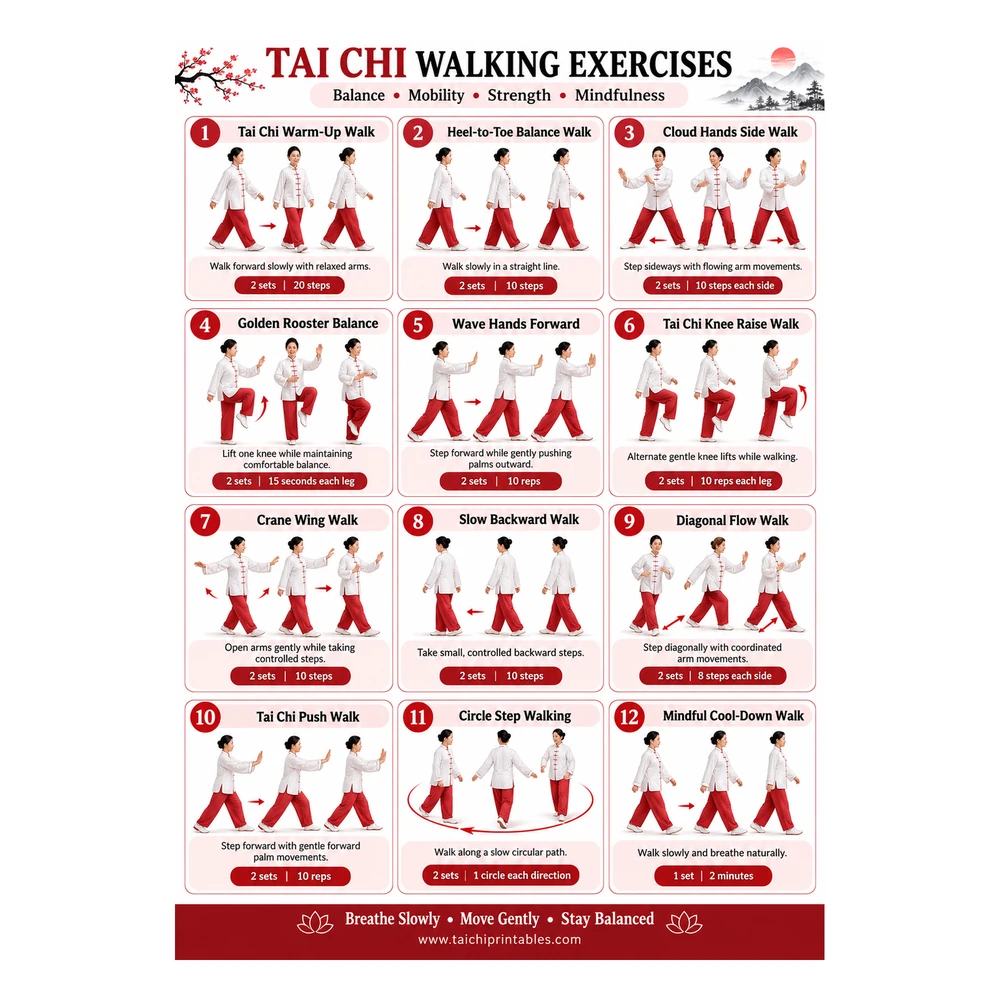
Some people find it easier to follow movements with a visual guide in front of them. Tai Chi Printables makes printable Tai Chi exercise charts that many readers use alongside their gentle movement practice. The charts show each movement clearly, so you can practise at your own pace without having to remember every step.
If you would like to take a look, you can browse the Tai Chi Printables shop to see the charts and other options available.
Frequently Asked Questions
How long does a Qigong session need to be?
It does not need to be long at all. A few minutes can be enough to feel more relaxed and centred. As you get used to the practice, you may find you want to spend a little longer, but you can also keep it brief. The most important thing is to keep it simple and regular.
Can I do Qigong every day?
Yes, you can. Many people practise Qigong daily, for a few minutes or a little longer, depending on how they feel. If you miss a day, that is not important. Just pick it up again the next day.
Can I sit down while doing Qigong?
Yes. Many of the movements can be done while seated in a chair. Simply adapt them to be more comfortable. Standing posture can also be done sitting down. The movements are still beneficial when done seated, so if standing is difficult for any reason, do not feel that you are missing out.
Is Qigong a form of exercise?
Qigong is a gentle form of exercise that also incorporates breathing and mindfulness. It is not the same as high-impact or vigorous exercise, but it can help you feel more relaxed and in touch with your body. Some people use it as a gentle warm-up or an addition to their regular routine.
Do I need any special equipment?
No. You do not need any special equipment. Wear comfortable clothing and a pair of supportive shoes or bare feet on a non-slip surface. Choose a quiet, comfortable space and take your time.
Final Thoughts
Qigong exercises are so simple that they sometimes get overlooked. But that is their power. Every movement you do slowly, softly, and with your breath is a chance to slow down, feel more grounded, and ease a busy mind. This is not about perfection or pushing yourself further. It is about taking a little time to breathe and move in a way that works for you. Start with one or two movements if you like. Tomorrow, you can try a few more. Bit by bit, day by day, it becomes a habit that you enjoy. And that is all you need.